Exact matches only
Search in title
Search in content
Search in comments
Search in excerpt
Search in posts
Search in pages
Search in groups
Search in users
Search in forums
Filter by Categories
Academic Practice
Academic Writing Month
AcWri
AcWriMo
Blogging and Social Media
Book Editing
Book Literature Review
Book Marketing and Impact
Book Planning
Book Proposals
Book Publishing
Book Writing
Books
Citations and Referencing
Collaboration
Community
Conference Paper Abstracts
Conference Paper Editing
Conference Paper Literature Review
Conference Paper Marketing and Impact
Conference Paper Planning
Conference Paper Presenting
Conference Paper Writing
Conference Papers
Digital Publishing
Experimental Digital Publishing
Grant Abstracts
Grant Completion Reporting
Grant Impact Statement
Grant Literature Review
Grant Methods Section
Grant Writing
Grants
Journal Article Abstracts
Journal Article Editing
Journal Article Literature Review
Journal Article Marketing and Impact
Journal Article Peer Review
Journal Article Planning
Journal Article Writing
Journal Articles
Networking
News
Open Access
Productivity
Reading and Note-Taking
Reseach Project Planning
Resources
Tools
Uncategorized
Website
How to be a Hackademic #36 by Charlotte Frost & Jesse Stommel
Image by http://www.flickr.com/photos/fiddleoak/ under this licence: http://creativecommons.org/licenses/by-nc-sa/2.0/deed.en_GB

How to be a hackademic pictureHybrid Pedagogy’s Jesse Stommel and our very own Charlotte Frost rethink academic life and writing productivity in this on-going series of hints, tips and hacks.

CITE EFFICIENTLY. Take advantage of new citation tools. Everyone will have a personal preference but with so many tools to choose from, you can find one that – with a bit of initial effort – makes life a lot easier in the long run. Citation doesn’t have to be a laborious task tacked onto the end of an otherwise exciting project; now you can cite as you write and not lose track of important references.


Want to be a full-time Hackademmic ?Get on track and read this tips.

How to be a Hackademic #35 by Charlotte Frost & Jesse Stommel
Image by http://www.flickr.com/photos/fiddleoak/ under this licence: http://creativecommons.org/licenses/by-nc-sa/2.0/deed.en_GB

How to be a hackademic pictureHybrid Pedagogy’s Jesse Stommel and our very own Charlotte Frost rethink academic life and writing productivity in this on-going series of hints, tips and hacks.

BINGE WRITE. Dedicate a block of time to do an insane amount of writing. NaNoWriMo is National Novel Writers Month. During the month of November, novelists and aspiring novelists publicly commit to writing 50,000 words, which is enough for a draft of a short novel or the first 50,000 words of something longer. The scope of the challenge adds a playfulness to the writing process, and the very public declaration of high levels of output makes us more accountable, while also providing a support network. There have been a number of non-fiction incarnations of this type of project including PhD2Published’s AcBoWriMo (Academic Book Writing Month) which uses Twitter to co-ordinate activity and offer fast and furious advice on keeping pace. You don’t have to wait until November, write quite so much, or even be as public with your intentions. Instead, try setting aside a space of time, deciding on a goal, and then dedicate yourself for this period to writing to the exclusion of almost everything else. Does the thought of such wanton writing behaviour completely appal you? Maybe you’re better off with a more measured approach like this…

How to be a Hackademic #34 by Charlotte Frost & Jesse Stommel
Image by http://www.flickr.com/photos/fiddleoak/ under this licence: http://creativecommons.org/licenses/by-nc-sa/2.0/deed.en_GB

How to be a hackademic pictureHybrid Pedagogy’s Jesse Stommel and our very own Charlotte Frost rethink academic life and writing productivity in this on-going series of hints, tips and hacks.

BE ADAPTABLE. You’re going to need expertise in more writing styles than just thesis/dissertation writing. When we write academic dissertations, we are learning how to write for a very niche academic audience. Now you need to adjust your writing style for a new audience (the one that isn’t examining your PhD). For example, if you are writing for a more popular or generalist audience, you’ll want to use a lot less jargon. When writing a dissertation, we laboriously chose and qualify our terms, such precision ensuring the intricacies of our argument are clear. The typical dissertation is very different in tone and structure from the typical academic book. While a dissertation is usually directed toward a very small audience, a successful book must be accessible to a wider audience. This modulation of tone may take time to master so it is worth practicing early on.

What else does it take to be a Hackademic? Click here to find out.

How to be a Hackademic #33 by Charlotte Frost & Jesse Stommel
Image by http://www.flickr.com/photos/fiddleoak/ under this licence: http://creativecommons.org/licenses/by-nc-sa/2.0/deed.en_GB

How to be a hackademic pictureHybrid Pedagogy’s Jesse Stommel and our very own Charlotte Frost rethink academic life and writing productivity in this on-going series of hints, tips and hacks.

WRITE IN MODERATION. If working in pre-specified blocks of time isn’t your thing, and writing in excess fills you with horror, then break your writing tasks into moderate daily or weekly word counts. We all have different ways of working. Some of us write lots quickly and then edit into more refined copy, while others might take more time but write a near perfect text that requires little editing. Some of us research and write at the same time and some of us like to get all the research done before even attempting to put words down. Once you know which type of researcher/writer you are, test yourself to see how much writing you can get done in a day. As you get into a groove, you might challenge yourself to do a little more each day. For some people 250-500 words will be more than enough, but others might find they can get to 1000 or even 1500 words in a day. Find what’s comfortable and measured and go with it.

Maybe this tip can help your writing?

How to be a Hackademic #32 by Charlotte Frost & Jesse Stommel
Image by http://www.flickr.com/photos/fiddleoak/ under this licence: http://creativecommons.org/licenses/by-nc-sa/2.0/deed.en_GB

How to be a hackademic pictureHybrid Pedagogy’s Jesse Stommel and our very own Charlotte Frost rethink academic life and writing productivity in this on-going series of hints, tips and hacks.

GRAMMAR. If you haven’t done so before, now is the time to start taking an interest in grammar. Unless you’re an English super-scholar, nobody is going to expect you to have perfect grammar, but anyone interested in writing should be interested in writing well. There are lots of basic guides to grammar that can help you tidy up some common mistakes, but it’s also a good idea to start paying close attention to details in everything you read. This will help as you put your own mental map together of what good writing looks like. Editors will be there to help polish a final piece, but you’ll find your entire writing process easier if you write carefully from the start.

What else you should not do ? Maybe this tip can help you.

When is a Hashtag a Journal Article? by Charlotte Frost
picture by my Dad

hashtag in a squareRight that’s it, I’ve done it, I’ve gone and put my money where my mouth is. Or rather, I’ve put my open access politics where my REFables should be.

I’ve written a journal article on the nature of art historical knowledge and its philosophical relationship to its physical archives. But rather than present that article all nicely peer-reviewed and in a high impact journal, I’m publishing it free online and inviting anyone and everyone to peer review it – publicly. I wanted my first full-length academic journal article to be in line with the online areas of art history that I research, where art and art history are freely shared. Because I am interested in the on- and offline networks that create and support our ideas about art, I wanted other people’s opinions to be integral to the piece. And as I run an academic book series that experiments with the relations between the form and content of art history books, I wanted to dig my own publishing sandpit (or rather, extend the one I already built when created PhD2Published).

As it’s not enough that I’ve gone all open access on art history’s ass, I also wanted to consider – along with the media-aware ideas in my article – what post-digital art history might be. Partly this is reflected in the fact the article is not print-published but it is also reflected in my decision to work with media artist Rob Myers to manifest what might be best described as a physical version of the article. Embedded within the text itself are links to a project where you can order your own version of a 3D printed hashtag of the phrase ‘art history’. This draws attention the fact all art historical writing takes some sort of physical form – whether it’s printed words on pages or tweeted hashtags on Twitter – and re-enforces my argument that art historians need to better understand our own media. It also allows the article to generate a number of new research objects. That is, as #arthistory is interacted with beyond the space of the article itself, it can become new things – crowdsourced things – which also (if not quite directly) support the article’s theories about the value placed on participative modes in online art contextual activity.

So here’s what happens. To read the article itself you can go here: http://www.gylphi.co.uk/artsfuturebook/

Or if that’s too long winded, you can also get the gist of the #arthistory component here: http://hasharthistory.net/

Ideally you’ll then either offer your peer review comments on the article and or you’ll purchase your own hashtag and start sharing photographs of it in use.

And then let’s all meet back here or on Twitter (I’m @charlottefrost) and discuss what we think of this as a project. Does it represent a step in the right direction for open access scholarship, the digital humanities and new forms of publication and research, or does it try to do too much at once? Does the theory at the heart of the article suffer due to the playfulness of the #arthistory project? Should such projects be evaluated and if so, how?

How to be a Hackademic #31 by Charlotte Frost & Jesse Stommel
Image by http://www.flickr.com/photos/fiddleoak/ under this licence: http://creativecommons.org/licenses/by-nc-sa/2.0/deed.en_GB

How to be a hackademic pictureHybrid Pedagogy’s Jesse Stommel and our very own Charlotte Frost rethink academic life and writing productivity in this on-going series of hints, tips and hacks.

TIME YOURSELF. Use something like the Pomodoro Technqiue, named after the iconic tomato kitchen timer. The idea is that you measure your working time in “pomodoros” which are blocks of time comprising 25 minutes of work, 5 minutes of rest. Each block of time is known as a “pomodoro” and signifies a unit of productivity. Even if you only do one pomodoro a day, you’ll find your writing output will increase greatly. Better still, though, try for 2 or 3 pomodoros a day. You can even use a focus boosting app – there’s lots based on the Pomodoro Technique which give you audio/visual reminders.

What else can help your Hackademic writing ? Click here to find out!

Spinning a Good Yarn by T Davies-Barnard
image from: http://www.flickr.com/photos/sasha_kopf/3811949321/in/photostream/
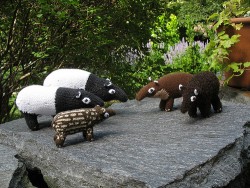
Knitted animals in group symbolising story telling. Image from: http://www.flickr.com/photos/sasha_kopf/3811949321/in/photostream/

“… And so the frogs cast off and lived happily ever after.”
Image from: http://www.flickr.com/photos/
sasha_kopf/3811949321/in/photostream/

When you think of academic writing, you don’t often think of a story in the conventional sense; academese is notorious for being dry and dull. But ‘story’ is a key piece of academic tacit knowledge.

Story: noun
Usual meaning: An account of events told for entertainment.
Academic meaning: A key conclusion/s of research which the reader is brought to through the flow of an academic paper.
Usage examples:
“I think I’ve got a story.”
“The story is coming together but it needs sharpening.”

The concept of story is an acknowledgement that a jumble of results doesn’t necessarily make a great paper. It’s easy to see the IMRAD structure followed by most scientific papers and think that all you need to do is fill in under each heading, and hey presto – paper. Not so. A paper needs results but also should have a punchy key message which the rest of the paper sets up and supports with a logical flow of ideas. The difficulty is that writing a great paper goes against most of the training PhD students have been given.

The concept of story in an academic paper is totally different to traditional essay structure. One of the key differences is balance – an essay is a balanced synthesis, whereas a paper is closer to a sales pitch. For those of you who have never been in sales, sales people deliberately control the conversation and lead the customer to buying the product. For an academic paper, the task is to control the reader’s thought-pathway so that they come to understand and agree with the key message. Though the word ‘control’ makes this sound awful, it’s not so different from the concept of classical style: the writer orients the reader to something in the world, which the reader can see with their own eyes. A paper attempts to lead the reader through the sequence of ideas so that they might come to the same conclusion as the author did. That’s a story.

The best papers draw you in to their narrative like a great story-teller. One of the ways that they do this is by telling a story and not getting distracted from it. That means paring down and building the story around the central logical sequence of ideas. A story needs the right amount of detail, at the right point. Too much or too little and the reader will go off down a mental side-alley. I realize that this is as clear as mud, so I will try to demonstrate using a crass example. Consider the following statement:

A person went down the street.

It’s informative and brief. This is fine, but leaves the reader wondering and potentially sidetracked by the lack of precision. What sort of person? How did they go down the street? What sort of street? The reader feels under-informed. Let’s try again, with more details:

The man in a blue coat skipped down the street with red brick houses on either side.

Lots more detail now, but how is the reader to ascertain what the salient point is? The sentence is longer, cumbersome and provides multiple opportunities for the reader to be derailed and wander off with a detail that may or may not be important to the story. Why is the man in a blue coat? What sort of red brick houses? The original purpose of the sentence, (to lead the reader down the street with the man), has been completely subverted by interesting but unimportant details. Third time lucky:

The man skipped down the street.

Here is a happy medium. Without increasing the word count from the original, the sentence provides two more (of the most salient) pieces of information. It keeps the focus on the person going down the street, with the most unusual element very clear (the skipping) because it isn’t hidden by other information.

So next time you’re writing, try asking yourself: what’s the story, and is this detail essential to it?

How to be a Hackademic #30 by Charlotte Frost & Jesse Stommel
Image by http://www.flickr.com/photos/fiddleoak/ under this licence: http://creativecommons.org/licenses/by-nc-sa/2.0/deed.en_GB

How to be a hackademic pictureHybrid Pedagogy’s Jesse Stommel and our very own Charlotte Frost rethink academic life and writing productivity in this on-going series of hints, tips and hacks.

LOVE WHAT YOU’RE WRITING. Jesse often tells his students when they’re working on class projects that if they’re not having fun, they’re doing something wrong. This doesn’t mean that every moment of the process will be fun, but it does mean that the overall trend should be to have the work be fun-inducing not pain-inducing. Countless studies have been done that show how much more we remember when learning is fun. When something is painful, we try to forget it as quickly as possible. Thus, if you love your project, you will learn more from the process and your learning will illuminate the page, improving the quantity and quality of your writing.

For more information on becoming a Hackademic , click here !

How to be a Hackademic #29 by Charlotte Frost & Jesse Stommel
Image by http://www.flickr.com/photos/fiddleoak/ under this licence: http://creativecommons.org/licenses/by-nc-sa/2.0/deed.en_GB

How to be a hackademic pictureHybrid Pedagogy’s Jesse Stommel and our very own Charlotte Frost rethink academic life and writing productivity in this on-going series of hints, tips and hacks.

KEEP SCORE. Writing is not a contest; however, as much as we’d like to say, “academic publishing is not a contest,” we can’t. There are winners and losers in academic publishing, so it makes sense to start keeping score. How many writing projects have you finished? Where has your work appeared? How many people have read it? How many times have you been cited? How many copies of your book have you sold? You can’t get to any of these larger questions without starting first with a more foundational one like, “How many words have I produced today?” So to start with, create a spreadsheet or just jot your daily word count onto a calendar. You can make yourself even more accountable by tweeting the numbers. The number of words is meaningless, really, except in the way that it inspires you to keep making more. We think this tips can also help you academic work as well.

How to be a Hackademic #28 by Charlotte Frost & Jesse Stommel
Image by http://www.flickr.com/photos/fiddleoak/ under this licence: http://creativecommons.org/licenses/by-nc-sa/2.0/deed.en_GB

How to be a hackademic pictureHybrid Pedagogy’s Jesse Stommel and our very own Charlotte Frost rethink academic life and writing productivity in this on-going series of hints, tips and hacks.

LOVE WRITING. A friend of Charlotte’s who finished her PhD a couple years before her once talked about the strange pleasures of the final writing stage. Charlotte thought she was mad when she told her about an unparalleled pleasure derived from delving deep into her thesis and thinking and writing intensely for hours. She spoke of a level of focus that was like nothing she’d experienced before and a connection with her work that was all-consuming and effervescent with ideas. Charlotte figured this was some strange state she’d invented to compensate for the final weeks of PhD work where bodily hygiene and a balanced diet would go out the window. But, later, as her own work reached that same stage, Charlotte discovered her friend was right. Let’s face it, we wouldn’t be doing this if we didn’t find some kind of pleasure in thinking and writing, but deadlines and writer’s block often loom large and eclipse those moments of personal-writerly-discovery. Quite the best way to approach writing projects is to embrace the real joys of writing and keep them foremost in your mind throughout all the low points. As with relationships, all too often we tend to share the pain and anguish, but if we talk more about what is good, we’ll soon foster a better attitude to writing.


Want more tips on Hackademic? Click here!

How to be a Hackademic #27 by Charlotte Frost & Jesse Stommel
Image by http://www.flickr.com/photos/fiddleoak/ under this licence: http://creativecommons.org/licenses/by-nc-sa/2.0/deed.en_GB

How to be a hackademic pictureHybrid Pedagogy’s Jesse Stommel and our very own Charlotte Frost rethink academic life and writing productivity in this on-going series of hints, tips and hacks.

PURGE YOUR THOUGHTS. Instead of asking yourself to practice writing, you might instead think of your daily writing as a sort of mental purging. You could, for example, start or end your day with a diary-style cleansing of your thoughts. Why would so many people write diaries if it wasn’t so incredibly useful in making sense of your own head? And besides, therapists can be really expensive! Sometimes we can’t see the forest for the trees, so siting down and writing whatever comes to mind can be a good way of getting some of distracting ideas out of your way. Likewise, engaging in a free-form writing session can spark some untapped creativity, helping us see some wilder connections in our ideas that we hadn’t considered before.

This tip also can help you with your thoughts.

How to be a Hackademic #26 by Charlotte Frost & Jesse Stommel
Image by http://www.flickr.com/photos/fiddleoak/ under this licence: http://creativecommons.org/licenses/by-nc-sa/2.0/deed.en_GB

How to be a hackademic pictureHybrid Pedagogy’s Jesse Stommel and our very own Charlotte Frost rethink academic life and writing productivity in this on-going series of hints, tips and hacks.

FIND AN AUDIENCE. Without an audience, you have no real motivation for writing. Your work becomes an exercise in speaking to an empty room, which is – to be fully honest – kinda crazy. So first it is a good idea to really think who you are aiming your work at? Who would you like to speak to and why? And then think about building this audience more literally. For example, students can be an excellent audience for rough pieces of writing and early ideas. Blog posts and conferences are other great platforms for building an audience for your work as you’re writing. Of course you need the writing to really win an audience, but building an audience one step at a time works really well. Then, once you have an audience, the demands of that audience will keep you writing.


Want more tips on Hackademic? Click here!

How to be a Hackademic #25 by Charlotte Frost & Jesse Stommel
Image by http://www.flickr.com/photos/fiddleoak/ under this licence: http://creativecommons.org/licenses/by-nc-sa/2.0/deed.en_GB

How to be a hackademic pictureHybrid Pedagogy’s Jesse Stommel and our very own Charlotte Frost rethink academic life and writing productivity in this on-going series of hints, tips and hacks.

WRITE SOME MORE. Write regularly to improve your communication skills in all areas of your work and ward off that dreaded writer’s block. Try to allot a bit of quiet time – even half an hour is enough – to get some thoughts onto paper/screen every single day. At first it will seem like a chore, but all too quickly you’ll notice how productive you can be. Some of the material you produce might well make it into your book or article, or perhaps it will become a blog post, or some other way of publicly discussing your work. In fact, blogging regularly can really help. It adds an important level of accountability if you imagine you have to blog once a week or you’ll lose face. Reporting on the ideas you’re processing in this lighter more chatty style will be easier and it will help you get to the crux of the matter – don’t underestimate how important it is to be able to communicate widely. Try to keep this daily writing routine no matter what else is going on. So, even if you’re traveling, consider setting aside just a small amount of time to do some writing, even if you’re just pecking letters into the notes app on your smart phone. It doesn’t have to be academic writing; every bit of writing we do ultimately helps hone our craft.
This tip also can help you with your thoughts.

How to be a Hackademic #24 by Charlotte Frost & Jesse Stommel
Image by http://www.flickr.com/photos/fiddleoak/ under this licence: http://creativecommons.org/licenses/by-nc-sa/2.0/deed.en_GB
How to be a hackademic pictureHybrid Pedagogy’s Jesse Stommel and our very own Charlotte Frost rethink academic life and writing productivity in this on-going series of hints, tips and hacks.
ER…WRITE. With all the different tasks that go into being an academic and a human being, our impulse is often to try and lump writing onto the end of the day, week or semester. We juggle all the other parts of our career and put writing off because it is difficult and requires focus. Turn the tables on this method and work out a schedule from the outset that at least features dedicated writing times, if not gives them top billing. A huge amount of what we do as academics requires writing, so you’ll always fill these times and – heaven forbid – you might even use them to get a bit ahead of yourself. If you know you have set writing times you’ll find it easier to filter out distractions during this period. You know what do you need to do ? Love it.