


 REVISE PAPERS QUICKLY. As an author, you don’t help through time to publication if you take a long time between receiving reviews of your paper and submitting the revised manuscript.

REVISE PAPERS QUICKLY. As an author, you don’t help through time to publication if you take a long time between receiving reviews of your paper and submitting the revised manuscript.

 This post is by Graham Steel who has been been actively involved in Patient Advocacy work for over 10 years. Graham acted as Vice-Chairman for a UK Charity, the Human BSE Foundation 2001 – 2005 and then as Information Resource Manager for the CJD International Support Alliance (CJDISA) 2005 – 2007.
More recently, his activities have been focused more on Patient Advocacy generally, but mainly upon Neurodegenerative conditions such as Motor Neurone Disease. He also is involved in and advocating for Open Access/Science/Data and now acts in un-renumerated advisory capacities to the Open Knowledge Foundation, the Public Library of Science (PLoS) and most recently, Digital Science
–So pretty much completely out of the blue, I received this tweet from Charlotte to which I tweeted back with “sure”. Read more
 In today’s post the Editorial Board behind the Journal of Peace and Conflict Development talk about how their journal is marking its mark in the changing world of academic publishing. This post was written by Benita Sumita and Roberta Hollanda Maschietto, doctoral researchers in Peace Studies, University of Bradford with input from the editorial board members of the Peace Conflict and Development journal.
“Can we improve our credibility without being ranked?” This potent question raised by one of the editorial board members defines the struggles that lie ahead for the Journal of Peace Conflict and Development (PC&D) nearly a decade since its founding. Apart from the continuing – now ever-more severe – funding constraints, the Journal is faced with having to prove its credibility through more mainstream avenues. It seems the PC&D is not visible within the UK’s mainstream cottage-industry of academic publishing and assessments, which has presumably led to a loss of the meagre financial backing the Journal received the last nine years. All these concerns need to be viewed within the contexts of the current climate of financial pressure in UK’s Higher Education and the increasing tendency to measure the quality, impact and ranking of journals by the number of times their articles are cited. It is perhaps time to question and rethink the systemically flawed nature of academic impact assessment rather than the credibility of a Journal such as PC&D that has made its own mark by reaching a wide and diverse national and international readership and attracting submissions from established scholars and practitioners. Read more

In this post Katherine Reekie discusses the issues surrounding publishing in the sciences.
“Publish or Perish” is a mantra which will be familiar to many of those working in academia. The pressure to publish your research in order to advance an academic career can be intense. PhD students and early career researchers in particular often find that their career prospects seem to go hand in hand with their publication record. I have heard several colleagues lament, after an unsuccessful interview, that the successful candidate had several first author papers. In the current climate, where funding for research is harder to come by, the competition for research posts is increasing, and having a good publication or two under your belt can be a considerable advantage.
The ultimate aim for a researcher in any field is to publish their research – to have it put out there in the public domain, to share their findings with the rest of the scientific community and to receive well deserved recognition for their research. The format of publication may take a variety of formats, for example journal articles, a book chapter, short news articles, reviews or letters. In Science, my own field, publishing of novel research is most typically in the form of a research paper in a scientific journal. These papers can be the result of many years of work, carried out by a great number of people. Due to an emphasis on collaboration, which is often encouraged by calls for grants involving groups of researchers all over the world to work together on the same project, the resulting research article can be a product of the work of many individuals. Therefore, rather than single or dual authored papers it is common to have several tens of contributing authors on a research article, and this number can grow to hundreds for large consortia, for example the International Human Genome Sequencing Consortium which published the sequence of the human genome in 2001. Read more

Following on from yesterday we continue with Klaus Dodds looking at publishing in journal articles. In this second post Klaus gives advice on how to deal with issues following on from submission.
Journal Submission
By the time you have a paper ready to submit it is highly likely you would have a sense of your target journal. There is absolutely no reason not to aim for a leading journal, especially if you have received positive informal feedback. In human geography, for example, this might include journals such as Transactions of the Institute of British Geographers, Annals of Association of American Geographers, Environment and Planning A-D, The Geographical Journal and leading specialist journals such as Economic Geography and Political Geography.
Determining your journal will in part be shaped by content and scope of your paper compared to the journal’s stated mission. In order to maximise your chances of being successful you need to do the following – ensure you comply with the journal’s submission guidelines, engage with recent papers within the target journal, think carefully about an engaging title/abstract/keywords and finally make sure that your paper has a good balance of theoretical and empirical material. Top journals, as based on citation factor or overall reputation within the field, do not tend to publish empirical papers. Do contact the editor prior to submission if you want to reassure yourself about the suitability of the piece Read more
Today we present part 1 of the second RGS-IBG Postgraduate Forum Annual Conference Training Symposium (PGF-ACTS) follow up pieces. In this post Professor Klaus Dodds looks at getting published in academic journals. Klaus is Professor of Geopolitics at Royal Holloway, University of London. Klaus is also Editor of the Geographical Journal.
For the vast majority of people undertaking a doctorate, getting their work published either during the research period or in the aftermath of the defence is a priority. The focus on journal publication is, more often than not, shaped by a number of factors; journal publications are highly regarded when it comes to future employment in academic and academic-related circles, journal articles are more manageable in the short-term compared to a potential monograph, articles are more likely to get read by non-academic audiences, and importantly publication whether in a journal or not fulfils a general desire to witness one’s scholarly work published online/print.
We target journals, therefore, for a variety of reasons including to secure that first academic post, after graduation. My comments reflect very much my own experience in the discipline of geography alongside publishing elsewhere in historical, political science, policy orientated and regional studies journals. I am also the editor of The Geographical Journal, and serve on the editorial boards of six other journals. Finally, multiple conversations with doctoral students I supervised in the past, and increasingly in the present, were sources of inspiration. Read more

Over the last few months we have looked at writing and publishing journal articles from a variety of different perspectives but mainly in the social sciences so here is a post for the natural and clinical scientists amongst our readers. Todays post comes from Dr Jigar Jogia. Jigar completed his PhD in the field of Psychiatry and Cognitive Neuroscience at the Institute of Psychiatry, (King’s College London, KCL) in 2010. He is currently a Postdoctoral researcher in the section of neurobiology of psychosis (Institute of Psychiatry, KCL). He also lectures and delivers training to staff and students for the Graduate School Researcher Development Unit at KCL. Jigar recently won the Samuel Gershon Award for Bipolar Disorder Research, in this post he reflects on the importance of journal selection.
Recently I have published some original data in a peer reviewed Journal Molecular Psychiatry which is the highest ranked psychiatric journal at present with an impact factor of 15.470. The impact factor is a measure of the average number of citations to articles published in science and social science journals. It is commonly used as a proxy for the relative importance of a journal within its field; with journals with higher impact factors deemed to be more important. My advice to young postdocs in any field wanting to publish their research is to be realistic about the strengths and weaknesses of your studies and select the right journal, it is one of the most crucial parts of the publication process but the importance of this step is underestimated by many. Selecting a journal whereby your research can reach your target audience and have a real impact in your field is vital for furthering your career as a postdoctoral researcher. Publishing in a good journal will add indirect credibility to your work and also introduce you as a new researcher in the field. Read more

The final post this week comes from Eva Lantsoght you can visit her blog here and follow her on twitter. In this post Eva discusses her practical experience of dealing with reviewers comments.
From last Thursday to Monday, I’ve been completely immersed into replying reviewers’ comments to a paper which will be published as a special publication after a conference in October. Previously, I did receive some comments from reviewers for other conference papers, but the effort they required to reply was typically negligible.
Wednesday evening, however, I received 3 pages of commentary on my paper, 19 sections with comments in total. I was both terrified (it looked like a lot of work) and enthusiastic (the reviewers really analyzed my paper and provided valuable input) at the same time. It did look like a lot of work, and I also was questioning my ability to deal with it. When quickly glancing over the comments, I could immediately point out a few remarks for which I thought I would need the input of my supervisors.
I took a deep breath, and decided I’d better first finish the (also urgent) report I was working on.
Thursday afternoon I finally started working on the comments. I started by printing out the comments, and reading through them to get a general idea of what I was supposed to do, and to check if everything is clear and not contradictory from the different reviewers’ perspectives. Read more

Today is the first response to Jess Drake’s question on how to deal with conflicting reviews. I approached Prof. Chris Hamnett and Prof. Matthew Paterson who have previously contributed to the body of advice and information on journal articles particularly revision and rejection. Their previous posts can be seen here (Chris Hamnett) and here (Matthew Paterson). The post below is a synthesis of their advice.
“Conflicting referee’s comments are not unusual. It would be surprising if everyone thought exactly the same. In general journals will go with the majority view from referees which is why many use three referees unless the minority view is so strong and convincing that they are willing to discount, to some extent, the views of the other two. Where one referee thinks the paper is good, but others see areas of weakness, you generally need to deal with these.
The big problem is where referees give contradictory suggestions, for example, one says shrink the theoretical section and expand the empirical section, and the other suggests the opposite. In these cases you need to make a reasoned decision on the basis of a close reading of the referee’s comments as to which, if either, is appropriate. If in real difficulty you could ask the editor for advice pointing to the contradiction. What is always important when you resubmit is to send an accompanying letter to the editor outlining the changes you have made and which referees criticisms they relate to and saying ‘I have addressed points A, B. and C of referee 1 but not point D, as this seems to contradict the recommendation of referee 2’. it is entirely legitimate to say that ‘I have not addressed point E as I believe that this is incorrect’ though you should always try to insert a sentence or two in the paper to explain why you have stuck to your original analysis or point. What editors want to see is a systematic and reasoned response to the main referee’s comments. They do not necessarily expect you to address all of them in the same depth or to agree with all of them. And if one referee recommends cutting X and the other says you should expand X, they cannot both be right” (Chris Hamnett). Read more

Over the last few months we have covered a range of issues related to the publication of journal articles. A couple of weeks ago we received a question via twitter from Jess Drake aka @soilduck relating to how to deal with conflicting reviewers comments. Jess is a PhD researcher at The Fenner School, Australian National University. During the day, she dabbles in understanding the environment of post-mining landscapes. At night, she writes for her own blog, contributes to online communities, ponders science communication and open science/review, cooks, bakes and brews. In today’s post Jess outlines her concerns then tomorrow and Thursday we shall look at providing some answers. You can read more about Jess and her work here
When reading comments from reviewers, there is that odd occasion that reminds me of being a kid stuck between parents with opposing views. Your Mum tells you to clean your room before dinner. Your Dad tells you it is ok to do it after, but you must do it before you can watch TV.
This creates a lot of confusion for a kid: Who do you listen to? Which one is right? Are they both right? What do you do? Learning how to deal with paper reviews can be the same. Read more

This week’s guets post is from Vivienne Dunstan (follower her on twitter here & visit her home page). Viv gives us her experience of producing journal articles. The moral of this story is grab any opportunity you can, you never know what may come of it …
I finished my history PhD in 2010 (viva March, all completed and graduated by June). After a well-earned rest I decided to spend twelve months converting my thesis into journal papers. My external examiner had thought journal papers were a better bet than going for a book publication, and it’s also something I have experience of, having produced two journal publications during my part-time PhD. I can’t work as an academic due to progressive neurological disease (it’s amazing I made it through the part-time PhD), but have been awarded an honorary research fellowship by my department, which provides good access to journal papers (so essential when producing new publications), and therefore set to work producing more journal papers. Read more

This weeks post comes from Prof Matthew Paterson, University of Ottawa. He is co-editor of the journal Global Environmental Politics. His latest books are “Climate capitalism: global warming and the transformation of the global economy” (with Peter Newell) and “Cultural Political Economy” (edited, with Jacqueline Best). Here he looks at strategies for getting published from a journal editors perspective.
Getting published is one of the big sources of stress for many young scholars in the early stages of an academic career. It poses generalised anxiety as it is often determinant of getting a job, but it is one of the situations where you are forced to submit yourself to the vagaries of the review process.
After 4 years of co-editing a major Political Science journal (Global Environmental Politics, ranked 24th overall according to the Web of Science, if you like such figures), two things about the review and editing process seem to me really useful to think through as you work through the choices involved in preparing an article.
You may be used to getting As all the time and feel it is a failure. So you sit on an article until you feel it is so solid, whereas it could be out there in the review process. Read more
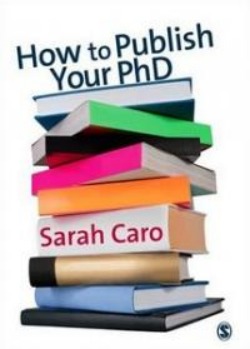
Sarah Caro, author of How to Publish Your PhD has kindly offered us this six-part guide on revising a thesis for publication as a book. Over the coming weeks she’ll be explaining how to understand what type of book you can produce as well as discover ways of shaping it up into a more book-like body of material.
Using the rough guidelines I offered last week, you can now begin to analyze your own thesis and try to identify those features that are unique to your thesis and those features which are common to the genre. You might even find it is easiest to do this by taking a piece of paper and dividing it into three columns. I will tell you what the third column is for in a minute but for the tine being you could put ‘unique feature’ at the top of one column and ‘feature of the genre’ at the top of the next. Feature of the genre should be easiest to start with and might include:

This week’s guest post comes from Carly Tetley PhD student and graduate Teaching Assistant at Salford University. Continuing with our series on getting published in journal articles Carly talks about her own journal selection strategy. (You can follow Carly on twitter here)
During our very first meeting, before I had even started my PhD, my supervisor set me a target: to write and publish a review paper before the end of my first year. This exercise has helped me to focus my reading and the resulting paper will be very useful as a base for a chapter of my future thesis. I would definitely recommend this as a worthwhile exercise for new PhD students. Six months on, the paper has been written and my supervisor and I are making a few final adjustments and corrections before we submit it for peer review. So the next question is: which journal should we submit to? Read more

Today we present a guest post from Jo VanEvery. I invited Jo to create a post giving her take / feedback / ideas about our series of posts on publishing in academic journals. Jo is an academic career coach you can read more about her here and you can follow her on twitter @jovanevery
The biggest barrier to publishing is fear.
As you progressed in your education you were consistently among the best in your
cohort. That’s what got you into your PhD program in the first place. Read more
