Exact matches only
Search in title
Search in content
Search in comments
Search in excerpt
Search in posts
Search in pages
Search in groups
Search in users
Search in forums
Filter by Categories
Academic Practice
Academic Writing Month
AcWri
AcWriMo
Blogging and Social Media
Book Editing
Book Literature Review
Book Marketing and Impact
Book Planning
Book Proposals
Book Publishing
Book Writing
Books
Citations and Referencing
Collaboration
Community
Conference Paper Abstracts
Conference Paper Editing
Conference Paper Literature Review
Conference Paper Marketing and Impact
Conference Paper Planning
Conference Paper Presenting
Conference Paper Writing
Conference Papers
Digital Publishing
Experimental Digital Publishing
Grant Abstracts
Grant Completion Reporting
Grant Impact Statement
Grant Literature Review
Grant Methods Section
Grant Writing
Grants
Journal Article Abstracts
Journal Article Editing
Journal Article Literature Review
Journal Article Marketing and Impact
Journal Article Peer Review
Journal Article Planning
Journal Article Writing
Journal Articles
Networking
News
Open Access
Productivity
Reading and Note-Taking
Reseach Project Planning
Resources
Tools
Uncategorized
Website
Rochelle Melander’s Write-A-Thon Techniques Part II

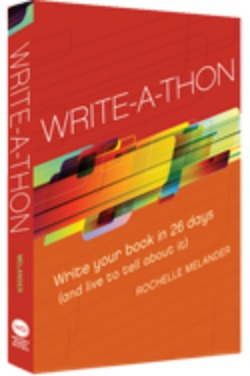
The following is an excerpt from Write-A-Thon: Write Your Book in 26 Days (And Live to Tell About It) by Rochelle Melander, now available from Writer’s Digest Books. Rochelle Melander is a certified professional coach and the author of 10 books, including a new book to help fiction and nonfiction writers write fast: Write-A-Thon: Write Your Book in 26 Days (And Live to Tell About It) (October 2011). Melander teaches professionals how to get published, establish credibility, and navigate the new world of social media. In 2006, Rochelle founded Dream Keepers Writing Group, a program that teaches writing to at-risk tweens and teens. Visit her online at www.writenowcoach.com.

Create Your Research and Development Team

Half of being smart is knowing what you’re dumb at.

—David Gerrold

“You can’t research and write a nonfiction book in a month! There’s not enough time!” said my client. Read more

Rochelle Melander’s Write-A-Thon Techniques Part I

The following is an excerpt from Write-A-Thon: Write Your Book in 26 Days (And Live to Tell About It) by Rochelle Melander, now available from Writer’s Digest Books. Rochelle Melander is a certified professional coach and the author of 10 books, including a new book to help fiction and nonfiction writers write fast: Write-A-Thon: Write Your Book in 26 Days (And Live to Tell About It) (October 2011). Melander teaches professionals how to get published, establish credibility, and navigate the new world of social media. In 2006, Rochelle founded Dream Keepers Writing Group, a program that teaches writing to at-risk tweens and teens. Visit her online at www.writenowcoach.com.

Discover Writing Strengths

Every writer has strengths and weaknesses in the process of converting the ideas into words on a page. Some writers excel at research, others love doing the rough draft, and some revel in the rewrite. Even professionals struggle with stages of the writing process. For the purposes of the twenty-six day writing marathon, we are looking at strengths and weaknesses in the five stages of the writing process: research, prewriting, writing the rough draft, revising, and proofreading. Note that most writers do not move through the following five steps in order. Most writers repeat the steps during the writing process, sometimes multiple times. Read more

Introducing Our New Managing Editor: Dr Anna Tarrant

Introduction to Me

Hello everyone,

I am delighted to announce that I am the new Managing Editor of phd2published! Just by way of introduction, here is a bit about me and my intentions for this role:

Anna 2011: Questions galore!

I am a human geographer by training and my thesis examined the social geographies of contemporary familial identities in a British context. I completed my PhD in July 2011 and have since realized my ambition to stay in academia. Currently I am a Senior Teaching Associate at Lancaster University, teaching a broad range of topics at both undergraduate and postgraduate levels. This is a short term, 10 month post and I view it as my opportunity to fill in the gaps of my knowledge, to get established as an academic and to develop my networks. So how do I asked? Read more

Weekly Wisdom #60 by Paul Gray and David E. Drew

DOWNLOAD COUNTS. Tenure and review committees like candidates who develop a personal reputation and hence reflect glory on the institution. Impact factors are one crude measure.  Another is the Download Count.  That is, if you have an academic publication that is accessible on the Internet, is anybody reading it or, better, downloading it?  Some publishers maintain download counts and send them to authors.  If you are fortunate to receive download counts, keep them.  They are handy at tenure and performance review time.

Graham Steel – Publish or Parish

This post is by  Graham Steel who has been been actively involved in Patient Advocacy work for over 10 years. Graham acted as Vice-Chairman for a UK Charity, the Human BSE Foundation 2001 – 2005 and then as Information Resource Manager for the CJD International Support Alliance (CJDISA) 2005 – 2007.

More recently, his activities have been focused more on Patient Advocacy generally, but mainly upon Neurodegenerative conditions such as Motor Neurone Disease. He also is involved in and advocating for Open Access/Science/Data and now acts in un-renumerated advisory capacities to the Open Knowledge Foundation, the Public Library of Science (PLoS) and most recently, Digital Science

–So pretty much completely out of the blue, I received this tweet from Charlotte to which I tweeted back with “sure”. Read more

Martin Paul Eve on Open Access Week

This post is by Martin Paul Eve,  a researcher at the University of Sussex working on the novels of Thomas Pynchon. Until recently he was chief editor of the postgraduate journal Excursions and he has just launched a gold-standard, libre OA journal, Orbit: Writing Around Pynchon. He is speaking as the opening plenary at the UK Scholarly Group next year on auto-subversive practices in academic publishing and has a forthcoming book chapter on Open Access in the edited collection, Zombies in the Academy.

For several years now, academic libraries worldwide have played host to Open Access week, an international celebration of the revolution in academic publishing. For the same number of years, a question has circulated among participants at these events: “is 20XX the year of the tipping point?” It is that question, after a brief excursion into the history of Open Access, that I wish to address. Read more

NaNoWriMo as AcBoWriMo Beta!
http://www.flickr.com/photos/wheatfields/3937933747/

http://www.flickr.com/photos/wheatfields/3937933747/

NaNoWriMo stands for National Novel Writing Month and it’s an initiative designed to turn the month of November into a month-long write-fest for current or would-be novelists. The idea is that you set yourself the task of writing 50 thousand words in November and bingo, you’ve got yourself a novel – or at least a first draft of a novel.

I did the bulk of my thesis writing in a fairly short amount of time. Not a month, I hasten to add, but I did embark on some intensive writing (as well as intensive Nutella-eating). Currently, I’m doing a Post-Doc in the US and part of why I’m here is so I can finish my first book. So after hearing about NaNoWriMo a colleague and I started wondering whether AcBoWriMo might be possible.

That’s right, we are here-by declaring November the first Academic Book Writing Month or AcBoWriMo Beta/0.1 or something. We are going to wear comfy clothes, drink a lot of coffee, probably nap in our offices at strange hours and see how close we can get to writing 50 thousand words in one month. I know, it’s totally insane, there can surely only be a handful of academics who can actually turn out decent material in such a short space of time. There are also a lot of differences between writing novels and academic books, but aren’t you just a little bit curious to know how much of a kick-start a dedicated writing month could give your book? Read more

Changes Afoot…

Image from: http://www.flickr.com/photos/pumpkincat210/with/3416918382/

We’re changing a few things here so please bear with us.

You may have seen that Sarah-Louise, our managing editor since January, has moved onto pastures new (she’ll like that metaphor, she’s mad about sheep!). The idea behind editing this site is to provide useful research into academic publishing for the wider PhD2Published community and in doing such, move your own career forwards. Sarah has managed to achieve a mind-boggling amount over the last 9 months and it seemed high time she focus on her new projects and give someone else a go. As a result, we’re interested to hear from anyone who fancies either running or contributing to the site. You’ll get all the support you need and don’t need to bring a single skill to the table – just a desire to build a shared knowledge base for us early-career academics. Just drop us a line and we can have a chat and see what works best for you. And bear in mind that the first two editors of the site (founder/director Charlotte, and Sarah herself) both now have book contracts (and more than one journal article published or in the pipeline) so we can guarantee that getting involved works!

Our amazing designer Sam Beddoes is also helping us tighten up the design a bit, and make sure buried content is more accessible. So the look and feel of the site is about to change just a little bit too. And then we’ll be back on track with lots more useful info!

“The Time Has Come” The Walrus Said …

To write my last post for phd2published. I have thoroughly enjoyed my time as the managing editor of this site but it is now time for me to move on to new things. When Charlotte offered me this opportunity just after my viva last year I wasn’t sure what I could contribute or whether it was a good idea but I have always taken every opportunity that has come my way so I said yes and saw it as a fabulous learning curve, and that’s exactly what it has been.

I have learnt a great deal about academic publishing and academic career development over the last 9 months and a great deal has happened for me on the back of being here thus, I shall use this last post to review my achievements through giving you my top tips:

Put Some Thought into Your Journal Choice and Don’t Be Scared of Top Ranked Journals:

For a variety of reasons I came to the end of my PhD not having published anything as a sole author. I had contributed to a number of policy reports but I had not got any peer reviewed publications out. this was a conscious decision which made sense at the time but at the same time when I got to the end of my PhD I was playing catch-up and this does impact upon your ability to get a post-doc position. Academic departments in the UK are now looking at what potential new staff can or will be able to offer toward the REF. For early-career researchers this is two publications in ‘good’ journals. ‘Good’ generally relates to impact factor and many early-career researchers are scared off from aiming at the top ranked journals in their field. One of the key messages from the Royal Geographical Society Post Graduate Forum Annual Conference Training Symposium (PGF-ACTS) was that if you have a piece which you think is relevant to that high ranking journal you should go for it! they treat everyone the same, even the big names get rejection letters! Read more

Journal of Peace Conflict and Development: Making Our Own Mark

In today’s post the Editorial Board behind the Journal of Peace and Conflict Development talk about how their journal is marking its mark in the changing world of academic publishing. This post was written by Benita Sumita and Roberta Hollanda Maschietto, doctoral researchers in Peace Studies, University of Bradford with input from the editorial board members of the Peace Conflict and Development journal.

“Can we improve our credibility without being ranked?” This potent question raised by one of the editorial board members defines the struggles that lie ahead for the Journal of Peace Conflict and Development (PC&D) nearly a decade since its founding. Apart from the continuing – now ever-more severe – funding constraints, the Journal is faced with having to prove its credibility through more mainstream avenues. It seems the PC&D is not visible within the UK’s mainstream cottage-industry of academic publishing and assessments, which has presumably led to a loss of the meagre financial backing the Journal received the last nine years. All these concerns need to be viewed within the contexts of the current climate of financial pressure in UK’s Higher Education and the increasing tendency to measure the quality, impact and ranking of journals by the number of times their articles are cited. It is perhaps time to question and rethink the systemically flawed nature of academic impact assessment rather than the credibility of a Journal such as PC&D that has made its own mark by reaching a wide and diverse national and international readership and attracting submissions from established scholars and practitioners. Read more

Charlotte Frost on Academic Blogging
Image from: http://www.flickr.com/photos/notionscapital/2965186113/sizes/m/in/photostream/

Image from: http://www.flickr.com/photos/notionscapital/2965186113/sizes/m/in/photostream/

Leonard Cassuto said in the Guardian: ‘If a graduate student asks me, “Should I blog?” my answer, at least right now, would still be, “Probably not “’. Just weeks ago I gave a talk at the British Library saying very much the opposite. Cassuto is a more established academic than myself, but I still think I have a point – and so did the people who invited me to give that opinion.

To discuss the fact that I came across Cassuto’s article and talked about it on Twitter would be to open another – if related – can of worms. Suffice to say that engaging with twitter for this type of academic commentary is the way I work. I’ve said time and again that Twitter and blogging allow me to usefully interact with so many academics – and non academics I hasten to add – whose opinions I value. I stand by this method of working as it helps me find great new people and ideas on a daily basis and this regularly directly informs my work.

I do recognize that my subject area lends itself particularly well to this type of information exchange. I’m currently writing a book on art mailing list culture and social media and my area of expertise is in art forms that thrive in these networks of sharing. I have had many people point out to me that they themselves aren’t working in a field where social media is considered appropriate and/or they are handling sensitive data that can’t be shared. However, I still take issue with much of what Cassuto says and I still think online discussion platforms have their place in academia.

Like Cassuto, I will divide my response into two sections. The first deals with form because I would argue that he doesn’t credit blogging or any other type of online communication with being anything other than ‘unpublished’, ‘unedited’, ‘unofficial’ writing. There is much about his tone that indicates he sees it as a lesser form of writing and I take issue with that. Read more

We Ask Ken Wissoker: Do We Need to Rethink Academic Publishing?
Image from: http://www.flickr.com/photos/pumpkincat210/with/3416918382/

Image from: http://www.flickr.com/photos/pumpkincat210/with/3416918382/

Continuing to gather responses to the Guardian article by George Monbiot on the broken model of academic publishing, we asked Ken Wissoker, Editorial Director at Duke University Press, to wade into the debate. Here’s what he had to say:

I thought Monbiot’s article was very valuable for getting the word out about how the big publishers – especially Elsevier – but also Taylor and Francis and Wiley-Blackwell have extracted as much money as possible from university libraries. Elsevier pioneered this, coming up with big packages of journals that universities needed and pricing them as high as possible.  Universities with researchers in those areas (mostly science and medicine) had to pay or they weren’t supporting their professors. Since every journal was unique intellectual property, there was no competition and no market. If a library wanted to cancel a journal, Elsevier didn’t lower the price of the collection. This really was wealth extraction in a frightening and damaging form. So the article’s account of all that was a good wake-up call for those, including many academics, who were not aware of these changes over the last ten or fifteen years.  He is totally right about the infuriating way these arrangements cut out anyone without access to a university library. Read more

We Ask Martin Paul Eve: Do We Need to Rethink Academic Publishing?

In his Guardian article, George Monbiot makes an excellent case against the existing academic publishing industry. Knowing that Martin Paul Eve would have much to say, we asked if he’d like to address Monbiot’s points in advance of his talk at the UKSG next year.

George Monbiot builds a good case against the corporate publishing machine that dominates the academic world and his article has had portions of the Twittersphere buzzing. I am due to speak in the opening plenary of the UK Scholarly Group conference next year – the biggest gathering of librarians and academic publishers – to make a similar argument: we don’t need academic publishers. While I won’t reiterate every aspect of Monbiot’s piece, there are several aspects, here, that are worth unpicking, especially where I diverge from Monbiot’s stance.

Firstly, Monbiot approaches, but never directly engages with, the driver of prestige in academia. He mentions the necessity of publishing with high impact factor journals and states that we can “start reading” new OA journals, but can’t “stop reading the closed ones”. Actually, we can, but only if people stop publishing therein. This will not happen in the UK because of the Research Excellence Framework and its insistence that the higher “impact” band a journal, the more weight a piece will have. This is a delegation of the critical task of the researcher into the arms of a commercial entity. While peer review serves as a useful filter, merely trusting this, based on journals which achieve their prestige based on rejection rates, is a foolish move, driven by the equally foolish baseline of a research assessment dependent on corporations. The REF, alongside competition for academic jobs, drives this system.

Secondly, publishers are able to use institutional libraries as a shield to hide a researcher’s autosubversive behaviour. Consider that, by publishing in a closed, proprietary journal, a researcher actually limits his or her own access to material by constricting his or her own institution’s library budget. This is not how it appears to the researcher, though, because the spend is at one remove. Researchers publish for prestige and it is the library’s fault if material is not forthcoming. Open Access supported by commercial entities does make a researcher aware of the problems, because in this case they will be asked to pay up front. However, most reactions from researchers to this tend to be: “I don’t want to pay, let us revert to the model where I didn’t pay”. In this way, publishers have built a “command and control” system for an entity that functions, in its obfuscation, distribution and resilience, in a mode most akin to a piece of computer malware. Libraries must educate researchers of their own complicity in this web. Read more

Getting from PhD to Published at InterFace 2011
I was really excited to speak at the amazing InterFace 2011 humanities and technology conference on the 29th July at UCL. It was organised by a really diverse and highly-skilled group of PhD students and it was such a pleasure to be involved with.
I spoke on ‘Getting from PhD2Published’ as part of a session on publishing. My Prezi is below and for the rest of the contributors head over to the publishing page on the InterFace website.

Charlotte Frost Interviewed in Adventures in Career Development

I was recently interviewed about PhD2Published for the excellent blog Adventures in Career Development by Tristram Hooley. It was great to reflect on how PhD2Published started and has grown over the last eighteen months or so. And I was really honoured Tristram was interested in the project.

My interview starts like this:

AiCD: Who are you?

My name is Dr Charlotte Frost I’m the 2011/2012 International Post-Doctoral Fellow at the Center for 21st Century Studies, University of Wisconsin-Milwaukee. I’m a broadcaster and academic interested in the relationship between art and technology. My particular specialism is the impact of digital technologies on art historical discourse, but I’ve also been studying and writing about the developing field of Digital and New Media art for over ten years. I teach art contextual modules at Writtle School of Design and the University of Westminster. And I run a range of projects that support my research objectives while creating platforms for knowledge exchange and experimentation – particularly with reference to publishing.

AiCD: Tell us a little bit about PhD2Published? Read more