Exact matches only
Search in title
Search in content
Search in comments
Search in excerpt
Search in posts
Search in pages
Search in groups
Search in users
Search in forums
Filter by Categories
Academic Practice
Academic Writing Month
AcWri
AcWriMo
Blogging and Social Media
Book Editing
Book Literature Review
Book Marketing and Impact
Book Planning
Book Proposals
Book Publishing
Book Writing
Books
Citations and Referencing
Collaboration
Community
Conference Paper Abstracts
Conference Paper Editing
Conference Paper Literature Review
Conference Paper Marketing and Impact
Conference Paper Planning
Conference Paper Presenting
Conference Paper Writing
Conference Papers
Digital Publishing
Experimental Digital Publishing
Grant Abstracts
Grant Completion Reporting
Grant Impact Statement
Grant Literature Review
Grant Methods Section
Grant Writing
Grants
Journal Article Abstracts
Journal Article Editing
Journal Article Literature Review
Journal Article Marketing and Impact
Journal Article Peer Review
Journal Article Planning
Journal Article Writing
Journal Articles
Networking
News
Open Access
Productivity
Reading and Note-Taking
Reseach Project Planning
Resources
Tools
Uncategorized
Website
Writing Accountability Part 2 by Jennifer Lim: How It Measures

In the second of two posts about Writing Accountability (the first of which introduces the initiative and you can read about here), Jennifer Lim explains how writing progress can be effectively measured and managed. Jennifer’s post is part of PhD2Published’s new Academic Writing feature.

For accountability to work, measuring and monitoring progress are essential too the writing process. Monitoring your own progress helps in recognizing current productivity status and finding ways to improve it. Setting an ultimate goal and daily writing plan to achieve it is important for improving writing productivity. Progress measurement is of great interest to me. As there is no strict rule about how writing progress should be measured, in the Writing Accountability initiative, I find it amazing that everyone has different ways of measuring their personal progress. Here are some examples of how to measure writing progress in order to develop accountability.

Word Counts/Targets

Although some measurements are similar, there are still many different ways of doing it. The most practical method is word count. Whether the final writing achievement is a few thousand words of an article or more than 10,000 words of a dissertation or thesis, word count is the best way to measure and monitor writing progress towards an ultimate writing goal. It is also best to break down the ultimate writing goal into smaller daily goals. Let’s say you need to write at least 12,000 words in 6 months and that most probably you do not plan to write over the weekend. This equates to at least 100 words per day in order to achieve 12,000 words in 6 months. By having this daily writing goal of 100 words, you have a clearer writing plan to help to achieve the ultimate goal and can diminish the overwhelming feeling that a larger word count often creates. If writing 100 words a day is too easy, set it higher or to a limit that you feel is challenging enough to motivate you to write daily.

Time Measurement

Writing is not the only thing one does as an academic however. A lot of time is also spent on reading, making notes, data collection and data analysis etc. Should we not measure those that actually contribute too the final product of our writing? What is the best way to measure these? I personally think the daily time spent on these activities should also be considered. This helps to minimize the feeling of unproductiveness if no significant words are written on those days when other academic activities take precedence. So, another good way to measure daily progress is the total time spent. Set a minimum time that you are willing to spend on a daily basis to work on your academic activities, including reading, literature review, etc. Your time target should be reasonable and something that you can achieve such as 1 or 2 hours a day. Setting a target too high will only decrease your motivation if you can’t achieve any at the end of each day.

Combining the two

It is viable to combine both word count and time spent measurements as the daily goal. In that way, you can measure word count when you are writing and time spent when you are working on other relevant academic activities. I also find it is beneficial to record daily progress together with some comments about what has been achieved or lack thereof so reflection is possible for self improvement. Another example of measurement is from Sarah Ford (who Tweets as @Sarah_M_Ford). She has a unique formula of calculating ‘score’ to measure her daily progress (learn more about it here).

Other than using the spreadsheet for progress update in writing accountability, there are also some #AcWri enthusiasts who like to blog or tweet about their writing goals and progress. The #AcWri community on Twitter provides great peer support where people are sharing writing advice and encouraging one another in the writing process. If you work better with pressure, the #AcWri community can also act as (positive) peer pressure. Seeing others progressing well when you are not provides encouragement to  improve your own productivity. Either way, participating in the #AcWri community will only benefit your progress and increase your motivation. Knowing you are not alone in whatever obstacles you are facing provides good solace. The key to accountability is: knowing what you need to achieve and making sure you put in the effort to achieve it. Regardless of how you measure your progress, all you need to do is to find the best way to achieve the ultimate goal by setting targets that are reasonable and achievable.

Blind Spots: Using Collaborative Open Peer Review to Support PGR Publishing. Part 1 by Sarah Pett
The editors, taken by Imke van Heerden on 3 February 2012, University of York. From left: James Fraser, Ben Madden (postcolonial hanger-on), Isabelle Hesse, Anna Bocking-Welch, and me (Sarah Pett).

The editors, taken by Imke van Heerden on 3 February 2012, University of York. From left: James Fraser, Ben Madden (postcolonial hanger-on), Isabelle Hesse, Anna Bocking-Welch, and me (Sarah Pett).

Four PhD students at the University of York are currently piloting an innovative peer review process for developing postgraduate conference papers into an edited collection. In the first of a series of posts, Sarah Pett (whose has her own blog and Tweets as @essiepett) discusses the project’s ethos, as well as the practicalities of turning an ambitious idea into a successful reality.

Prompted by a shared experience of the difficulties inherent in positioning our individual research projects in relation to postcolonial studies, in 2010 Anna Bocking-Welch, Isabelle Hesse, James Fraser and myself established Postcolonial Perspectives, an interdisciplinary reading group for postgraduates at the University of York. From the beginning, the group focused on unconventional approaches to the postcolonial, with an emphasis on contexts that troubled its paradigms. It soon became apparent that we were not alone in our frustrations – discussions with postgraduates from across the UK revealed that we were grappling with an issue of increasing relevance and concern to PGRs working in a range of disciplines, periods, and contexts. Thus the Living Beyond Theory: Interdisciplinary Perspectives on the Postcolonial postgraduate conference was born. The event was a resounding success, and highlighted an emerging body of research into contexts that trouble the established paradigm of postcolonial studies. But how, we wondered, to sustain the dialogue that shaped the event, and disseminate the wealth of ideas it generated? Given the different stages of our projects, it will be several years until our individual monographs appear, while their disciplinary and contextual diversity means that our shared concerns would inevitably be diluted. With the help of Dr Jason Edwards at the University of York, as well as funding from the Postcolonial Studies Association and York’s Centre for Modern Studies, we decided to keep the momentum generated during the conference going by developing a selection of the papers into an edited collection.

Why open peer review?

“Blind peer review is dead. It just doesn’t know it yet.”

Inside Higher Ed’s Scott Jaschik begins his report on the Future of Peer Review session at the 2012 MLA convention with this provocative statement from CUNY’s Dr Aaron J Barlow. As Barlow points out in his paper, “The Bearable Light of Openness: Renovating Obsolete Peer-Review Bottlenecks”, the rise of digital publishing has brought traditional peer review procedures into question. For Barlow, its impression of “quality control” is no longer a fair exchange for the publication delays and complex, occasionally unethical, personal and institutional agendas blind peer review entails – a foible I know all too well. Full of the bravado of youth, I thought I’d try my hand at academic publishing soon after completing my BA. Without any knowledge of established protocol, I made the mistake of submitting my paper to two journals simultaneously. Not a wise move, but it did open my eyes at an early stage to the inconsistencies of the field. One journal returned my article within the fortnight, accompanied by a largely positive review that recommended only a handful of minor revisions. Several months later, I received a two page review from the other journal, which included an ultimatum: significantly shift the focus of the paper, or it won’t be published. The recommended shift seemed to reflect the reviewer’s research interests, rather than my own, which was an unpleasant and demoralizing experience for a young researcher. More importantly, however, it was disabling, leaving me with no platform from which to respond to the reviewer’s diktat.

Clearly, this is not something we wished to replicate in the preparation of the edited collection. What’s more, as postgraduate researchers, we have been aware from the outset that the collection has to be tip-top to stand a chance with a “proper” academic press. And finally, with an editorial committee made up of four researchers in the final stages of their PhDs, we simply couldn’t afford to commit to providing each participant with the level of feedback and writing support we hoped to offer. To optimize what we could do in the time available, we opted to select and improve articles via an intensive, collaborative process based around realtime participation. To do so, we designed a series of open peer review workshops that allowed our authors to participate in providing and responding to feedback over the course of several months: a model that closely resembles that employed by Kairos, whose editor Cheryl Ball appeared alongside Barlow at the MLA. Kairos—a journal of rhetoric, technology, and pedagogy—employs a three tier review process. In tiers one and two, submissions are evaluated by individual editors before being forwarded for discussion to the editorial board as a whole. In tier three, a staff member is assigned to mentor the author in implementing revisions for up to three months. The Postcolonial Perspectives publication workshop series sought to emulate and even build on this process. In stage one, the editorial committee selected papers from the conference to invite as contributors; stage two involved refining the ethos of the project and requesting that contributors develop their papers with this in mind. Stage three is when the realtime workshops came into play, allowing contributors and reviewers to meet and discuss feedback over the course of a day.

The first workshop, which took place at York on 16 January 2012, was extremely successful—one academic staff member said he was keen to adopt our model in his own work—and demonstrates how a collaborative open peer review model can be implemented at a grassroots level to support the career development of PGRs and ECRs. The second workshop is scheduled to take place in early May, during which participants will go over the final revisions and collaborate in refining the book proposal and editorial introduction as a group. We are also looking into using an open source manuscript management and publishing system such as the Public Knowledge Project’s Open Journal Systems as a means of continuing the workshops’ collaborative format remotely. While the project’s aim—publication with an academic press—is ambitious, the workshop format means that, at worst, our contributors can walk away with a carefully revised paper for submission to an international peer reviewed journal, a committed mentor, and a handful of supportive peers with shared research interests and career goals.

Workshop One: From left: Dr Jason Edwards (York), Professor David Attwell (York), James Fraser (York), Anna Bocking-Welch (York), Rebecca Jones (Birmingham), and Katherine Ebury (York).

The radical in me would love the project to culminate in a high profile open access publication, accompanied by a creative and thought-provoking social media campaign to raise awareness about postcolonial studies, its contributions and its limitations. For the time being, we’ll continue to play it safe, but it won’t stop me thinking about the possibilities for reform in academic publishing, and the instrumental role PGRs have to play in changing the game. Hopefully before too long there will be a copy of Beyond the Postcolonial Paradigm: Interdisciplinary Perspectives on the Parapostcolonial on a library shelf—or Kindle—near you…

Why so Shameless? On Self-Promotion and Networking by Amber K.Regis

Todays post is about the value of blogging and promoting research through social media. It is written by Amber K. Regis who completed her PhD in Victorian life-writing at Keele University. She is an Associate Lecturer for the Open University and teaches English literature at the Universities of Chester and Liverpool John Moores. She blogs at Looking Glasses on Odd Corners on life-writing and life-narratives across different media. She has published work on John Addington Symonds, Virginia Woolf and Vita Sackville-West. You can follow her on Twitter: @AmberRegis

I started a research blog in the final months of 2011 in a wave of enthusiasm. I was going to become an overnight internet sensation; I was going to get my research ‘out there’, reach new audiences and make a name for myself! And do you know what? I thoroughly enjoyed the act of blogging, and while I’m still waiting go viral, I have managed to share ideas and start conversations with a multitude of readers (including many beyond the ivory tower of academe). But blogging is also a commitment that takes up time, and in recent weeks time has been desperately lacking.  Like so many other post-PhD researchers, I’m juggling multiple jobs while I seek the ‘holy grail’ of a permanent academic appointment. Prepping, marking and commuting has taken its toll and I’ve been neglecting my blog.

But, rather surprisingly, the blog has remained active during my absence. Others have started to take notice.

Shameless self-promotion?

I’ve already admitted that increasing my online presence was a key motive in setting up my blog, and it has received several special mentions in recent weeks:

  • A post on material objects and life-writing was quoted by Charlotte Mathieson, an Associate Fellow in English at the University of Warwick, in a recent piece on literary tourism for the Journal of Victorian Culture Online.
  • A keynote speaker at a recent Victorian Studies conference referred to a post on souvenirs and collecting. I was sitting in the audience. It was all terribly flattering, but I blushed and looked at my feet.

As a means of self-promotion, blogging appears to be paying off. Each special mention resulted in increased traffic and a number of Google search hits. Internet sensationdom is just around the corner…

But why is this kind of ‘self-promotion’ so consistently paired with the pejorative ‘shameless’? And why did I blush when my blog was mentioned at a conference? After all, wasn’t this what I wanted? But alas, was my face now registering the inevitable ‘shamelessness’ of attention seeking in the blogosphere?

Not-so-shameless self-promotion?

I do not believe that self-promotion is a shameless or even a necessarily selfish activity. Indeed, the three instances above demonstrate a range of benefits to increasing online visibility and engaging with social media. Attention has been drawn to my work, yes, but I have also engaged directly with other researchers, forging connections with peers and more senior academics. Social media have thus transformed self-promotion into a mode of continual networking—formerly an oft-dreaded activity that required awkward conversations over coffee cups during breaks in conference schedules. But networking can now extend beyond the temporal and physical space of a conference; conversations can start before an event and continue long after, mediated online.

So yes, all this blogging and tweeting is a form of self-promotion, but it is certainly not shameless. The clue is in the title: social media and the social web. Making connections, forming communities, offering support; in getting your name ‘out there’, you are not a voice crying out in the wilderness. Self-promotion in the age of the social web is very much a team sport; plugged-in academics are networked and networking all the time.

Writing Accountability Part 1 by Jennifer Lim: How It Works

Today’s post complements our new #AcWri project and is written by Jennifer S. H. Lim, a Computer Science graduate, currently working on her final submission of her dissertation as part of the fulfillment for her Master in Computer Science at University of Malaya, Malaysia. In the first of a two part series, Jenn introduces her now established academic writing initiative. She also blogs about her studious life and tweets as Studious Jenn @mystudiouslife.

I love writing. I use it to share ideas and information with the hope that it engages people in conversations that generate more ideas. That’s why I also love blogging, where I can write freely about topics that interest me whenever I like. However, academic writing is a different story. I still write topics that interest me but the need to actually write is more intense than merely writing a blog post. Academic writing projects are usually longer and more time consuming and no matter how much I love writing, when it comes to writing academically, the process can become overwhelming. Most of the time, writing just doesn’t happen at all. Procrastination ensues and then I just panic and write  last minute, which doesn’t meet any quality control.

This approach just doesn’t work well for me, especially at the point when I needed to write at least 10,000 – 30,000 words of a dissertation over a period of time. Although there was no set due date in that situation, I knew that the longer I delayed writing, the longer I would take to finish it. My biggest problem is that when there is no one to ‘force’ me to write I eventually procrastinate more. Hence, in order to succeed, I have to take actions. I need to be the one who ‘forces’ myself to write and I must be accountable for my own progress and success. This is the reason I started the Academic Writing Accountability initiative, where writing goals are shared in a spreadsheet and progress are updated daily. This initiative revolves around a Twitter community made up of anyone who is interested in academic writing and is willing to share their writing progress. Hopefully, this initiative helps as many people as possible to become more productive in writing to achieve their goals.

It all started when I was feeling ‘blocked’ while I was writing my last few dissertation chapters. I thought I couldn’t write because I didn’t have enough time to write for long hours due to my full-time job. When PhD2Published started the Academic Book Writing Month (#AcBoWriMo) project last November however, I was glad to join so many in the initiative to achieve my goal. My writing goal at that moment was to complete two chapter and by the time November ended I had completed Chapter 4 and started Chapter 5. I realized that such an initiative had actually helped me progress better even though I didn’t achieve my goal completely. I still continue to be in touch with the writing community.

Eventually, #AcWri was formed because there were still people (including me) who were keen to continue the writing initiative. One day, I was tweeting about how to improve academic writing productivity. After some tweets, I suggested using Google spreadsheet to share productivity progress so we can keep track of our own goal and progress online and at the same time let others  hold us accountable. Once the spreadsheet was created, a few of the #AcWri regulars joined the initiative by sharing their ultimate/daily goals and their updated daily progress.

Why writing accountability? I have a few beliefs that motivated me to start this initiative:

  1. Daily writing habit is essential for academic success and this habit can be cultivated through practice. This is the practice where you become the one to ‘force’ yourself to write daily.
  2. Be accountable for your own writing by publicly sharing your writing goal: ultimate goal (i.e. complete a dissertation) and daily goal (i.e. write 500 words). By sharing your goal, all will know what you are trying to achieve and you are being hold accountable for achieving your goals.
  3. Productivity will increase when it is being measured or monitored. By keeping a record of what you have done, it’s good for reflecting and planning to improve your productivity.
  4. Peer support is the best motivation in academic writing. Knowing you do not struggle alone in the writing process is helpful.

Does accountability in writing work for everyone? The answer will vary among individuals but most importantly, you can just give it a try and see for yourself. It works wonderfully for me. My ultimate goal of completing dissertation chapters and a journal article was achieved using this initiative. Regardless of what you choose to do, be sure it works for you in achieving your goals. If you have any other ideas about increasing writing productivity, I would love to hear from you.

Introducing #AcWri live!

Source: http://seo-contentwriter.com/

PhD2Published has made some exciting changes in the past couple of weeks. We have officially joined forces with Dr Jeremy Segrott to run fortnightly live chats on Twitter focused on academic writing (or AcWri, which is our associated hashtag). To celebrate this we now have a new live chat tab on the home page of the site!

In the about section you can find out more about the live chats and a little bit about us but essentially we saw this as a fabulous opportunity to build upon the previous success of the AcBoWriMo project and to develop the community of academic writers that this helped to establish. We will also be posting summaries of each discussion on a fortnightly basis in the archive section so if you miss the chat itself you can still see what was discussed and benefit from the communities wisdom by picking up some useful hints and tips.

If you’re interested in participating (the more the merrier!) you can either join the fortnightly live chats on Thursdays at 6pm GMT or contribute to the more regular community conversation using the #AcWri hashtag on Twitter. We also welcome AcWri themed blog posts so if you have something to say and want to join us get in touch!

Should You Make Your Thesis Available Online? Part 6: On the outside of Academic Publishing by Kathryn Allan

The final post in this series about posting a thesis online is by Kathryn Allan. Kathryn completed her PhD (English) at McMaster University in 2010. Her doctoral thesis, Bleeding Chrome: Technology and the Vulnerable Body in Feminist Post-Cyberpunk Science Fiction, is awesome and available online for free here. She operates an (academic) copy editing and dissertation coaching business, Academic Editing Canada, as she pursues independent scholarly research into (feminist/cyberpunk) science fiction. Dr. Allan is currently putting together a collection of essays that deal with the representation of disability in science fiction. She tweets under @BleedingChrome.

When I finished my PhD in English Literature in 2010, I also said good-bye to the ivory tower. Frustrated with the current funding and work environment of academia (in North America), I set out on my own – and I took my dissertation with me. While my committee members encouraged me to consider publishing my thesis the old-fashioned way, I felt like it wasn’t the right option for me. Instead, I decided to publish my dissertation in pdf format and make it freely available on my professional blog to anyone interested in reading it.

At first, I was slightly worried that someone might plagiarize my work, but after a minute of thought, I remembered that nothing stops students who want to plagiarize from doing so, regardless of the medium of the text. With confidence, I made my thesis available on my blog. It shows up in relevant Google searches and I have repeatedly shared the link over email and Twitter with people who share my research and reading interests.

I share my thesis online because: (1) I believe that publicly funded work (like my Canadian graduate education) should be publicly accessible; and, (2) as an independent scholar who studies feminist and cyberpunk science fiction, I want to easily share my work with the science fiction fan community.

Accessibility

When I state that I believe academic work should be accessible, I mean it in all aspects of the word. I put in a good deal of effort into writing my thesis in language that can be followed by non-academic readers, so putting my thesis online is a natural extension of my dedication to open research and communication.

My PhD thesis is available on ProQuest through the university where I studied, but access to that database is still limited to people with university library access or who are willing and able to pay. Since I don’t believe that anyone should have to pay to read my thesis, simply having it available on academic marketed sites like ProQuest is not a good enough solution to accessibility.

Independent Scholarship

My thesis was a labour of love and passion for the subject matter. I want to share the knowledge I gained with as many interested individuals as I can. Admittedly, I also enjoy operating outside of the formal academic system. Science fiction, particularly the feminist science fiction of my interest, has generally been a marginalized field of study, so it felt right to pursue a more marginal and independent approach to publishing my dissertation.

One of my goals as an independent scholar is to connect with fans in the vibrant and diverse science fiction community. If my thesis was only available through one university and a pay-to-read internet platform, then most fans are not going to read it (or even know that it exists). While I could have arguably sought out a publisher to reach this fan audience, I am also aware that “free” and “online” appeal to far more readers. And it has.

It’s All Good

It has almost been a year since I made my thesis available online and the response I have received has been overwhelmingly positive. Many people – some are academics, some are science fiction fans – have emailed or tweeted me about my thesis. Most of the comments I get are “thanks for sharing” or specific nerdy questions about something I’ve written. To date, I can’t think of one drawback from having my thesis online. Not a single one. I don’t intend on applying for an academic position, nor am I pursuing independent scholarship for financial gain. For me, there is simply is no downside to having my thesis online.

Should You Make Your Thesis Available Online? Part 5: Where Can I Make My PhD Thesis Available Online?

If, having considered all of the issues, you still feel that you want to make your thesis available online, the question you may now face is where to post it? This blog post explores where you can publish your thesis online and what options there are.

Library and university archives for E-Theses

According to Emily Kothe on Twitter (@emilyandthelime) some universities already require students to post their thesis online upon submission, along with paper copies. When I submitted in July 2011 I was not required to do this, but having contacted the librarian at the university where I conducted my PhD, I learned that it has now become a requirement for students submitting their thesis from 2011/2012 onwards to submit a further digital copy. I missed out on this but have been informed that if I want to, I can make it available through this outlet. At present I am uncertain who is aware of this service, other than students who submit their thesis to it from now on, or who can access the service beyond the university, if at all. According to the online deposit for Lancaster University (which you can view here) there are benefits to both the student and the university itself:

For the student

  • Increased visibility for your work
  • Easier access to your thesis
  • Raise your personal profile
  • Can use digital services such as links to datasets, videos etc.

For Lancaster University

  • Raise institutional profile
  • Showcase successful graduate research

There are several of these services now available and visible through a simple Google Search that PhD students in particular may find useful if they are looking for ways to structure their thesis and want to look at some examples of theses that have passed. Durham University depository and Nottingham University depository are good examples. It may be important too inform academic book publishers if your thesis is available in this way; these issues are discussed in Part 3 of this series.

Ethos – British Library

Rob Myers on Twitter (@robmyers) initially drew attention to Ethos, an electronic online thesis service run by the British Library (see Part 4 of this series about EThOS by Sara Gould). This is a site I had actually used myself when writing my PhD. I downloaded some theses in order to explore how they were structured and to access additional research in my topic area. My university does subscribe to the service and I was informed that “if a thesis is only available in print form, we send it to the British Library to be digitised, and the person making the request has to pay the British Library £40 towards the cost of digitisation”, not entirely free but eventually Open Access. There are now 44,000 online theses available, and to download a copy you first need to register so that records can be kept and to ensure the intellectual property of the author is protected.

Personal Blog Site

I have also considered posting a copy of the thesis to my own personal blog. Before I posted it online however I wanted to check copyright right and intellectual property issues, something that RuthFT (@RuthFT) warned me of and that I discuss in Part 2 of this series. Some universities hold intellectual property rights to the thesis even if you have written it and conducted the research for it so it is essential that this is considered before rushing ahead to do it. A librarian at my university informed me that because my thesis is an unpublished piece of work it can be uploaded online on my personal blog, as long as I respect and observe the rights of those who participated in the study, which of course is part of ethical research practices anyway. It is highly recommended that you check with your own institution first though because rules may differ.

There are therefore several places where the unpublished PhD thesis can be deposited online, if you deem the issues detailed in previous posts to be outweighed by the benefits of disseminating your research more widely. These are just a very few of those I have explored (in repsonse to Part 3 for example user moorbi, introduces us to GRIN, a free German publisher). Having researched this in greater detail, I am still concerned that by posting my thesis online I may face additional challenges in publishing a monograph. This ultimately has become an issue of Open Access and I have to admit I find it encouraging that universities (in the UK at least) and EThOS and the like, are making it easier for PhD researchers to make their PhD research available online.

I’d love to hear more about this issue, particularly if anyone is against doing this or has critiques of it (most people I have spoken to support onlinethesis). Please do get in contact if you want to add, or contribute any ideas and do let us know if you plan to submit your thesis online (#onlinethesis).

Should You Make Your Thesis Available Online? Part 4: Introducing EthOS by Sara Gould

Today’s post, which contributes to our series about publishing dissertations and theses online is written by Sara Gould. Sara is the EThOS Service Manager at the British Library, UK. She is managing the transition of this e-theses website to a sustainable Higher Education shared service.

Anna has been wondering whether to publish her thesis. Or if not ‘publish’ then put it online somewhere to share the results of her work more widely, and gain the benefits she mentions, like raising the level of interest in her research and making connections with like-minded researchers.

EThOS is the UK’s e-theses website that gives instant access to 55,000+ doctoral theses. Pretty much all UK universities have their theses listed in EThOS so there’s around 300,000 records in all, with a variety of routes to get hold of the full text if it’s not already available.

That’s a fantastic resource for students and all researchers, not just to be able to dig deep into research that’s already happened, but to see who’s researching what and who the key players are – individuals, departments, institutions, even funders.

It almost goes without saying that open access to research theses is a ‘good thing’ for new researchers, for those looking for source material. But what about for thesis authors themselves? Should Anna try to make sure her PhD thesis appears in her university’s repository and/or EThOS, or not?

Here are a few frequently expressed concerns:

1.    It’ll spoil my publication chances later

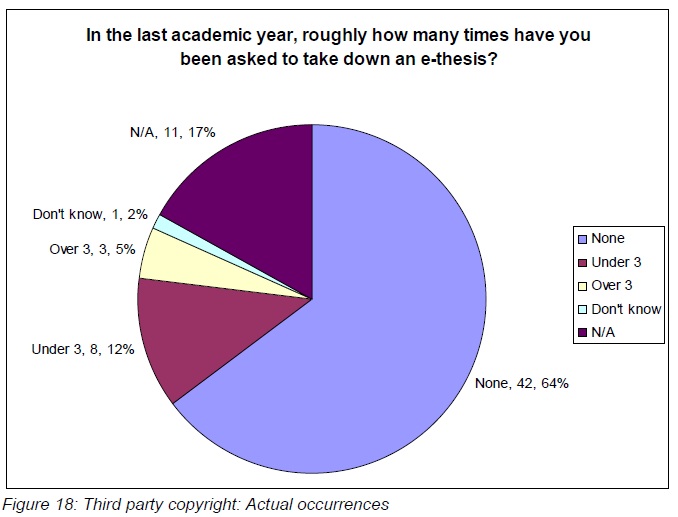
Well, it might, but in a recent survey only 7% of institutions cited this as a frequent concern amongst their students, and no concrete examples were found of publication being refused because the PhD thesis had been added to an open access repository. If reassurance is needed, then an embargo period can be applied, with may be the record plus abstract still being available to all.

2.    My work will be plagiarised

It’s possible, but then again people can plagiarise from printed theses too, and in those cases there’s no automated way to detect the crime.

Allowing open access to your thesis does open it up to all sorts of people who may come along and use the content in whatever way they like. But plagiarism detection services can help to mitigate the risks, and in EThOS at least, users have to register their details, so we could if necessary track all users of a particular thesis. So far that’s never been needed. And as people get more and more used to open access and theses become increasingly available in institutional repositories, it may be that the login process is becoming a tiresome deterrent to use and has had its day.

Brown J. (2010) Influencing the deposit of electronic theses in UK HE: report on a sector-wide survey into thesis deposit and open access. UCL. http://eprints.ucl.ac.uk/116819/

3.    All that hassle with third party copyright

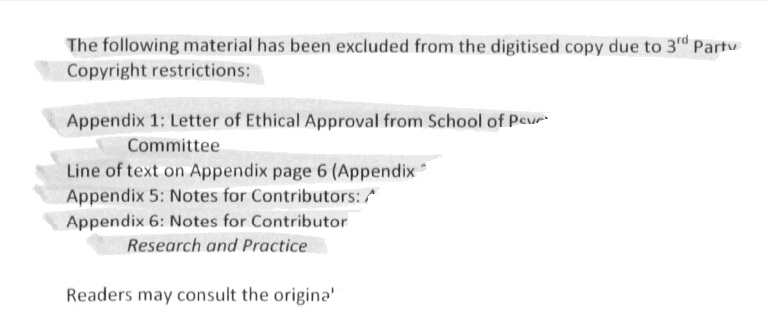
We do need to take copyright ownership seriously and it can be really time-consuming to seek permissions from any third party for permission to publish. Some university libraries are able to support their students to make sure any third party copyright is managed properly, but most don’t have the resources to undertake such a massive task. Take-down policies and embargoes come into play here, and digitisation services, whether through EThOS or another route, will carefully redact any sections, diagrams etc that aren’t copyright cleared on instruction from the institution.

List of redactions from a 2002 thesis held in EThOS.

The world of repositories and open access is moving fast. EThOS celebrated its third birthday last month. When it launched – on the same day as another auspicious event – theses were held in paper format in the university library and a microfilm copy held by the British Library. Now those microfilms have been packed away, and an average of 450 people a day download a copy of a full-text thesis from EThOS. With possibly the same number again accessing copies held directly in university open access repositories, it appears that full-text open access is here to stay.

Should You Make Your Thesis Available Online? Part 3: Thinking about Publishing

You have made your thesis available online, but does that affect whether or not it will get accepted for publication as a monograph? Academic publishers have varying opinions about this…

This is a very important issue for postdocs who are planning how to disseminate and publish the findings from their PhD research and an increasingly common question that academic publishers are now being asked. It was this question that originally kick-started my desire to run this blog series and start this conversation (#onlinethesis). I know that I am not the only one who has been dealing with this question either. One of the comments made in relation to Part 1 of this series was that a thesis that is available online is something that may be seen as problematic to publishers if a monograph based on a PhD is proposed. Others on Twitter are also interested in how publishers responded to this question. I contacted several publishers to find out more about this and these were the responses.

Jay Dew of University of Oklahoma Press informs me that this is a question he is frequently asked and his response is in favour of making theses online:

“On the whole, I don’t believe that having a dissertation or thesis available online works to the detriment of publishing a monograph. Indeed, more and more dissertations and theses are available online through library databases such as Dissertation Abstracts, etc. A dissertation and a book are two different things, with two different and distinct audiences. The revisions that are almost always necessary to bring a dissertation into book manuscript form are usually substantial enough that one need not cannibalize the other. There may be exceptions, of course, especially in the hard sciences, but at least for my press and the kinds of books we publish, this is not a problem.”

John Yates of University of Toronto Press extends this debate further arguing:

“I believe the situation in North America is different from yours [in the UK]. I understand that here all PhD thesis are licensed to ProQuest. I also understand that in Canada, theses are posted on-line by University libraries. Consequently scholars have quite a bit of work to do to convert their thesis into a scholarly monograph since libraries are not interested in purchasing titles that are effectively a thesis with minor revisions.

In your situation, if there is no requirement to post the thesis on-line and you’d like to have it published it as a monograph, I would think by not posting it on-line you’d be able to have the monograph published sooner, since fewer changes would be required than if the full thesis was publicly available on the web.”

The responses I have received in relation to this issue support the idea that making a thesis available online is generally acceptable to academic publishers, as long as the proposed monograph is substantially different to the submitted PhD thesis. Nonetheless, concerns are still evident amongst authors and researchers and it is recommended that potential publishers are contacted in advance of proposing a monograph to find out how they view this because opinions may vary depending on discipline and research topic. A more specialised research topic for example with a smaller market and audience may be seen as more problematic for some publishers if the material is already accessible online. It is possible to embargo the publication of your thesis in university depositories if this is considered an issue and you plan to propose a monograph but it is increasingly important to make this decision before the thesis is submitted, and made available electronically.

The key message then, is that the monograph based on a PhD thesis should be in substantially different format to the submitted PhD. Publishing houses from different countries are in agreement about this as presented here but it is important to be aware that making it available in an online depository may slow down the process of writing a book. It is also important to check the position of publishers who you wish to write book proposals for, to ensure that your decision is well informed. In a period of increased debate over open access to research, making the thesis online should not be, and doesn’t appear to be, a barrier to publishing a monograph but is certainly a consideration.

Should You Make Your Thesis More Widely Available Online? Part 2: Fear of Idea Theft

Following my first post that introduced my musings on the debate about making a PhD thesis or dissertation available online, this blog explores the issue of fear in relation to the theft of your ideas. This is an issue that is fairly central in Alex Galarza’s article for @GradHacker. The student in question feared that their ideas may be more susceptible to being stolen if they were to be made available online; a reasonable assumption given that, if the intention to put your thesis online is to make it more widely accessible, then the more likely it is that the ideas can be accessed and potentially lifted.

For me, this fear is not altogether unfounded and essentially boils down to a lack of knowledge about how online material is managed and regulated. In university teaching in the UK at least, students are taught about plagiarism, or the use of someone else’s work without acknowledgement, and are warned of the need to avoid doing it. Not only is it considered bad academic practice, but a plagiarised essay or piece of coursework is more likely to be of poor standard. As academics this becomes deeply ingrained in everyday working and writing practices, and is currently regulated through the processes of peer review and assessment. How this may be regulated online however, is less clear and the boundaries of citing and discussing the work of others is increasingly blurred.  Similarly if the aim of publishing online is to reach broader audiences, there is potential that those audiences are unfamiliar with referencing practices or maybe unwilling to use them.

A research paper about electronic theses by Copeland et al (2005, pg 195) suggests however that ‘it is easier to detect instances where this activity [plagiarism] has taken place when the material is published on the web. Electronic detection software is available’. My university in the UK uses Turn-It in for student essays for this purpose.

While this is comforting to know to some extent, an important thing to do before making your thesis available online is to check the copyright regulations of the archive you post to and to ensure that you own those rights as primary researcher. This should discourage any potential theft, protect your property rights and discourage the potential for idea theft by others. Where you make the thesis available online is also a consideration. The chances of having your ideas stolen and reproduced online or elsewhere are much less likely if you post to a university online archive than a personal blog for example because these are better regulated. It is also recommended that you seek advice from your PhD supervisor before posting online to check if there are any issues with copyright that you hadn’t thought of (especially important if the work is funded). You could also protect your work using a Creative Commons license. These allow ‘everyone from individual creators to large companies and institutions a simple, standardized way to grant copyright permissions to their creative work’ (Creative Commons website).

Fear of theft of your work when making it more readily available online is reasonable, and was something that led me to research and produce this series of blog posts. However there are frameworks and laws in place that are designed to protect your ideas and your intellectual property, as well as new technologies that are detecting plagiarism online. Make sure you are aware of these before you make your research outputs available online however. If you want to disseminate your work more widely to broaden its impacts, you should be able to, and it is important that academic work is accountable but also used in appropriate ways.

A recent hashtag on Twitter that has been used in relation to these ideas (and also Will’s post) is #notopenenough (thanks @ThomsonPat). Publishing online is becoming more popular, and hopefully fear of theft won’t stand in your way in your quest to make your research more widely known.

Join the conversation at #onlinethesis.

Reference

Copeland, Susan,  Penman, Andrew and  Mime Richard (2005) “Electronic Theses: The Turning Point.” Program: Electronic Library & Information Systems 39, no. 3 : 185-197.

The Now Frontier: Posting Dissertations Online

A note from Anna: As part of a series of blogs on PhD2Published about Online Theses, Will Deyamport, III explains why he will definitely post his dissertation online. To engage in this conversation on Twitter please use the Online Thesis hashtag #thesisonline

Will Deyamport, III is an Ed.D student in Educational Leadership and Management at Capella University. He is the founder of peoplegogy.com, a blog that focuses on life and career developments. He is a monthly contributor to MyPathfinder Career Blog, where he writes about higher education. Currently, Will is writing his dissertation on how Twitter can support the professional learning needs of teachers.  You can follow him on twitter @peoplegogy.

This digital world we live in isn’t going anywhere. We pay bills online, we shop online, we make phone calls online, we date online, and now we’re streaming movies and going to school online. So why wouldn’t I post my dissertation online?

Has the academy become so insular that it has failed to understand and embrace the realities of this digital age? Has it become so arrogant that it believes that it can remain the sole guardian of academic knowledge? Or has the academy so blindly held on to its beliefs of what scholarly work is that it refuses to see this work being published on a daily basis on blogs around the globe?

Whatever its reasons, I plan to publish my dissertation online and here’s why:

  • I happen to have a passion for digital media and most of what I read is read online.
  • What I do and want to do for a career is done online. I’ve been a social media strategist, I blog, and I am earning my doctorate online. So for me the online space is a place of isn’t some separate entity. It’s a part of who I am and how I express my ideas.
  • I am a digital citizen. As such, I see the online world as the way for mobilizing the world towards a common humanity.
  • I routinely seek out information online. Whether it is via Youtube, LinkedIn, or my personal learning network on Twitter, I am able to gain access to experts from a variety of fields and disciplines.
  • I believe that academic knowledge belongs to the masses and should be made available and given freely to those who seek it.
  • My dissertation is on teachers using Twitter to support their own professional development.  The topic doesn’t belong is some bound book. It was meant to be posted online and shared with scholars and practitioners alike.

The ivory tower and those who worship at its feet need to understand that education is no longer insular. Holding information hostage does nothing for the academy or the betterment of society. In order to truly build a thriving academic knowledge-base and further the continued and expansive research expected in academia, technology has to be a part of how that research is shared and disseminated. Using emerging technologies, schools have the capacity to expose its students’ research to every corner of the globe. It is with this type of free exchange that the academy can reinvent itself and lead the way in today’s growing global economy and workforce.

Moving forward, I would like to see every doctoral student publish their dissertation on ProQuest or some other online platform. Just like TED has revolutionized the conference model, as current and future scholars, we have an opportunity to revolutionize the way people think, learn, and are taught about academic research.

Should You Make Your Thesis More Widely Available Online? Part 1

A brief note from Anna: Being Managing Editor of PhD2Published has been a fantastic opportunity for me so far. It has introduced me to lots of interesting people and has helped me to think about key issues I am facing post-PhD. My current thinking is about whether or not to make my PhD thesis more readily available online. This post, which is the first in a series, explores this idea in more detail.

Impact has increasingly become an academic buzzword and requirement, which has led me to think much more about my PhD thesis, its accessibility and the impact it could (and should) have on a variety of audiences, both academic and public. I have heard from several colleagues that the only people who are ever likely to read the actual thesis are yourself and your supervisor (my family and friends certainly haven’t read it!). Frankly this seems wasteful and a bit sad (just look at the picture!), especially considering all of the hard work that went into it, including by myself, my participants and my supervisors. Even with the potential of developing publications and monographs from it in different formats, later on, in its unpublished form, my thesis is meaningful to me and took time and effort to construct.

This thinking prompted me to consider how I could make my thesis more accessible and more widely read, particularly in an age of social media and open access. Before launching into making it available online however, I wanted to do some research into the potential barriers to publishing online and the current debates that will inform this decision.

Following these musings, I posted this question on Twitter: “What are people’s opinions on making theses available online?” Several interesting and important issues and questions were raised. While limited,  there is already an emerging debate about the digital dissertation, which you can read about in this interesting and informative post by Alex Galarza for @GradHacker. There are several positives for doing this, and indeed many universities are now making it a requirement, if it isn’t already. @Gradhacker outlines that online material such as the unpublished thesis for example is still protected by copyright, useful to know if there is concern about the acknowledgement of your work. At the same time, in being overly cautious about protecting your thesis/dissertation you may risk restricting the development of your academic identity, online and otherwise. Furthermore (and some publishers may vary on this) putting your thesis/dissertation online may actually aid in the communication and appeal of your research to a variety of audiences and may even encourage sales of subsequent published work should you wish to publish it elsewhere in a different form. Twitter follower Christina Haralanova (@ludost11) has also received positive replies from people who have read hers.

Despite the many positives, I still think it is important to consider the range of different issues relating to putting a PhD thesis out there; issues that I will explore in a short series of blogs that will be posted here on PhD2Published in the coming weeks. These include posts I have constructed myself, and also opinion posts, and feedback from academic publishers. If any of this resonates and you have anything to add that has occurred to you, please do get in touch, either by Email or Twitter (@PhD2Published). Should you wish to join an online discussion on Twitter about the debate please use hashtag thesisonline (#thesisonline).

Rochelle Melander’s Write-A-Thon Techniques Part IV

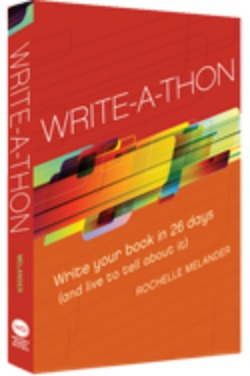
The following is an excerpt from Write-A-Thon: Write Your Book in 26 Days (And Live to Tell About It) by Rochelle Melander, now available from Writer’s Digest Books. Rochelle Melander is a certified professional coach and the author of 10 books, including a new book to help fiction and nonfiction writers write fast: Write-A-Thon: Write Your Book in 26 Days (And Live to Tell About It) (October 2011). Melander teaches professionals how to get published, establish credibility, and navigate the new world of social media. In 2006, Rochelle founded Dream Keepers Writing Group, a program that teaches writing to at-risk tweens and teens. Visit her online at www.writenowcoach.com.

Get Rewards

Before the reward there must be labor. You plant before you harvest.

—Ralph Ransom Read more

AcBoWriMo Motivational Speech!

How’s AcBoWriMo going? Written an insane amount yet? No? Not good enough people so I’m dishing up some tough love…

When I was about eighteen months away from finishing my PhD I had a phone call I will never forget. It broke the news to me that my oldest friend had died in a car accident with her boyfriend.

A couple of months later, as all writing productivity had ground to a halt, I tried to think of a way to motivate myself. Family and friends did an amazing job of keeping me going through this intensely difficult time, but the drive to succeed in my PhD – in anything – was definitely gone. Read more

Rochelle Melander’s Write-A-Thon Techniques Part III

The following is an excerpt from Write-A-Thon: Write Your Book in 26 Days (And Live to Tell About It) by Rochelle Melander, now available from Writer’s Digest Books. Rochelle Melander is a certified professional coach and the author of 10 books, including a new book to help fiction and nonfiction writers write fast: Write-A-Thon: Write Your Book in 26 Days (And Live to Tell About It) (October 2011). Melander teaches professionals how to get published, establish credibility, and navigate the new world of social media. In 2006, Rochelle founded Dream Keepers Writing Group, a program that teaches writing to at-risk tweens and teens. Visit her online at www.writenowcoach.com.

Get a Cheering Section

We can’t all be heroes because someone has to sit on the curb and clap as they go by.

—Will Rogers

We write more when we connect with others who are writing productively. As I mentioned in an earlier chapter, a recent study on friendship and obesity suggested that having just one overweight friend increases our chances of being overweight. Other recent studies suggest that happiness is also contagious. It just makes sense that having one friend who writes like mad increases our chances of doing the same. The success of NaNoWriMo suggests that writers get more done when they’re connecting with other writers. Other writers offer valuable support. Or, you are who you connect with. Read more