Exact matches only
Search in title
Search in content
Search in comments
Search in excerpt
Search in posts
Search in pages
Search in groups
Search in users
Search in forums
Filter by Categories
Academic Practice
Academic Writing Month
AcWri
AcWriMo
Blogging and Social Media
Book Editing
Book Literature Review
Book Marketing and Impact
Book Planning
Book Proposals
Book Publishing
Book Writing
Books
Citations and Referencing
Collaboration
Community
Conference Paper Abstracts
Conference Paper Editing
Conference Paper Literature Review
Conference Paper Marketing and Impact
Conference Paper Planning
Conference Paper Presenting
Conference Paper Writing
Conference Papers
Digital Publishing
Experimental Digital Publishing
Grant Abstracts
Grant Completion Reporting
Grant Impact Statement
Grant Literature Review
Grant Methods Section
Grant Writing
Grants
Journal Article Abstracts
Journal Article Editing
Journal Article Literature Review
Journal Article Marketing and Impact
Journal Article Peer Review
Journal Article Planning
Journal Article Writing
Journal Articles
Networking
News
Open Access
Productivity
Reading and Note-Taking
Reseach Project Planning
Resources
Tools
Uncategorized
Website
Hackademic Guide to Networking: Be a Good Blogger
Image by http://www.flickr.com/photos/fiddleoak/ under this licence: http://creativecommons.org/licenses/by-nc-sa/2.0/deed.en_GB
Image by http://www.flickr.com/photos/fiddleoak/  under this licence: http://creativecommons.org/licenses/by-nc-sa/2.0/deed.en_GB

Image by http://www.flickr.com/photos/fiddleoak/
under this licence: http://creativecommons.org/licenses/by-nc-sa/2.0/deed.en_GB

Hybrid Pedagogy’s Jesse Stommel and our very own Charlotte Frost continue their Hackademic series with a new set of hints, tips and hacks focused on academic networking.

BE A GOOD BLOGGER. Blogging is a genre and so it has certain conventions. On the other hand, while we’re full of tips, we’re also both fans of experimentation. Here are some suggestions on how to get started with blogging, but these are only a jumping off point, from which you should carve your own path:

  1. Make it as easy as possible to post to your blog. Many blogging sites allow you to email your content and add an image as an attachment. Or there are sharing widgets you can add to your desktop or smartphone so you can add content at the click of a button. This means you don’t have to login anywhere to write full blog posts. It also means you can recycle content. For example the usual email announcement about your upcoming talk can be speedily repurposed into a blog post.
  2. Help readers share your content. Most people can copy and paste a link from your blog post to their Facebook wall, but if you’ve added some sharing buttons (which can be done in seconds using a WordPress plugin) then you make it even easier. Likewise, consider setting up a ‘recipe’ tool like IFTTT so that when you upload a blog post you automatically post it to your own Facebook page, Twitter account, etc.

  3. If it’s too big a commitment to blog alone, set up a group blog with some friends/colleagues. This can be an even better idea than blogging alone because you’ll bring more readers to your site with the increase in volume and variety of content. It’ll keep the blog fresh and full of interest and take the pressure off each of you to be highly productive.

  4. Schedule staggered content. If you’ve got four big things planned in a month, write four posts and schedule them weekly. This will stop you ever having to even think about apologising for not posting. Likewise, if you’re suddenly feeling prolific, by all means write a whole bunch of posts, but spread out their publication. You might also bank a few posts in advance for quiet times.

  5. Plan ahead. Aim to feed your blog with varied content by keeping an eye out – in advance – for what that content is going to be and by taking advantage of every opportunity. For example, if you know you’re going to a conference, why not arrange to interview someone or report on a particular paper or session?

  6. Comment. Take time to read other people’s blogs and add your own comments to their posts. This will help you get a better idea of what other people are blogging about (and how) as well as directing them and their audience back to your own blog.

  7. Have a piece of stock content as your fall-back. It could even be light-hearted. Why not post a relevant video every Friday, or ask another academic the same set of questions every Wednesday? The goal is consistency, and what might otherwise feel like “filler” can actually help create bridges from one substantive post to the next. And sometimes its the stock content that draws in the bigger crowd, meaning more people will eventually discover the meat of your research.

  8. Other bits of regular content can include: book reviews; summaries for newcomers to the field; posts about your latest paper presentation, guest lecture, or journal article; profiles of your students and their work; and championing of contingent colleagues that might not otherwise have time to write about their own work.

  9. Recycle and reshare. As your blog grows popular pieces of content will become less visible. Periodically review your content and re-share (through Facebook and Twitter et al) good posts over a period of time. You might consider writing a new post that updates or expands on the older one (but definitely visibly links to it). Also, when reviewing your past content, notice which posts are thematically connected and take a second to add links back and forth between each post. Again this will make burried material more findable to new visitors.

  10. Look at your stats. Google Analytics will tell you how many people are visiting your website/blog and from where. Initially this might just be a nice ego boost and a way of forcing yourself to continue blogging when you feel stressed and over-stretched but eventually this is the type of data that can be used on grant applications and even CVs.


Hackademic Guide to Networking: Set Up a Blog
Image by http://www.flickr.com/photos/fiddleoak/ under this licence: http://creativecommons.org/licenses/by-nc-sa/2.0/deed.en_GB
Image by http://www.flickr.com/photos/fiddleoak/  under this licence: http://creativecommons.org/licenses/by-nc-sa/2.0/deed.en_GB

Image by http://www.flickr.com/photos/fiddleoak/
under this licence: http://creativecommons.org/licenses/by-nc-sa/2.0/deed.en_GB

Hybrid Pedagogy’s Jesse Stommel and our very own Charlotte Frost continue their Hackademic series with a new set of hints, tips and hacks focused on academic networking.

SET UP A BLOG. Having a blog or a website as a platform for your career is a really good idea. So often these days people will just plug your name into Google and work with whatever results come up. Having your own site allows you to have more control in how you’re perceived. It’s great for job-hunting as it can be your online dossier and you can also use your blog when you teach to communicate with students and share course materials. With a blog as part of your site, you can regularly broadcast what you’re doing, including posting abstracts for conferences and papers or sharing notes for lectures you’re giving. It’s also a really good way to reflectively share the work of your peers and work out ideas for forthcoming publications.

Hackademic Guide to Networking: Get a Twitter Account
Image by http://www.flickr.com/photos/fiddleoak/ under this licence: http://creativecommons.org/licenses/by-nc-sa/2.0/deed.en_GB

Image by http://www.flickr.com/photos/fiddleoak/ under this licence: http://creativecommons.org/licenses/by-nc-sa/2.0/deed.en_GB

Hybrid Pedagogy’s Jesse Stommel and our very own Charlotte Frost continue their Hackademic series with a new set of hints, tips and hacks focused on academic networking.

GET A TWITTER ACCOUNT.  And while you’re at it, sign up for every social media platform, even if you don’t intend to use them. Here’s why: you’ll secure your user name of choice (good for branding purposes to keep these consistent); you’ll have a history with the tool when you do go to use it (which helps your profile show up in search results); and you’ll start making connections, even if you aren’t actively massaging those connections. Remember that not everyone is on any single social media channel, so having a presence on them all will assure that no potential collaborators fall through the cracks. As with the bulk of the tips in this series, this is actually less about promotion and more about presence — making sure that you’re only one mouse click away from a potential editor, colleague, or co-author.

But why the Twitter account in particular? Twitter is actually one of the lowest-maintenance platforms you can engage with. Just write your mini profile, upload a picture and off you go. The best way to engage is to log on at certain times (or leave Twitter open while you work) and just dip in to read tweets and chat with others when you have time. You may never keep up if you try to read all the tweets so it’s best to think of it as listening in on a live conversation. In fact liveness is key to Twitter, many people think of it as a place you send boring life updates, but it’s much more of a discussion space – like an Instant Messenger but where (potentially) the whole world is listening.

Twitter also boasts a number of live chats that provide space to discuss a range of academic conundrums, which will also help you build an almost-instant network of supportive peers. Check out #phdchat for all things PhD, #digped for discussions on teaching in the digital age, #acwri for academic writing, #ecrchat for issues pertinent to early career researchers and #scholarsunday for recommendations on who to follow. Finally, if you teach, consider finding ways to incorporate twitter into your pedagogy.

Hackademic Guide to Networking: Go Public By Degrees
Image by http://www.flickr.com/photos/fiddleoak/ under this licence: http://creativecommons.org/licenses/by-nc-sa/2.0/deed.en_GB
How to be a hackademic picture

Image by http://www.flickr.com/photos/fiddleoak/
under this licence: http://creativecommons.org/licenses/by-nc-sa/2.0/deed.en_GB

Hybrid Pedagogy’s Jesse Stommel and our very own Charlotte Frost continue their Hackademic series with a new set of hints, tips and hacks focused on academic networking.

‘Networking’ is a word often made cold by its business associations. It’s easy to imagine CEOs on a golf course and think that’s a million miles away from what we do as educators and scholars. Perhaps a better way to think of networking — particularly in academia — is as yet another form of publishing. For example, each time we share information about our work we’re performing a valuable citation. In the same way that direct marketing takes an idea straight to the right audience, this form of citation is fast and efficient. And it goes both ways. Each time we find out details about someone else’s work we’re potentially saving ourselves hours of research time. And each time we boost that person’s work by sharing it on social media, we’re potentially saving someone else hours of research time. This info-thrift can be very potent and it’s why coffee breaks at conferences are often where the real work happens. So whilst there’s no need to take up golf… We are here beginning a new set of tips in our How to Be a Hackademic series focused specifically on academic networking. So, our first bit of advice:

GO PUBLIC BY DEGREES. The decision to go public on social media with our professional life is actually a very nuanced one. And it’s not a decision anyone should make all at once. We strongly encourage going public by degrees. Start with a professional site that houses a CV, links to syllabi, online publications, etc. Academia.edu is a great place to start or perhaps set up an about.me page. You might then decide to explore a platform like Twitter where you can dip your toe in by following lots of interesting people and gradually engaging them in conversation. Eventually you might decide to get a domain of your own and use a tool like WordPress to build a more personalised online space.

How to be a Hackademic #48 by Charlotte Frost & Jesse Stommel
Image by http://www.flickr.com/photos/fiddleoak/ under this licence: http://creativecommons.org/licenses/by-nc-sa/2.0/deed.en_GB
How to be a hackademic pictureHybrid Pedagogy’s Jesse Stommel and our very own Charlotte Frost rethink academic life and writing productivity in this on-going series of hints, tips and hacks.

HAVE A BIO. Write a concise bio (you might like to take the twitter bio word limit as your guide) and use it across all social media. It’s worth using the same profile picture everywhere too. You can write longer biographies to use for conferences etc but having a nice short one and a good memorable picture mean that people will easily find and remember you online. It’s a little like branding yourself, which sounds icky, but don’t think of it like that. Many of us are really bad at remembering people’s names and faces – let alone now that we live so much of our lives online and don’t always actually meet the person behind the avatar. Help everyone out by always looking and sounding the same online. And when you get to meet people IRL (in real life) who you’ve mostly known only in cyberspace, they’ll recognise you in an instant and feel like they’ve known you for years.


Besides Bio , there some other important tips to be a hackademic. 


How to be a Hackademic #41 by Charlotte Frost & Jesse Stommel
Image by http://www.flickr.com/photos/fiddleoak/ under this licence: http://creativecommons.org/licenses/by-nc-sa/2.0/deed.en_GB
How to be a hackademic pictureHybrid Pedagogy’s Jesse Stommel and our very own Charlotte Frost rethink academic life and writing productivity in this on-going series of hints, tips and hacks.

HAVE AN EMAIL SIGNATURE. Make sure your email contains a short signature detailing your current job and the main place people can find you online. You might even consider regularly updating this signature with a link to your latest piece of work, whether that’s a journal article or a blog post. Just like an online bio/image combo, this consolidates and re-enforces your persona and area of expertise. It is also a way to get your work under the nose of new people whose curiosity in link-clicking will be satisfied in spates.

This tip also can help you with your thoughts.

Baby on board, so time to take my leave (at least for a little while!)…by Anna Tarrant

baby-on-boardThe time has come to announce that this is my last post for PhD2Published for a little while (boo! 🙁 because I am going to be taking some time off to have a baby! 🙂 She (yes apparently it’s a girl!) is due at the end of April 2013 so my attentions will be re-directed elsewhere for a while.

I have thoroughly enjoyed being the Managing Editor for PhD2Published and given that my body is being incredibly productive, I thought I would also take this opportunity to reflect on my time with PhD2Published to share some of the things I have learnt.

Becoming Managing Editor was a ‘seize the moment’ type affair (my first tip; seize any opportunity that you can – but be strategic!). I was working as a Senior Teaching Associate at Lancaster University (a teaching only position) at the time and I felt really disconnected from the world of academic publishing and research. In identifying a need for support and guidance in publishing I embarked on an online search for resources and that was when I came across PhD2Published.  As luck would have it, Charlotte was looking for someone to fill the Managing Editor role so I jumped at the opportunity and just over a year later I am so grateful I did. Here’s why:

I have learnt about how and where to publish

One of my roles as Managing Editor is to source material relating to topics relevant to academic publishing. With a desire to publish myself I sought information that would not just help me, but others too, in all our publishing journeys. This helped me to collate useful material that also built a strong personal, but openly accessible narrative about publishing.  In the past year I have invited academics of various career stages to write blogs, ranging in focus and including (but not limited too): contemporary publishing models such as Open Access; developing academic writing (see the benefits of writing in groups and collaborative writing); and reflection on publishing and emotion (e.g. Publish or Perish). I have even written my own resources for the site (see my series of #acwri summaries and what not to send for peer review) and for other reputable blogs including Guardian Higher Education.

As well as publishing blogs, I have gained a great deal of knowledge and confidence in publishing in more traditional ways. In the past year I have had three journal articles accepted, have had a book chapter published, with another on the way, and have been asked to peer review for several journals – all skills I needed to acquire but felt less able to in my teaching post. Needless to say, I am now a Research Associate at the Open University and can boast a much-developed CV.

I have upskilled

  • I have learnt how to blog, how to set up a blog site and how to write for different audiences,
  • I have learnt how to use Twitter, to network, to establish a professional identity, to share resources, to chair and manage a live chat (#acwri) and a large scale online project (#acwrimo),
  • I have also learnt how to use a range of different social media and applications including Twitter, Storify, Paper.li, Dropbox and Google Docs.

Networking: online and off

Networking and contacting academics from a variety of backgrounds, disciplines, geographic locations and so on has also launched me into a supportive, active and engaged community across multiple social media platforms; the website itself, Twitter and Facebook. Meeting people at conferences who know of me through Twitter has undeniably enhanced my ability to network and to meet people in my fields of research. Get known on Twitter, it helps to enhance your networking skills and visibility at conferences!

I have become involved in emerging academic debates about publishing/writing

Finally, PhD2Published has also expanded my research interests and expertise, so much so that I gave a conference paper about it at the SRHE Annual Conference 2012. This has afforded me the opportunity to reflect critically on academic use of social media for knowledge production and there is even a publication in the pipeline about this very topic, so watch this space!

Last but not least, as well as acquiring a range of skills I have also found a great colleague and friend in the one and only, charismatic and creative, Charlotte Frost. She is a quirky, selfless lady (with a penchant for pretty, purple, glittery things) and a true inspiration. I have the utmost respect for her and she has truly shown me that respect is earned; through hard work, tenacity, friendship, intelligence and a lust for life. I have a lot to thank her for and everyone who I have had the pleasure of working with/meeting in the past year or so.

Of course, I am not disappearing completely so hope to see you online soon!!

Questioning the legitimacy of new-form digital projects: An autoethnography of #AcWri and PhD2Published by Anna Tarrant
Image from Mochimochiland.com

Image from Mochimochiland.com
This blog post by Anna Tarrant (aka PhD2Published’s Managing Editor and co-instigator of #AcWri) is part of a series that asks after new forms of scholarship projects and demonstrates how academic out-put is changing in the digital age.

From blogs like the Thesis Whisperer to Twitter communities like #PhDchat there are a number of ways in which academics are harnessing digital communication technology to support each other and their work within and without institutions. And some are even outright reinventing what academic scholarship might be. We are well beyond the early phase of academic listserves and blogs and into a – perhaps third wave – of digital discourse design.

In this series I’ve invited the people responsible for these types of projects what their intentions where when the established them. How their projects have changed the way they (and we, as participants) work, research, share, support and interact with each other as global colleagues. And how they might describe what the emerging skill-sets are and their benefits and pitfalls.

When I first contacted Charlotte just over a year ago asking if I could become the Managing Editor of PhD2Published, I never suspected what kind of new doors it would, and could, open for me. In this blog piece I reflect on the role PhD2Published has played for me in the early development of my academic career and muse about how online spaces such as this are integral to an emerging movement that is transforming academic knowledge production and empowering contemporary academics. While my personal experiences are fairly unique, one of the ways in which I think we can learn about and understand the position, increased uptake and legitimacy of online academic spaces is by adopting autoethnographic methodologies; reflecting on our own positions in these new online participatory cultures.

I found PhD2Published while looking for some guidance and support for my newly forming publishing plans. I was on a short, fixed term contract as a Senior Teaching Associate at the time, which meant that the majority of my thinking and time was dedicated to teaching plans, maintaining relationships with my students and marking. While I maintained a fantastic mentor in my PhD supervisor, I felt adrift. It wasn’t part of my paid role to publish at this point, but I was conscious of the need to develop personally in order to competitively pursue the career I so long for (something permanent that combines both teaching and research – note I am currently in my third short-term academic contract since Oct 2010). At this time, I knew that I had to have a publishing strategy and some personal goals to become established in my field. Feeling lost in my institution and disconnected in terms of my research aims and development, I went in search of something else; support, community, the ‘how to’ of academic publishing. In the end, I turned to the Internet for this support and PhD2Published couldn’t have provided a better opportunity.

In the past year or so, since being involved with the site as a Managing Editor, I have learnt so much. In brief, I have learnt how, and where to publish to maximize my impact. I have had two traditional style journal papers accepted, I have contributed to various blogs, including the Guardian Higher Education blog, I have learnt how to use Twitter, Facebook and other online platforms to enhance my professional profile and have set up my own professional blog, which has even attracted attention from people outside of academia. I have also up-skilled; not only have I learnt how to run and manage an academic blog, I have networked much more widely on a variety of social media platforms to the point where I am recognized for my work at conferences. I have learnt a great deal from others – having also collaborated on #Acwri, the monthly live chats Dr Jeremy Segrott and I run on Twitter. And I have continued to publicly share my experiences in order to support others.

The #AcWri live chats in particular were established by myself and Jeremy after PhD2Published’s writing initiative, AcBoWriMo (now AcWriMo), when Jeremy was publicly searching for a community for academic writing discussion. It was quickly recognized that a much larger community of academics (of different disciplines, career stages and nationalities) wanted support with the emotional, as well as practical elements of one of their main crafts. Jeremy and I decided to collaborate and run fortnightly live chats on Twitter focused on different aspects of academic writing under the hashtag #AcWri. The intention of this was to establish an on-going, online participatory community, an open platform for sharing knowledge about academic writing (empowering each member as experts in their right) and to generate useful resources in the form of sumWwri has been successful in these goals so far, but what does this mean for academic knowledge production and has this changed our ways of working?

The establishment of the #AcWri community has emerged from, and aligns with PhD2Published’s (and other sites’) ethos of open, participatory learning but it has also contributed to changing the ways we work/research, publish/share and network/support each other. It allows a diverse group of researchers to connect and share their knowledge beyond the physical boundaries of institutions and to publish in new ways that are available to others beyond academia. It has allowed for a more engaged and open conversation about the ‘hidden injuries’ (Gill 2009) of neo-liberal academia (in this case through frank discussions about writing, a key part of the publishing we need to do, or risk ‘perishing’). It also allows us to share our successes and failures, to support and to network with one another in ways that have been less available to us before. The need for these spaces is evident in that the community, in size and quality of contribution, has flourished and is also self-perpetuating without the need for Jeremy and I to intervene beyond the live chats.

Importantly, the increased use and uptake of these online academic sites indicates broader changes, both within, and outside academic institutions that cannot be ignored. What is (not) happening within institutions that is encouraging more scholars to go online? Is this indicative of an absence of support in contemporary academia for its staff, particularly those who are Early Career? All of these questions are beginning to be raised and I am really excited to be part of a group of scholars (who have also written for this series of blogs) who are reflecting on, and even theorising about the increased uptake of online academic spaces where academic knowledge production is taking place. Through my involvement with PhD2Published and #AcWri I have personally developed essential and empowering skills that are required by the contemporary Early Career academic and yet for some reason these spaces still lack legitimacy

“You make me want to throw up”: why do some academics hate blogging? by Inger Mewburn
Image from Mochimochiland.com

Image from Mochimochiland.com

This blog post by Inger Mewburn (aka The Thesis Whisperer) is part of a series that asks after new forms of scholarship projects and demonstrates how academic out-put is changing in the digital age.

From blogs like the Thesis Whisperer to Twitter communities like #PhDchat there are a number of ways in which academics are harnessing digital communication technology to support each other and their work within and without institutions. And some are even outright reinventing what academic scholarship might be. We are well beyond the early phase of academic listserves and blogs and into a – perhaps third wave – of digital discourse design.

In this series I’ve invited the people responsible for these types of projects what their intentions where when the established them. How their projects have changed the way they (and we, as participants) work, research, share, support and interact with each other as global colleagues. And how they might describe what the emerging skill-sets are and their benefits and pitfalls.

Recently I changed jobs, moving on from RMIT University to The Australian National University (ANU). For those who are unfamiliar with the pecking order of Australian Universities, this is like moving from an obscure Polytechnic in a regional town to somewhere like Oxford or Cambridge.

It’s hardly suprising then, that my move sparked a lot of, what one colleague called, ‘corridor talk’. I had many curious emails and phone calls from my RMIT colleagues along the lines of “Did ANU employ you because of the Thesis Whisperer blog?”

Well, yes.

And no.

If the only thing I was capable of was blogging I’m sure ANU wouldn’t have been interested in me – certainly not interested enough to fly me in and out for a year until my son finishes primary school. The blogging merely made my many years of experience in research education visible.

The Thesis Whisperer blog enabled the right people at ANU to notice my expertise at the right time. The fact of the matter is, had I continued to plod away, teaching and publishing in respectable journals (ie: the conventional career strategy advocated in many a workshop), ANU management would never have known I existed.

The move has caused me to reflect on the passive – and occassionally active – resistance I have encountered from other academics about blogging. “A waste of time,” some said “not scholarly” others opined. I’ve noticed that blogging is often framed in this everyday talk as mere self promotion and not the serious, scholarly work I believe it is.

So I hope you’ll forgive me for admitting to feeling a little bit smug about how it all turned out.

Those years of invisible – and unpaid – work have finally paid off, and in the most delightful way. I now have a new job, one which has more scope for me to do the work I love – helping research students finish their PhDs.

When the benefits of blogging to the individual are so clear, why don’t more academics do it?

Many academics tell me they just don’t have time. As Pat Thomson wrote on the LSE impact blog said recently, the question “how do you find the time to blog?” is often a way non-bloggers can indulge a bit of stealthy criticism on the bloggers amongst us. Which is why, perhaps, bloggers like me feel they need to write pieces like this. We feel moveed to defend ourselves about a practice that is seen as a little… unsavoury.

I agree that institutional paperwork can be onerous, research is time consuming and students are demanding, but this has been the case since I started as an academic in 1995. Today we have advantages that were still the stuff of science fiction in 1995: extremely light-weight computers, ubiquitous wifi, tablets and smart phones, google scholar, cloud computing.

While I can understand not writing a blog (sort of) I really can’t understand people who don’t read blogs, take part in Twitter or otherwise take part in the scholarly dialogue which is happening online.

I notice that those who complain about time are usually those who haven’t even tried to integrate this technology in their daily routine. In vain I try to point out that we all have odd bits of time in our day which can be put to use: at the bus stop, on a train, waiting an appointment, a solitary lunch time here and there. All of these moments are an opportunity to fire up an RSS reader on our phone or laptop and learn something new online.

No doubt you, as a blog reader, know this already. I don’t have to point out the benefits to the converted. The question I have for you is, how many of your colleagues are doing the same? And more importantly – why don’t they? It’s a question that is beginning to fascinate me and one which I don’t have a ready answer for.

When Charlotte asked me to write a post about how we can legitimise and encourage this new kind of scholarly practice she gave me a couple of words: hybrid, ‘outstitutional’, feral. I like these words because they make me feel a bit edgy and special. At the same time I think it’s a bit worrying that words like this are used to describe my Thesis Whisperer work. Interesting or not, such words tend to situate blogging as ‘other’ to mainstream academic practice. It’s not the way I want my work to be viewed.

As Martin Weller pointed out in a recent paper about digital scholarship and tenure (and on his blog) blogging is unlikely to become a mainstream academic practice if there are no insitutional incentives to blog. Weller highlights that academics don’t just blog (or research for that matter) to gain monetary reward, but that institutional attitudes to rewarding blogging (or not) have the capacity to influence behaviour.

In a recent article on the Guardian Education network Claire Warwick put forward one of the best explanations I have heard to date. She talked about her friends who don’t tweet and pointed out: “They know Twitter exists, but they are either too busy; can’t be bothered; prefer traditional forms of academic interaction – face to face or via conventional publication; or think that Twitter is too ephemeral a medium for considered scholarly debate: ‘The talk-radio of academia” She goes on to comment: “I think academics, perhaps even more than most people, are driven by the herd mentality, especially when it comes to questions of prestige.”

This is quite true, but I still think the incentive structure is only part of the answer. Reluctance and determined avoidance may have multiple causes. The emotions that surround scholarly work are rarely attended to, but they are complex; ranging from curiosity and excitement to fear and envy and every stop in between. This volatile mix extends into online spaces.

We need to listen carefully to the way people express their reluctance to social media in order to understand what is going on. Recently my friend Joyce Seitzinger, better known as @catspajamasnz, told me about something that happened to her when she was helping to run a seminar on social media. One of the academics seemed very upset, even angry, so Joyce took her aside to ask what was wrong.

“You people make me want to throw up,” the academic said.

I was struck by the violence of this reaction. It is so other to my own attitude to social media, which has always been dominated by emotions of excitement and curiosity. Why would one want to throw up – anxiety? Anger? Or both?

I remember feeling similar, complex emotions at high school towards the cool kids. I was a nerd and I liked being a nerd, but they made fun of me for being who I was. Getting visibly upset or angry only made me more of a target, so I tried treating the cool kids with derision or ignoring them. Inside however, I felt angry and inadequate. I hated that I cared what they thought of me. I didn’t want to be them – not really – but they certainly made me want to throw up.

I wonder: have I become the cool kid? Am I witnessing a similar set of complex emotions, but from the other side?

It is not really up to those who do use social media to try to therapise others. If others don’t want to partake, whether from fear, or disinterest, there’s not much we can do to convince them otherwise. We can only model other ways of being an academic and hope others may follow our lead. So I have changed my standard line on blogging and tried to be less defensive.

When people tell me they don’t have time to blog I point out the time they can save because of the good work being done on so many blogs, Patter, Explorations in Style, The Research Whisperer and LitreviewHQ just to name a few. I highlight how much free labour goes on to produce these blogs. Then I ask: “what do you have to give? How can you make a difference?” Because making a difference, surely, is what being an academic and a teacher is all about.

So I’d be interested to hear what you think. Why do you think academics are reluctant to blog? Are any of the explanations and suggestions here useful? Do you have more ideas?

What Does Writing a Writing Lab Look Like? by Charlotte Frost
Image from Mochimochiland.com

Image from Mochimochiland.com

This blog post by Charlotte Frost (aka PhD2Published’s founder/director) is part of a series that asks after new forms of scholarship projects and demonstrates how academic out-put is changing in the digital age.

From blogs like the Thesis Whisperer to Twitter communities like #PhDchat there are a number of ways in which academics are harnessing digital communication technology to support each other and their work within and without institutions. And some are even outright reinventing what academic scholarship might be. We are well beyond the early phase of academic listserves and blogs and into a – perhaps third wave – of digital discourse design.

In this series I’ve invited the people responsible for these types of projects what their intentions where when the established them. How their projects have changed the way they (and we, as participants) work, research, share, support and interact with each other as global colleagues. And how they might describe what the emerging skill-sets are and their benefits and pitfalls.

People tend to think that PhD2Published is simply a blog about academic publishing. Well, that’s true, but there might be some in which it helps promote an understanding of publishing that you hadn’t realised about.

PhD2Published was set up as a research tool. What I mean is that I started the blog as a way to get myself published. I thought that by running a resource on publishing I would learn a lot about academic publishing that I could pass on. I could build a career platform for myself that would allow me to directly network with academic publishers. It functioned in a way that was like simultaneously writing and testing a ‘how to’ guide.

In addition to this, in order to run the site, I was having to learn about other publishing platforms as I went along. These were the publishing platforms of social media including WordPress and other blogging platforms, Facebook Pages, Twitter, YouTube, Google + (I still haven’t nailed Google + by the way) etc etc. Although not yet legitimate modes of publishing academic work, they are an increasingly important way in which we can do research and share our ideas. Jesse Stommel and I have referred to this open way of working as ‘public scholarship’ and even if the REF doesn’t officially recognise it, many of us recognise the strength it gives our work.

PhD2Published was designed as a public way of learning and sharing ways of being public with our work. However, knowing the framework I had built for going on this public learning journey, I wanted the site to be used by others in the same way. It might share all of its articles and advice for free, but my feeling was that it should also be free for people to use the same way I had. This is where the role of Managing Editor comes in.

Managing Editors are people who get to come on board and use the site to learn the same things I have – more, hopefully. They can publicly investigate the parts of academic publishing most relevant for their own career paths. For example, I was told I needed to get a book published but in many other areas of academia the journal article reins supreme. So a PhD2Published Managing Editor can use the project to compensate for what they didn’t learn at grad school and, like me, they can do this in a way that shares this knowledge and allows others to make use of it. They can also network directly with – say – the journal editors most likely to publish their work and find out well in advance of submitting, what the editors are looking for and what mistakes they must avoid making.

Likewise, they get to learn about how to use and write for all of the public ‘publishing’ platforms that the site functions on and that interest them. Twitter is increasingly used at conferences but if you’re someone used to having a Facebook account just for keeping in contact with close friends, it is a confusing realm to make sense of. Having to use all of these social media on behalf of PhD2Published and with all the archives of how they’ve been used in the past for the project as well as my advice and support, Managing Editors can quickly make appropriate use of social media.

In addition to all this, from the start, I have kept files on how PhD2Published operates which I give Managing Editors complete access to. This means that not only does a Managing Editor come on board and learn how to get published by expanding their knowledge of publishing and networking with prospective publishers. Not only do they learn how to use and write for a range of social media. But they also learn how to set up and run a resource dedicated to public scholarship. In a sense then, PhD2Published is like its own own little publishing laboratory.

I cannot emphasise the importance of this last aspect. It is more and more the case these days that an academic is required to handle certain public-facing aspects of their research. For many, this will mean having a web presence. It is all very well learning how to write a research paper, and it’s great to compare this with blogging and nail the art of writing a good blog post too, but what about building a community around your work? How much do you really know about doing that? And how much do you know about setting up an online project not just to showcase your work but to actually do quality academic research?

There may well come a point at which in addition or perhaps even instead of writing journal articles or a book, a researcher will be required to demonstrate their research-community-building credentials. Right now, institutions in the UK want to see cold hard REF-ables, but I believe it is only a matter of time before a successfully run knowledge-engagement-community itself becomes a REF-able output. What resources like PhD2Published do, therefore, is not just help early career academics consider what is required of them now, but it allows them to explore the future of academic research and publishing models and develop valuable transferable skills.

PhD2Published is a resource on and model for contemporary modes of knowledge generation and transfer. And yet I don’t know how to describe it. Recently I’ve taken to calling it ‘new-form scholarship’. If I had the time to write up all the things I learn from running it, I could argue that it forms part of a practice-based research model but in truth its just one part of my on-going research into publishing in the arts. I also lack the time and sometimes also the vocabulary to describe the benefits of being involved. Apart from anything else, it’s deeply empowering to set up your own project outside of an institution and build not just a knowledge resource but a dedicated community of participants. And it’s extremely rewarding to make a quite mystifying part of academia more transparent. It also takes a lot of work. Even when I’m not editing the site myself I’m working on it and last year’s AcWriMo (our off-shoot writing project) cost me (wait for it) over 100 hours of unpaid work to keep the information and motivation flowing.

So now what? How can we continue to harness the benefits and skills of these open and collaborative ways of working? How can we consolidate what is being learned this way and prove its academic credentials? Can we and should we fight for this work to be more legitimate or do we risk pinning the proverbial butterfly to the board and stilling the dynamism that makes it what it is?

Guess What?! NOBODY failed AcWriMo!
Why so Shameless? On Self-Promotion and Networking by Amber K.Regis

Todays post is about the value of blogging and promoting research through social media. It is written by Amber K. Regis who completed her PhD in Victorian life-writing at Keele University. She is an Associate Lecturer for the Open University and teaches English literature at the Universities of Chester and Liverpool John Moores. She blogs at Looking Glasses on Odd Corners on life-writing and life-narratives across different media. She has published work on John Addington Symonds, Virginia Woolf and Vita Sackville-West. You can follow her on Twitter: @AmberRegis

I started a research blog in the final months of 2011 in a wave of enthusiasm. I was going to become an overnight internet sensation; I was going to get my research ‘out there’, reach new audiences and make a name for myself! And do you know what? I thoroughly enjoyed the act of blogging, and while I’m still waiting go viral, I have managed to share ideas and start conversations with a multitude of readers (including many beyond the ivory tower of academe). But blogging is also a commitment that takes up time, and in recent weeks time has been desperately lacking.  Like so many other post-PhD researchers, I’m juggling multiple jobs while I seek the ‘holy grail’ of a permanent academic appointment. Prepping, marking and commuting has taken its toll and I’ve been neglecting my blog.

But, rather surprisingly, the blog has remained active during my absence. Others have started to take notice.

Shameless self-promotion?

I’ve already admitted that increasing my online presence was a key motive in setting up my blog, and it has received several special mentions in recent weeks:

  • A post on material objects and life-writing was quoted by Charlotte Mathieson, an Associate Fellow in English at the University of Warwick, in a recent piece on literary tourism for the Journal of Victorian Culture Online.
  • A keynote speaker at a recent Victorian Studies conference referred to a post on souvenirs and collecting. I was sitting in the audience. It was all terribly flattering, but I blushed and looked at my feet.

As a means of self-promotion, blogging appears to be paying off. Each special mention resulted in increased traffic and a number of Google search hits. Internet sensationdom is just around the corner…

But why is this kind of ‘self-promotion’ so consistently paired with the pejorative ‘shameless’? And why did I blush when my blog was mentioned at a conference? After all, wasn’t this what I wanted? But alas, was my face now registering the inevitable ‘shamelessness’ of attention seeking in the blogosphere?

Not-so-shameless self-promotion?

I do not believe that self-promotion is a shameless or even a necessarily selfish activity. Indeed, the three instances above demonstrate a range of benefits to increasing online visibility and engaging with social media. Attention has been drawn to my work, yes, but I have also engaged directly with other researchers, forging connections with peers and more senior academics. Social media have thus transformed self-promotion into a mode of continual networking—formerly an oft-dreaded activity that required awkward conversations over coffee cups during breaks in conference schedules. But networking can now extend beyond the temporal and physical space of a conference; conversations can start before an event and continue long after, mediated online.

So yes, all this blogging and tweeting is a form of self-promotion, but it is certainly not shameless. The clue is in the title: social media and the social web. Making connections, forming communities, offering support; in getting your name ‘out there’, you are not a voice crying out in the wilderness. Self-promotion in the age of the social web is very much a team sport; plugged-in academics are networked and networking all the time.

Should You Make Your Thesis Available Online? Part 4: Introducing EthOS by Sara Gould

Today’s post, which contributes to our series about publishing dissertations and theses online is written by Sara Gould. Sara is the EThOS Service Manager at the British Library, UK. She is managing the transition of this e-theses website to a sustainable Higher Education shared service.

Anna has been wondering whether to publish her thesis. Or if not ‘publish’ then put it online somewhere to share the results of her work more widely, and gain the benefits she mentions, like raising the level of interest in her research and making connections with like-minded researchers.

EThOS is the UK’s e-theses website that gives instant access to 55,000+ doctoral theses. Pretty much all UK universities have their theses listed in EThOS so there’s around 300,000 records in all, with a variety of routes to get hold of the full text if it’s not already available.

That’s a fantastic resource for students and all researchers, not just to be able to dig deep into research that’s already happened, but to see who’s researching what and who the key players are – individuals, departments, institutions, even funders.

It almost goes without saying that open access to research theses is a ‘good thing’ for new researchers, for those looking for source material. But what about for thesis authors themselves? Should Anna try to make sure her PhD thesis appears in her university’s repository and/or EThOS, or not?

Here are a few frequently expressed concerns:

1.    It’ll spoil my publication chances later

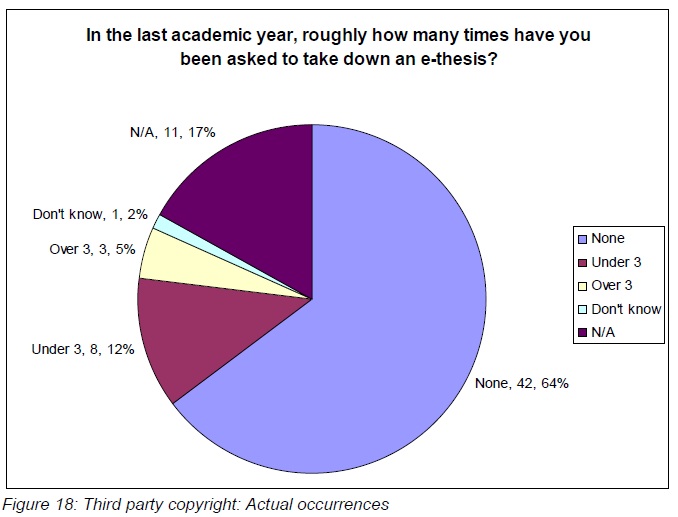
Well, it might, but in a recent survey only 7% of institutions cited this as a frequent concern amongst their students, and no concrete examples were found of publication being refused because the PhD thesis had been added to an open access repository. If reassurance is needed, then an embargo period can be applied, with may be the record plus abstract still being available to all.

2.    My work will be plagiarised

It’s possible, but then again people can plagiarise from printed theses too, and in those cases there’s no automated way to detect the crime.

Allowing open access to your thesis does open it up to all sorts of people who may come along and use the content in whatever way they like. But plagiarism detection services can help to mitigate the risks, and in EThOS at least, users have to register their details, so we could if necessary track all users of a particular thesis. So far that’s never been needed. And as people get more and more used to open access and theses become increasingly available in institutional repositories, it may be that the login process is becoming a tiresome deterrent to use and has had its day.

Brown J. (2010) Influencing the deposit of electronic theses in UK HE: report on a sector-wide survey into thesis deposit and open access. UCL. http://eprints.ucl.ac.uk/116819/

3.    All that hassle with third party copyright

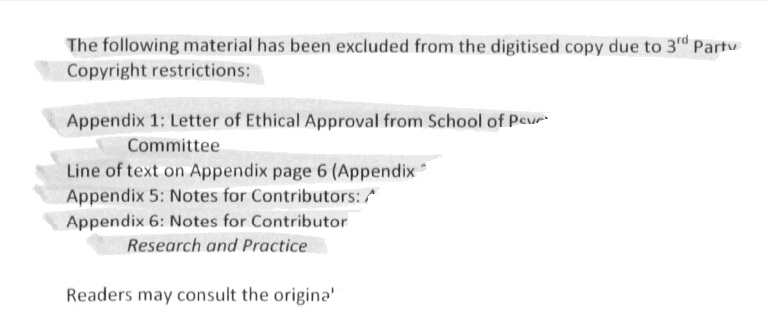
We do need to take copyright ownership seriously and it can be really time-consuming to seek permissions from any third party for permission to publish. Some university libraries are able to support their students to make sure any third party copyright is managed properly, but most don’t have the resources to undertake such a massive task. Take-down policies and embargoes come into play here, and digitisation services, whether through EThOS or another route, will carefully redact any sections, diagrams etc that aren’t copyright cleared on instruction from the institution.

List of redactions from a 2002 thesis held in EThOS.

The world of repositories and open access is moving fast. EThOS celebrated its third birthday last month. When it launched – on the same day as another auspicious event – theses were held in paper format in the university library and a microfilm copy held by the British Library. Now those microfilms have been packed away, and an average of 450 people a day download a copy of a full-text thesis from EThOS. With possibly the same number again accessing copies held directly in university open access repositories, it appears that full-text open access is here to stay.

Weekly Wisdom #75 by Paul Gray and David E. Drew

COMMUNICATING YOUR FIELD TO THE PUBLIC. Those who can communicate ideas from their discipline clearly to the public hold an important place in our society.  If you develop this skill, you can become a “public intellectual”.  Some highly successful public intellectuals in the recent past included astronomer Carl Sagan (Cornell) who had a television series, Daniel Patrick Moynihan (Harvard) who became a United States senator, and Stephen Jay Gould (Harvard) a broadly published a paleontologist and evolutionary biologist. Listed by your school’s PR department as an expert in your field, you can expect local (and sometimes national) media will ask for your comment.  If you are good on TV, you will be asked about all kinds of subjects, many beyond your expertise. Be careful not to pontificate about subjects where you know next to nothing.

Should You Make Your Thesis Available Online? Part 3: Thinking about Publishing

You have made your thesis available online, but does that affect whether or not it will get accepted for publication as a monograph? Academic publishers have varying opinions about this…

This is a very important issue for postdocs who are planning how to disseminate and publish the findings from their PhD research and an increasingly common question that academic publishers are now being asked. It was this question that originally kick-started my desire to run this blog series and start this conversation (#onlinethesis). I know that I am not the only one who has been dealing with this question either. One of the comments made in relation to Part 1 of this series was that a thesis that is available online is something that may be seen as problematic to publishers if a monograph based on a PhD is proposed. Others on Twitter are also interested in how publishers responded to this question. I contacted several publishers to find out more about this and these were the responses.

Jay Dew of University of Oklahoma Press informs me that this is a question he is frequently asked and his response is in favour of making theses online:

“On the whole, I don’t believe that having a dissertation or thesis available online works to the detriment of publishing a monograph. Indeed, more and more dissertations and theses are available online through library databases such as Dissertation Abstracts, etc. A dissertation and a book are two different things, with two different and distinct audiences. The revisions that are almost always necessary to bring a dissertation into book manuscript form are usually substantial enough that one need not cannibalize the other. There may be exceptions, of course, especially in the hard sciences, but at least for my press and the kinds of books we publish, this is not a problem.”

John Yates of University of Toronto Press extends this debate further arguing:

“I believe the situation in North America is different from yours [in the UK]. I understand that here all PhD thesis are licensed to ProQuest. I also understand that in Canada, theses are posted on-line by University libraries. Consequently scholars have quite a bit of work to do to convert their thesis into a scholarly monograph since libraries are not interested in purchasing titles that are effectively a thesis with minor revisions.

In your situation, if there is no requirement to post the thesis on-line and you’d like to have it published it as a monograph, I would think by not posting it on-line you’d be able to have the monograph published sooner, since fewer changes would be required than if the full thesis was publicly available on the web.”

The responses I have received in relation to this issue support the idea that making a thesis available online is generally acceptable to academic publishers, as long as the proposed monograph is substantially different to the submitted PhD thesis. Nonetheless, concerns are still evident amongst authors and researchers and it is recommended that potential publishers are contacted in advance of proposing a monograph to find out how they view this because opinions may vary depending on discipline and research topic. A more specialised research topic for example with a smaller market and audience may be seen as more problematic for some publishers if the material is already accessible online. It is possible to embargo the publication of your thesis in university depositories if this is considered an issue and you plan to propose a monograph but it is increasingly important to make this decision before the thesis is submitted, and made available electronically.

The key message then, is that the monograph based on a PhD thesis should be in substantially different format to the submitted PhD. Publishing houses from different countries are in agreement about this as presented here but it is important to be aware that making it available in an online depository may slow down the process of writing a book. It is also important to check the position of publishers who you wish to write book proposals for, to ensure that your decision is well informed. In a period of increased debate over open access to research, making the thesis online should not be, and doesn’t appear to be, a barrier to publishing a monograph but is certainly a consideration.