Exact matches only
Search in title
Search in content
Search in comments
Search in excerpt
Search in posts
Search in pages
Search in groups
Search in users
Search in forums
Filter by Categories
Academic Practice
Academic Writing Month
AcWri
AcWriMo
Blogging and Social Media
Book Editing
Book Literature Review
Book Marketing and Impact
Book Planning
Book Proposals
Book Publishing
Book Writing
Books
Citations and Referencing
Collaboration
Community
Conference Paper Abstracts
Conference Paper Editing
Conference Paper Literature Review
Conference Paper Marketing and Impact
Conference Paper Planning
Conference Paper Presenting
Conference Paper Writing
Conference Papers
Digital Publishing
Experimental Digital Publishing
Grant Abstracts
Grant Completion Reporting
Grant Impact Statement
Grant Literature Review
Grant Methods Section
Grant Writing
Grants
Journal Article Abstracts
Journal Article Editing
Journal Article Literature Review
Journal Article Marketing and Impact
Journal Article Peer Review
Journal Article Planning
Journal Article Writing
Journal Articles
Networking
News
Open Access
Productivity
Reading and Note-Taking
Reseach Project Planning
Resources
Tools
Uncategorized
Website
Agata Mrva-Montoya – From a Thesis to a Book, Publishers Advice from Sydney University Press

Today’s guest post comes from Agata Mrva-Montoya. Agata is an archaeologist turned editor, currently at Sydney University Press and interested in books, publishing and social media. Here she gives tips on turning your thesis into a book.

Congratulations! After years of doing research and writing, you finally joined the ranks of freshly minted PhDs. You even have an endorsement from your examiners – ‘this work is brilliant and should be published’. So you send it in to a publisher, then another one or two. And your proposal gets knocked back, time after time. Why?

Publishers rarely consider unrevised PhD theses. A dissertation in social science and the humanities is written with a different intent and structure to a book, and for a different audience. Your thesis may be brilliant ­­– well researched, well referenced and well organized – but what the publisher sees is a manuscript that is too long, with tedious and predictable structure, full of jargon and repetitious announcements of intent, and so many quotes and references that it reads like compilations of facts and regurgitated opinions.

So before you send your dissertation to another publisher, you need to revise it, rewrite it and turn it into something that someone, apart from your long-suffering supervisors and briefly accosted examiners, might actually want to read. Read more
Weekly Wisdom #47

Weekly Wisdom #47 Be conscious that a book has a complicated life-cycle which your editor is responsible for. The work doesn’t stop when your book hits the book shops!

Sarah Caro – REVISING YOUR PhD: Part 3 ‘Revisions for a Monograph’

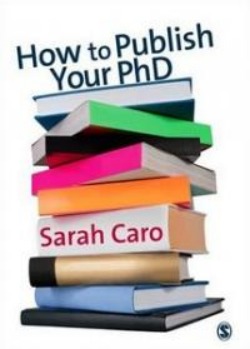
Sarah Caro, author of How to Publish Your PhD has kindly offered us this six-part guide on revising a thesis for publication as a book. Over the coming weeks she’ll be explaining how to understand what type of book you can produce as well as discover ways of shaping it up into a more book-like body of material.

Transforming your thesis into a format suitable for publication as an academic monograph may or may not involve much cutting down of length. In fact it may require the inclusion of some additional material or expansion of existing sections (as we shall see below). What is cer­tain, however, is that unless you are exceptionally gifted, lucky, or have been guided by a supervisor who has early-on spotted the publication potential of your work, it will need substantial reworking and restruc­turing if it is to escape its roots and become a convincing monograph.

As discussed before the average monograph does not follow the thesis-methods-results-analysis paradigm unless it has started life as a PhD and it is usually screamingly obvious when this is the case and the author has not revised it. Recently I received a pro­posal with the following table of contents (some details have been changed to avoid the person and project being identified): Read more

Sarah Caro – REVISING YOUR PhD: Part 2 ‘The Style and Genre of your Thesis’

Sarah Caro, author of How to Publish Your PhD has kindly offered us this six-part guide on revising a thesis for publication as a book. Over the coming weeks she’ll be explaining how to understand what type of book you can produce as well as discover ways of shaping it up into a more book-like body of material.

Using the rough guidelines I offered last week, you can now begin to analyze your own thesis and try to identify those features that are unique to your thesis and those features which are common to the genre. You might even find it is easiest to do this by taking a piece of paper and dividing it into three columns. I will tell you what the third column is for in a minute but for the tine being you could put ‘unique feature’ at the top of one column and ‘feature of the genre’ at the top of the next. Feature of the genre should be easiest to start with and might include:


Read more

Sarah Caro – REVISING YOUR PhD: Part 1 ‘Publication Types’

Sarah Caro, author of How to Publish Your PhD has kindly offered us this six-part guide on revising a thesis for publication as a book. Over the coming weeks she’ll be explaining how to understand what type of book you can produce as well as discover ways of shaping it up into a more book-like body of material.

A PhD performs a specific function, very different from that of a book or a journal. As a result it is structured differently and the tone and approach are not those you would use in a journal or a book. This six-part series provides some general advice on revising your thesis and high¬lights some common problems and issues that will need to be addressed whether you opt for articles or a book. It includes a practical example of how one might set about restructuring one’s thesis into a book and some basic guidelines on content and style.

Unless you are a student of literature the chances are that in your aca¬demic career to date you have spent little time thinking about genre or style. You will hopefully have made an effort to write clearly and will have learnt how to lay out references and notes but you may have never consciously considered the genre or format of what you are writing. In fact academic writing like any other form of writing geared to a specific audience is a distinctive genre in its own right and comes with a clear set of expectations on the part of both reader and writer. All academic disciplines conform to the basic strictures of the genre of academic writing, though there may well be significant dif¬ferences in style which can obscure these similarities. Read more

Getting Published: What’s Your Approach?

Last week, the Guardian Higher Education Network published a blog post I wrote for them about the origins of this very website. I discussed where the idea came from and noted that despite being engaged with all things digital, I set up the site because  I was well aware books (and all manner of peer-reviewed publishing) still carry weight in academia.

Through much of the first year of PhD2Published, we featured sets of tips from well-known academic publishers on how to get published. In line with this, and the spirit of PhD2Published, which all about sharing, I also offered Guardian readers my own set of tips in the blog post. For example I said:

Think about your market.

If you want to end up with a printed book published by a reputable academic press, you will need to make a case for its economic viability. This means market research. Don’t just tell your publisher the book would appeal to course X, Y and Z, tell them why. What exactly does it do that other books in the field don’t? How will it transform teaching in this area? Why will course managers make students read your book over the others on their list? Show the publisher there’s a really good chance your book will sell – preferably in decent numbers. Read more

Author Tips: Sarah Cook

This weeks Top Tips are from Sarah Cook co-author of Rethinking Curating: Art After New Media

Publishing can be a waiting game, while you wait to hear if a publisher is going to accept a proposal or not, and then, hopefully, while your manuscript is being peer-reviewed.. Here are some tips (noted with the benefit of hindsight) for how to manage that waiting game.

1. When your dissertation is finished, don’t immediately publish all the best bits in the first invitation you get to contribute a chapter to another book, in case you later get the chance to write your own book! You don’t want to have contractually signed away the first-publishing-rights to that researched material and then have your own book proposal accepted at another publisher. This happened to me. If you do get asked to contribute a chapter to someone else’s edited anthology or journal of course do it, but pick a single idea from your thesis, or a single chapter (not the conclusion!) and rework it accordingly. Read more

Lucy Wickens – Using Facebook for Networking & Research

As part of our week devoted to social networking here we present the second in the two part guest post by our intern Lucy Wickens on how to use Facebook for networking and research, you can see her previous post here.

Welcome back!

So hopefully by now you have successfully set up an account and are eager to become avid Face- bookers! Read more

Eloise Zoppos – The Virtual for the Professional: How Postgraduate Students can Manage their Professional Social Media Use

This is the second of our social media week posts. Here Eloise Zoppos examines how postgraduate students can manage their professional social media use. Eloise Zoppos is now embracing the virtual for the professional and you can find out more about her on her website http://eloisezoppos.com or follow her on Twitter @eloise_z.

Lately it seems like everything virtual is now normal: using Facebook to contact friends, reading the news online, calling people through Skype, online banking. Over the last few years, this rise in online activities has slowly begun to seep into the academic world with online conferences, virtual internships and online resumes (hosted on both LinkedIn and personal websites) just to name a few. This got me thinking about whether as a postgraduate student interested in getting published I should be investing more time into using social media for professional purposes. Read more

Weekly Wisdom #40

Weekly Wisdom #40 Don’t give your ideas away and let someone publish before you; publicise the outline of your book, not the details!

The Road from Dissertation to Book Has a New Pothole: the Internet

An article on The Chronicle of Higher Education called: The Road From Dissertation to Book Has a New Pothole: the Internet raises some important points about whether a thesis that exists online can still be published.

The important thing to consider is  that most publishing has to function as a viable business model. If a thesis has been freely available online, why would anyone buy it? And you need to bear in mind that when your book is sold, it’s likely to be funding not it’s own production, but that of the next book in line, so you’ve got more weight on your shoulders than just your career.

That said, as Gary Hall elegantly argues in Digitize This Book, these business models are being rapidly redeveloped by forms of online content sharing. So for example, your work might reach a bigger audience by being freely available online and this might become a surer route to career success.

Also, remember that presses seldom publish a thesis as is. We have a series coming up by Sarah Caro, author of How to Publish Your PhD, that explains how much redrafting must go on before your average thesis is even remotely book-shaped.

Or you can take my route and work on a book that expands one element of your thesis and maybe come back to tackling the whole thing later (losing that element if need be). Or just have done with your thesis altogether, see it as a ladder you climbed to get this far and then kick it away and start on the next one…

Hello! We would like to publish your thesis … (Note of Caution)

Isn’t that what we all want to hear? Well yes and no as it depends who wants to publish it. Most PhD students I know have received at least one email with the exciting title ‘We want to publish you thesis’ or words to that effect and the follows this kind of line …

Dear ….

I am Joe Bloggs and I work for (insert name of random company here). We would like to offer you the possibility of making your academic paper / thesis available as printed book.

I would appreciate if you could confirm your interest in our publishing house and I will be glad to provide you with detailed information about our services.

I am looking forward to receiving a positive response from you

Read more

Lauren Bailey – A Procrastinator’s Guide to Finishing Your Book on Schedule

This weeks advice on how to finish your book on schedule comes from Lauren Bailey. Lauren is a freelance writer and blog junkie, who blogs about online colleges. Questions and comments can be sent to: blauren99 @gmail.com.

Submitting a proposal and getting it accepted can be difficult enough, but the real work comes along when you must deliver on your promise and complete the book on schedule. Whether you are publishing your dissertation or are writing a different work related to your research and expertise, it pays to nip procrastination in the bud and have a plan for finishing your book on schedule. Read more

Is Getting Published a Feminist Issue?

I must confess (and I do hang my feminist head in shame) that when I started out researching publishing processes, gender bias wasn’t on my mind. I hadn’t considered whether I was more or less likely to get published than my male academic counter-parts. But then two things happened:

First, I heard a really interesting edition of Great Lives, on Radio 4, on the life of journalist Mary Stott. She was the first editor of the Guardian’s women’s page and discussion centred a lot about the all-too-recent notion that if women were going to read information in a newspaper they wouldn’t want to read the same information as men. And it really got me thinking about very recent shifts in the publishing industry that give women readers and writers more freedom.  Second, I was sent a link to an article in Bitch magazine about the disproportionately small number of women writers being written about in literary journals. Read more

Weekly Wisdom #32

Weekly Wisdom #32

Dare to ask collegues about the contracts they’ve accepted and what worked or didn’t!