Exact matches only
Search in title
Search in content
Search in comments
Search in excerpt
Search in posts
Search in pages
Search in groups
Search in users
Search in forums
Filter by Categories
Academic Practice
Academic Writing Month
AcWri
AcWriMo
Blogging and Social Media
Book Editing
Book Literature Review
Book Marketing and Impact
Book Planning
Book Proposals
Book Publishing
Book Writing
Books
Citations and Referencing
Collaboration
Community
Conference Paper Abstracts
Conference Paper Editing
Conference Paper Literature Review
Conference Paper Marketing and Impact
Conference Paper Planning
Conference Paper Presenting
Conference Paper Writing
Conference Papers
Digital Publishing
Experimental Digital Publishing
Grant Abstracts
Grant Completion Reporting
Grant Impact Statement
Grant Literature Review
Grant Methods Section
Grant Writing
Grants
Journal Article Abstracts
Journal Article Editing
Journal Article Literature Review
Journal Article Marketing and Impact
Journal Article Peer Review
Journal Article Planning
Journal Article Writing
Journal Articles
Networking
News
Open Access
Productivity
Reading and Note-Taking
Reseach Project Planning
Resources
Tools
Uncategorized
Website
Weekly Wisdom #75 by Paul Gray and David E. Drew

COMMUNICATING YOUR FIELD TO THE PUBLIC. Those who can communicate ideas from their discipline clearly to the public hold an important place in our society.  If you develop this skill, you can become a “public intellectual”.  Some highly successful public intellectuals in the recent past included astronomer Carl Sagan (Cornell) who had a television series, Daniel Patrick Moynihan (Harvard) who became a United States senator, and Stephen Jay Gould (Harvard) a broadly published a paleontologist and evolutionary biologist. Listed by your school’s PR department as an expert in your field, you can expect local (and sometimes national) media will ask for your comment.  If you are good on TV, you will be asked about all kinds of subjects, many beyond your expertise. Be careful not to pontificate about subjects where you know next to nothing.

Should You Make Your Thesis Available Online? Part 3: Thinking about Publishing

You have made your thesis available online, but does that affect whether or not it will get accepted for publication as a monograph? Academic publishers have varying opinions about this…

This is a very important issue for postdocs who are planning how to disseminate and publish the findings from their PhD research and an increasingly common question that academic publishers are now being asked. It was this question that originally kick-started my desire to run this blog series and start this conversation (#onlinethesis). I know that I am not the only one who has been dealing with this question either. One of the comments made in relation to Part 1 of this series was that a thesis that is available online is something that may be seen as problematic to publishers if a monograph based on a PhD is proposed. Others on Twitter are also interested in how publishers responded to this question. I contacted several publishers to find out more about this and these were the responses.

Jay Dew of University of Oklahoma Press informs me that this is a question he is frequently asked and his response is in favour of making theses online:

“On the whole, I don’t believe that having a dissertation or thesis available online works to the detriment of publishing a monograph. Indeed, more and more dissertations and theses are available online through library databases such as Dissertation Abstracts, etc. A dissertation and a book are two different things, with two different and distinct audiences. The revisions that are almost always necessary to bring a dissertation into book manuscript form are usually substantial enough that one need not cannibalize the other. There may be exceptions, of course, especially in the hard sciences, but at least for my press and the kinds of books we publish, this is not a problem.”

John Yates of University of Toronto Press extends this debate further arguing:

“I believe the situation in North America is different from yours [in the UK]. I understand that here all PhD thesis are licensed to ProQuest. I also understand that in Canada, theses are posted on-line by University libraries. Consequently scholars have quite a bit of work to do to convert their thesis into a scholarly monograph since libraries are not interested in purchasing titles that are effectively a thesis with minor revisions.

In your situation, if there is no requirement to post the thesis on-line and you’d like to have it published it as a monograph, I would think by not posting it on-line you’d be able to have the monograph published sooner, since fewer changes would be required than if the full thesis was publicly available on the web.”

The responses I have received in relation to this issue support the idea that making a thesis available online is generally acceptable to academic publishers, as long as the proposed monograph is substantially different to the submitted PhD thesis. Nonetheless, concerns are still evident amongst authors and researchers and it is recommended that potential publishers are contacted in advance of proposing a monograph to find out how they view this because opinions may vary depending on discipline and research topic. A more specialised research topic for example with a smaller market and audience may be seen as more problematic for some publishers if the material is already accessible online. It is possible to embargo the publication of your thesis in university depositories if this is considered an issue and you plan to propose a monograph but it is increasingly important to make this decision before the thesis is submitted, and made available electronically.

The key message then, is that the monograph based on a PhD thesis should be in substantially different format to the submitted PhD. Publishing houses from different countries are in agreement about this as presented here but it is important to be aware that making it available in an online depository may slow down the process of writing a book. It is also important to check the position of publishers who you wish to write book proposals for, to ensure that your decision is well informed. In a period of increased debate over open access to research, making the thesis online should not be, and doesn’t appear to be, a barrier to publishing a monograph but is certainly a consideration.

Should You Make Your Thesis More Widely Available Online? Part 2: Fear of Idea Theft

Following my first post that introduced my musings on the debate about making a PhD thesis or dissertation available online, this blog explores the issue of fear in relation to the theft of your ideas. This is an issue that is fairly central in Alex Galarza’s article for @GradHacker. The student in question feared that their ideas may be more susceptible to being stolen if they were to be made available online; a reasonable assumption given that, if the intention to put your thesis online is to make it more widely accessible, then the more likely it is that the ideas can be accessed and potentially lifted.

For me, this fear is not altogether unfounded and essentially boils down to a lack of knowledge about how online material is managed and regulated. In university teaching in the UK at least, students are taught about plagiarism, or the use of someone else’s work without acknowledgement, and are warned of the need to avoid doing it. Not only is it considered bad academic practice, but a plagiarised essay or piece of coursework is more likely to be of poor standard. As academics this becomes deeply ingrained in everyday working and writing practices, and is currently regulated through the processes of peer review and assessment. How this may be regulated online however, is less clear and the boundaries of citing and discussing the work of others is increasingly blurred.  Similarly if the aim of publishing online is to reach broader audiences, there is potential that those audiences are unfamiliar with referencing practices or maybe unwilling to use them.

A research paper about electronic theses by Copeland et al (2005, pg 195) suggests however that ‘it is easier to detect instances where this activity [plagiarism] has taken place when the material is published on the web. Electronic detection software is available’. My university in the UK uses Turn-It in for student essays for this purpose.

While this is comforting to know to some extent, an important thing to do before making your thesis available online is to check the copyright regulations of the archive you post to and to ensure that you own those rights as primary researcher. This should discourage any potential theft, protect your property rights and discourage the potential for idea theft by others. Where you make the thesis available online is also a consideration. The chances of having your ideas stolen and reproduced online or elsewhere are much less likely if you post to a university online archive than a personal blog for example because these are better regulated. It is also recommended that you seek advice from your PhD supervisor before posting online to check if there are any issues with copyright that you hadn’t thought of (especially important if the work is funded). You could also protect your work using a Creative Commons license. These allow ‘everyone from individual creators to large companies and institutions a simple, standardized way to grant copyright permissions to their creative work’ (Creative Commons website).

Fear of theft of your work when making it more readily available online is reasonable, and was something that led me to research and produce this series of blog posts. However there are frameworks and laws in place that are designed to protect your ideas and your intellectual property, as well as new technologies that are detecting plagiarism online. Make sure you are aware of these before you make your research outputs available online however. If you want to disseminate your work more widely to broaden its impacts, you should be able to, and it is important that academic work is accountable but also used in appropriate ways.

A recent hashtag on Twitter that has been used in relation to these ideas (and also Will’s post) is #notopenenough (thanks @ThomsonPat). Publishing online is becoming more popular, and hopefully fear of theft won’t stand in your way in your quest to make your research more widely known.

Join the conversation at #onlinethesis.

Reference

Copeland, Susan,  Penman, Andrew and  Mime Richard (2005) “Electronic Theses: The Turning Point.” Program: Electronic Library & Information Systems 39, no. 3 : 185-197.

Josie Dixon – From Planet PhD to Destination Publication: A Traveller’s Guide. Part 1. Ivory Tower vs Shopping Mall

This post is the first in a series by Josie Dixon, a consultant with 15 years’ experience in academic publishing, as Senior Commissioning Editor at Cambridge University Press and Publishing Director for the Academic Division at Palgrave Macmillan.  She now runs her own business, Lucian Consulting, and gives training workshops on publishing and other forms of research communication for postgraduates, postdocs and staff in over 50 universities internationally, alongside her training and consultancy work in the publishing industry. In this new set of blog posts for PhD2Published, Josie examines some of the polarities between Planet PhD and the world of publishing, and offers strategies for how to bridge the gap. 

In this series:

  1. Ivory Tower vs Shopping Mall
  2. Micro vs Macro
  3. Passenger vs Driver
  4. Process vs Afterlife
  5. Features vs Benefits

There’s a great article by Peter Barry which appeared in the Times Higher Education under the headline ‘Footnotes and Fancy Free’.  Among many useful insights, Barry caricatures very effectively two opposing worldviews or value systems in academic research.  For residents of the Ivory Tower, it’s all about pure intellectual excellence, never mind who (or what) it’s for.  For those who inhabit the Shopping Mall, there needs to be a clear benefit to an identifiable audience, and ultimately some form of commercial value for a paying market.  Barry diagnoses a fundamental problem in the fact that all too often PhDs (particularly in the arts and humanities) are supervised and examined by Ivory Tower standards, yet at the postdoctoral stage, researchers are suddenly pitched headlong into the Shopping Mall.  This is of necessity where publishers live, since their business is dependent on realising a commercial return on the investment that is made in every new publication.

Profitability – at whatever level – is key to a sustainable publishing business, and even university presses (whose non-profit model is the least commercially driven in the industry) can’t avoid this fundamental pillar of the Shopping Mall.  The sources of subsidy which have long shored up large sectors of university press publishing (particularly in the US) are running dry, and editors are looking ever harder at the commercial factors which position a prospective publication on the right or wrong side of the margins of viability.  At the other end of the scale, many major players in the academic publishing industry are fully commercial businesses accountable to shareholders with steep demands when it comes to the return on their investment.  It’s a fine balancing act to reconcile editorial values based on intellectual quality (those ivory tower sympathies which bring graduates into publishing in the first place) with tough financial imperatives, but that’s the daily challenge for commissioning editors at commercial academic presses like Palgrave Macmillan, Routledge, Blackwell, Ashgate or Continuum, to name only a few.

So the first stage in your journey from PhD to publication has to involve stepping out of the Ivory Tower and into the Shopping Mall, in order to see your project from the publisher’s point of view.  Here are five key questions to ask yourself, to help you to take this more commercial perspective on your research:

  1. What’s your USP (unique selling point)?  Can you sum up the original contribution of your research in a few accessible sentences, and make it into a selling point?  Imagine a blurb in a publisher’s catalogue – your sales pitch needs to be aimed at non-specialists in the book trade and the library supply business, not your end-user academic readers.
  2. Who are you writing for?  Publishers respond best to projects pitched at a well-defined readership.  Beware losing focus by trying to be all things to all people, either in terms of level (a research monograph is not a textbook or a trade book) or subject (interdisciplinary projects run the risk of being peripheral to several markets and central to none).
  3. Why do they need it (and will they pay)?  In tough market conditions like the present, there is very little room for discretionary, nice-to-have purchases.  Even libraries are having to prioritise very carefully after severe budget cuts, so there must be a clear demand for your research before they will consider buying it.  This is closely related to the next question:
  4. What benefit does your research provide?  (not to you, but to the reader!) Think about the applications of your research – how will it be used, and where will it make a difference?  Is there a problem (intellectual or otherwise) to which your research offers a solution?  Are there methodological tools or reference features which your readers will find helpful?  Publishers are looking for something more tangible than ‘another new interpretation’ of the subject, or research that ‘fills a gap’.
  5. How international is its focus and appeal?  The UK is a small market, and these days even the US is insufficient to carry the commercial viability of an academic publication.  Publishers will be thinking about the appeal to international markets, so you need to, too.

For more detailed guidance on these and other factors essential to maximising your chances of success in a competitive publishing climate, come to one of Josie’s publishing workshops or contact her direct. 

The Now Frontier: Posting Dissertations Online

A note from Anna: As part of a series of blogs on PhD2Published about Online Theses, Will Deyamport, III explains why he will definitely post his dissertation online. To engage in this conversation on Twitter please use the Online Thesis hashtag #thesisonline

Will Deyamport, III is an Ed.D student in Educational Leadership and Management at Capella University. He is the founder of peoplegogy.com, a blog that focuses on life and career developments. He is a monthly contributor to MyPathfinder Career Blog, where he writes about higher education. Currently, Will is writing his dissertation on how Twitter can support the professional learning needs of teachers.  You can follow him on twitter @peoplegogy.

This digital world we live in isn’t going anywhere. We pay bills online, we shop online, we make phone calls online, we date online, and now we’re streaming movies and going to school online. So why wouldn’t I post my dissertation online?

Has the academy become so insular that it has failed to understand and embrace the realities of this digital age? Has it become so arrogant that it believes that it can remain the sole guardian of academic knowledge? Or has the academy so blindly held on to its beliefs of what scholarly work is that it refuses to see this work being published on a daily basis on blogs around the globe?

Whatever its reasons, I plan to publish my dissertation online and here’s why:

  • I happen to have a passion for digital media and most of what I read is read online.
  • What I do and want to do for a career is done online. I’ve been a social media strategist, I blog, and I am earning my doctorate online. So for me the online space is a place of isn’t some separate entity. It’s a part of who I am and how I express my ideas.
  • I am a digital citizen. As such, I see the online world as the way for mobilizing the world towards a common humanity.
  • I routinely seek out information online. Whether it is via Youtube, LinkedIn, or my personal learning network on Twitter, I am able to gain access to experts from a variety of fields and disciplines.
  • I believe that academic knowledge belongs to the masses and should be made available and given freely to those who seek it.
  • My dissertation is on teachers using Twitter to support their own professional development.  The topic doesn’t belong is some bound book. It was meant to be posted online and shared with scholars and practitioners alike.

The ivory tower and those who worship at its feet need to understand that education is no longer insular. Holding information hostage does nothing for the academy or the betterment of society. In order to truly build a thriving academic knowledge-base and further the continued and expansive research expected in academia, technology has to be a part of how that research is shared and disseminated. Using emerging technologies, schools have the capacity to expose its students’ research to every corner of the globe. It is with this type of free exchange that the academy can reinvent itself and lead the way in today’s growing global economy and workforce.

Moving forward, I would like to see every doctoral student publish their dissertation on ProQuest or some other online platform. Just like TED has revolutionized the conference model, as current and future scholars, we have an opportunity to revolutionize the way people think, learn, and are taught about academic research.

Should You Make Your Thesis More Widely Available Online? Part 1

A brief note from Anna: Being Managing Editor of PhD2Published has been a fantastic opportunity for me so far. It has introduced me to lots of interesting people and has helped me to think about key issues I am facing post-PhD. My current thinking is about whether or not to make my PhD thesis more readily available online. This post, which is the first in a series, explores this idea in more detail.

Impact has increasingly become an academic buzzword and requirement, which has led me to think much more about my PhD thesis, its accessibility and the impact it could (and should) have on a variety of audiences, both academic and public. I have heard from several colleagues that the only people who are ever likely to read the actual thesis are yourself and your supervisor (my family and friends certainly haven’t read it!). Frankly this seems wasteful and a bit sad (just look at the picture!), especially considering all of the hard work that went into it, including by myself, my participants and my supervisors. Even with the potential of developing publications and monographs from it in different formats, later on, in its unpublished form, my thesis is meaningful to me and took time and effort to construct.

This thinking prompted me to consider how I could make my thesis more accessible and more widely read, particularly in an age of social media and open access. Before launching into making it available online however, I wanted to do some research into the potential barriers to publishing online and the current debates that will inform this decision.

Following these musings, I posted this question on Twitter: “What are people’s opinions on making theses available online?” Several interesting and important issues and questions were raised. While limited,  there is already an emerging debate about the digital dissertation, which you can read about in this interesting and informative post by Alex Galarza for @GradHacker. There are several positives for doing this, and indeed many universities are now making it a requirement, if it isn’t already. @Gradhacker outlines that online material such as the unpublished thesis for example is still protected by copyright, useful to know if there is concern about the acknowledgement of your work. At the same time, in being overly cautious about protecting your thesis/dissertation you may risk restricting the development of your academic identity, online and otherwise. Furthermore (and some publishers may vary on this) putting your thesis/dissertation online may actually aid in the communication and appeal of your research to a variety of audiences and may even encourage sales of subsequent published work should you wish to publish it elsewhere in a different form. Twitter follower Christina Haralanova (@ludost11) has also received positive replies from people who have read hers.

Despite the many positives, I still think it is important to consider the range of different issues relating to putting a PhD thesis out there; issues that I will explore in a short series of blogs that will be posted here on PhD2Published in the coming weeks. These include posts I have constructed myself, and also opinion posts, and feedback from academic publishers. If any of this resonates and you have anything to add that has occurred to you, please do get in touch, either by Email or Twitter (@PhD2Published). Should you wish to join an online discussion on Twitter about the debate please use hashtag thesisonline (#thesisonline).

Weekly Wisdom #65 by Paul Gray and David E. Drew

PREPARE AN “ELEVATOR SPEECH”. Throughout your PhD studies, your professors grounded you in your discipline and taught you all the caveats and disclaimers that must accompany your scholarly research.  Then, in the dissertation defense, and afterwards, for example when you seek a job, you will be asked to succinctly summarize your work and what it means. Imagine that you are attending a national conference.  You step into an express elevator on the 45th floor of the building, and push “lobby”.  the only other person in the elevator is, say the senior Federal policy maker in your area of interest, for example, the National Endowment for the Humanities or the President’s Science Advisor, or the chair of the department you really want to interview for a job.  He or she says that they heard that you completed an important dissertation study.  S/he explains that s/he would like to know about your research, but,given a packed schedule, only has this elevator ride to learn about your work.  What do you tell them?


Weekly Wisdom #61 by Paul Gray and David E. Drew

WRITE A CROSS-OVER BOOK. Professors build their reputations by publishing articles and books in their specialty. Almost always, their only readers are other professors, graduate students, and their own family. Sometimes, however, a faculty member produces a successful crossover book, a work respected by, and receiving laudatory reviews from, his or her academic colleagues while also selling well with the general public.

Such books are difficult to write, however. If your book is to fly off the shelves at bookstores such as Barnes and Noble, it has to be both readable and entertaining. Few people reach the level of clear and creative writing required. Furthermore, even among highly skilled professional nonfiction writers, New York Times best sellers are rare. Nonetheless, some university scholars have written best sellers. They include  Peter Drucker, Margaret Mead, Paul Krugman, Gail Kearns Goodwin, and Stephen Hawking. We believe that professors who produce crossover books perform a valuable public service. Unless you become a world-class public intellectual like the people in the above paragraph, you may be denigrated by your academic peers as a mere popularizer. A false equation that does not work mathematically, but still describes the behavior of many misguided professors:  excellent technical productivity plus commercial success is respected less than excellent technical productivity alone.

Editors Love Authors Who Understand Publishing – Patrick H. Alexander in the Chronicle
http://www.flickr.com/photos/kavo1/526298447/
http://www.flickr.com/photos/kavo1/526298447/

Patrick H. Alexander (Director of Pennsylvania State University Press) has written a really useful article for the Chronicle entitled:  The Less-Obvious Elements of an Effective Book Proposal. He points out all the important things about getting your pitch right, making a thesis-based manuscript less thesis-y and, of course, not making any silly spelling mistakes.

Perhaps particularly interesting, however, is that he mentions the need for scholars to understand publishing and ‘get involved’. Regular readers of PhD2Published will know that this is one of the main reasons I set up this website. It seemed crazy for me to pitch a book to a publisher without knowing more about what publishing entails. How could I hope to be a part of a publishing engine if I didn’t understand what all the other parts did and how we’d work together? So I was really pleased to see Alexander point out that ‘editors love authors who understand publishing’. Read more

Weekly Wisdom #60 by Paul Gray and David E. Drew

DOWNLOAD COUNTS. Tenure and review committees like candidates who develop a personal reputation and hence reflect glory on the institution. Impact factors are one crude measure.  Another is the Download Count.  That is, if you have an academic publication that is accessible on the Internet, is anybody reading it or, better, downloading it?  Some publishers maintain download counts and send them to authors.  If you are fortunate to receive download counts, keep them.  They are handy at tenure and performance review time.

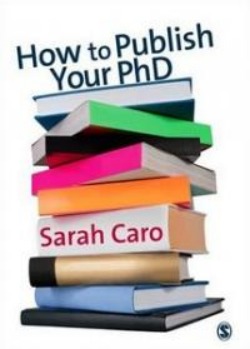
Review of How to Publish Your PhD

As a PhD student puzzled and disorientated by the seemingly impenetrable complexity of academic publishing, reading How to Publish your PhD by Sarah Caro was a balm for my anxieties. At present, I find myself occupying a point on the winding and erratic road to doctoral submission at which I am grateful (sometimes pathetically so) for advice, any advice, about demystifying academia. Having read several books on thesis writing early in my doctoral research, I had yet to discover a book that convincingly dealt with the practicalities of publishing a book from one’s thesis. In this ‘publish or perish’ world, it is really never to early to begin thinking about ‘the m word’. Monograph. Even reading the word itself gives me the willies.

This thin volume (a sprightly 136 pages) is packed with valuable material for the angst-ridden PhD student with no idea of where to start, or the confused early career academic staring down the barrel of their first monograph. Filled with sensible advice and divided into self-evidently useful chapters such as ‘Books or Articles?’ and ‘Revising your PhD’, Caro has created a text to be read, re-read and referred to when needed. Every chapter is summarised in point form, making quick checks exceedingly simple. As the current Publisher for Economics and Management journals at Wiley and obvious veteran of the publishing world, Caro is ideally suited to be the author of such a book.

The text provides the reader with a series of things that a would-be creator of an academic monograph can do to help themselves, with particular focus on small and yet oft-overlooked details. Attentiveness to these details, according to Caro, can mean the difference between a submission ending up in the ‘no’ pile or the ‘maybe’ pile (p. vi). To say that Caro has thought of everything in this book would naturally be an exaggeration, but it is definitely fair to say that the book contains all of the major aspects of importance to the author. Given that these points are based on years of experience, I am inclined to believe that they are significant. Read more

Pip Bruce Ferguson On “Getting Published” – a Workshop for PhD Students and Staff at the University of Waikato
http://www.flickr.com/photos/barbourians/5365888653/

http://www.flickr.com/photos/barbourians/5365888653/

This post is by Pip Bruce Ferguson, Teaching Developer at The University of Waikato. Hamilton, New Zealand”

Two weeks back I facilitated a workshop that was advertised to a combination of PhD students plus staff at this University, where I work as a Teaching Developer. While my unit doesn’t work directly with PhD students nor supervise them, we do offer ‘Supervisory Conversations’ in conjunction with our Pro Vice Chancellor (Postgraduate), and have done for a couple of years now. These have been an effective way of supporting our supervisors, but have rarely included PhD students. We offer them in a beautiful location on campus, away from main teaching rooms, and provide a finger-food lunch.

Hospitality is important in New Zealand, and getting away from the hustle and bustle of ‘normal’ work and having time to discuss and reflect is very important to our supervisors, who can participate in cross-disciplinary discussion at these events.

Because of the pressure for staff to publish under our Performance-Based Research Fund (the New Zealand equivalent of the U.K.’s Research Assessment Exercise, but funded by rating individuals rather than units) we decided to offer a workshop on how to get published. This was also advertised to PhD students, and the workshop attracted a significant cohort of these, mainly international students. As with the conversations mentioned above, we offered morning tea, some resources such as hardbound notebooks and highlighters to help with the inevitable handouts (!) and an environment where people could ‘come apart’ from their normal workplace. Read more

Weekly Wisdom #57 by Paul Gray and David E. Drew

PUBLICATIONS ARE THE ONLY FORM OF PORTABLE WEALTH.  Teaching is a great personal satisfaction and an important public good that you perform. It is an important, necessary condition but not a sufficient one for being hired or tenured.

Kevin Ward – Writing an Academic book – Some Thoughts

Following on from my appearence on the panel at RGS Postgraduate ForumAnnual Conference Training Symposium (PGF-ACTS) last week I present the first of three posts from the speakers on publishing. Todays post looks at writing and academic book and is brought to you by Professor Kevin Ward. Kevin is Professor of Human Geography at Manchester University and has been the Editor of Area a journal published on behalf of the Royal Geographical Society (with The Institute of British Geographers) since 2010.

So, you’ve decided that you are going to write an academic book.  Well, here are five tips:

1. It is worth considering the sort of book you want to write.  Look at publishers’ websites and consider the following: 

– Does the publisher produce the type of book that you want to write in your field?

– Are hardback and paperback versions of the book published simultaneously?  If not, how many hardbacks does your book have to sell before the publisher will commission a paperback run?

– What marketing and distribution system does the publisher have?

– Does the publisher send out copies to academic journals for review?

– Does the publisher attend large academic conferences and participate in book exhibitions? Read more

Getting from PhD to Published at InterFace 2011
I was really excited to speak at the amazing InterFace 2011 humanities and technology conference on the 29th July at UCL. It was organised by a really diverse and highly-skilled group of PhD students and it was such a pleasure to be involved with.
I spoke on ‘Getting from PhD2Published’ as part of a session on publishing. My Prezi is below and for the rest of the contributors head over to the publishing page on the InterFace website.