Exact matches only
Search in title
Search in content
Search in comments
Search in excerpt
Search in posts
Search in pages
Search in groups
Search in users
Search in forums
Filter by Categories
Academic Practice
Academic Writing Month
AcWri
AcWriMo
Blogging and Social Media
Book Editing
Book Literature Review
Book Marketing and Impact
Book Planning
Book Proposals
Book Publishing
Book Writing
Books
Citations and Referencing
Collaboration
Community
Conference Paper Abstracts
Conference Paper Editing
Conference Paper Literature Review
Conference Paper Marketing and Impact
Conference Paper Planning
Conference Paper Presenting
Conference Paper Writing
Conference Papers
Digital Publishing
Experimental Digital Publishing
Grant Abstracts
Grant Completion Reporting
Grant Impact Statement
Grant Literature Review
Grant Methods Section
Grant Writing
Grants
Journal Article Abstracts
Journal Article Editing
Journal Article Literature Review
Journal Article Marketing and Impact
Journal Article Peer Review
Journal Article Planning
Journal Article Writing
Journal Articles
Networking
News
Open Access
Productivity
Reading and Note-Taking
Reseach Project Planning
Resources
Tools
Uncategorized
Website
Weekly Wisdom #63 by Paul Gray and David E. Drew

TURN YOUR REVIEWS OF OTHER PEOPLE’S PAPERS AROUND QUICKLY. Reviewing is both a scarce resource and important work. You will want your work reviewed quickly. You should offer the same courtesy to others. Don’t be too busy to review. Turn your reviews around quickly.


Matt Might – Writing Productivity Tips for Academics
http://www.flickr.com/photos/vblibrary/4384435939/

http://www.flickr.com/photos/vblibrary/4384435939/

Matt Might is a professor in the School of Computing at the University of Utah. He blogs at blog.might.net and tweets from @mattmight, here he rounds up some of his great advice on writing productivity for academics.

Academics must become productive, efficient writers.

Yet, many fledgling academics struggle to produce even a trickle of words (let alone the flood) that is required.

Fortunately, a few small tricks generate an outsized impact on the output of technical words per minute.

[These tips are an amalgam of my posts on crippling technology to boost productivity and general academic productivity hacks.]

Find your place

Measure your words per hour in your usual spots. Where do you write best? Is it at home? The office? The back yard? The coffee shop? The park? The library?

Once you’ve found the best place for you, make it better:

  1. Move your books to your place. This is a forcing function. You’ll go to your place more often because that’s where your references are.
  2. Get an ergonomic chair. Nothing beats the Aeron chair.
  3. Get a high-quality ergonomic keyboard. If you’re going to write a lot in a short amount of time, protect your wrists. I highly recommend the Kinesis Advantage. Read more

AcBoWriMo Motivational Speech!

How’s AcBoWriMo going? Written an insane amount yet? No? Not good enough people so I’m dishing up some tough love…

When I was about eighteen months away from finishing my PhD I had a phone call I will never forget. It broke the news to me that my oldest friend had died in a car accident with her boyfriend.

A couple of months later, as all writing productivity had ground to a halt, I tried to think of a way to motivate myself. Family and friends did an amazing job of keeping me going through this intensely difficult time, but the drive to succeed in my PhD – in anything – was definitely gone. Read more

Rochelle Melander’s Write-A-Thon Techniques Part III

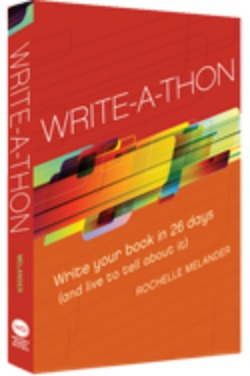
The following is an excerpt from Write-A-Thon: Write Your Book in 26 Days (And Live to Tell About It) by Rochelle Melander, now available from Writer’s Digest Books. Rochelle Melander is a certified professional coach and the author of 10 books, including a new book to help fiction and nonfiction writers write fast: Write-A-Thon: Write Your Book in 26 Days (And Live to Tell About It) (October 2011). Melander teaches professionals how to get published, establish credibility, and navigate the new world of social media. In 2006, Rochelle founded Dream Keepers Writing Group, a program that teaches writing to at-risk tweens and teens. Visit her online at www.writenowcoach.com.

Get a Cheering Section

We can’t all be heroes because someone has to sit on the curb and clap as they go by.

—Will Rogers

We write more when we connect with others who are writing productively. As I mentioned in an earlier chapter, a recent study on friendship and obesity suggested that having just one overweight friend increases our chances of being overweight. Other recent studies suggest that happiness is also contagious. It just makes sense that having one friend who writes like mad increases our chances of doing the same. The success of NaNoWriMo suggests that writers get more done when they’re connecting with other writers. Other writers offer valuable support. Or, you are who you connect with. Read more

Rebekah Sheldon – Writing Game for AcBoWriMo
http://www.flickr.com/photos/br1dotcom/6319224845/

http://www.flickr.com/photos/br1dotcom/6319224845/

This post comes from Rebekah Sheldon who earned her Ph.D. in English from the CUNY Graduate Center, where she did work on contemporary American catastrophe discourse. She is presently the Provost Postdoctoral Fellow at the Center for 21st Century Studies at the University of Wisconsin-Milwaukee.

My husband lives a few hours south of me, in an eastern time-zone. So it was 7 am my time when he called to ask me to write two sentences on the political theorist Giorgio Agamben’s concept of bare life for a paper he’s writing. Now, two weeks ago, in the lead-up to a presentation on biopolitics and maternity, this same task took me several whole-day stretches before I gave up in disgust. This morning, however, out of the blue and with nothing at stake, I wrote two hundred words in less than half an hour.

They were not my most perfect sentences, but I got to the crux of the issue faster and more lucidly than I had in a week of working. In looking it over, I realized that I had just found my first AcBoWriMo strategy: the feint. Here’s what I propose as a way to trick myself into putting on paper what I know that I know:

On a bunch of paper scraps, write down writing tasks — anything from footnotes and edits to descriptions, analysis, and conclusions. Make them as specific or as general as your own needs and the needs of your audience. Mix them up in a basket or bag, and make sure to include a few rewards as well. Whenever you find yourself tempted to flip over to Facebook, or shifting the words around in the same few sentences, reach instead for the writing task bag. The important part is to do the task, whatever it is, as soon as you get it.

Or you can try Dacia Mitchell’s writing game instead, anything to keep those ideas flowing…

Weekly Wisdom #62 by Paul Gray and David E. Drew

PUBLISH EARLY AND OFTEN as they say in Chicago. Begin writ­ing for publication while you are still in graduate school. Data shows that people who publish while still in graduate school usually con­tinue to publish at a faster rate after they graduate than those who didn’t publish while still a student. Furthermore, published papers and monographs help you get your first job.

Nina Amir – How to Complete a Nonfiction Project in 30 Days

This post is by Nina Amir, Your Inspiration-to-Creation Coach, who inspires writers to create the results they desire—publishable and published products and careers as writers and authors.  She inspires writers to combine their purpose and their passion so they Achieve More Inspired Results. The author of the forthcoming book, How to Blog a Book: How to Write, Publish and Promote Your Work One Post at a Time (Writer’s Digest Books, April 2012) and the author of the popular workbook How to Evaluate Your Book For Success, Amir is a seasoned journalist, nonfiction editor, consultant, and writing, book, blogging, and author coach with more than 33 years of experience in the publishing field. She writes four blogs, including Write Nonfiction NOW! and How to Blog a Book, and two national columns at Examiner.com and serves as the weekly writing and publishing expert on Michael Ray Dresser’s popular radio show, Dresser After Dark (www.DresserAfterDark.com). For more information: www.ninaamir.com or www.copywrightcommunications.com.

November can constitute a busy month. It includes the end of Daylight Savings Time, Veterans Day and Thanksgiving as well as the beginning of the holiday shopping period. Writers could complain that there’s no time for writing. Read more

Rochelle Melander’s Write-A-Thon Techniques Part II

The following is an excerpt from Write-A-Thon: Write Your Book in 26 Days (And Live to Tell About It) by Rochelle Melander, now available from Writer’s Digest Books. Rochelle Melander is a certified professional coach and the author of 10 books, including a new book to help fiction and nonfiction writers write fast: Write-A-Thon: Write Your Book in 26 Days (And Live to Tell About It) (October 2011). Melander teaches professionals how to get published, establish credibility, and navigate the new world of social media. In 2006, Rochelle founded Dream Keepers Writing Group, a program that teaches writing to at-risk tweens and teens. Visit her online at www.writenowcoach.com.

Create Your Research and Development Team

Half of being smart is knowing what you’re dumb at.

—David Gerrold

“You can’t research and write a nonfiction book in a month! There’s not enough time!” said my client. Read more

Editors Love Authors Who Understand Publishing – Patrick H. Alexander in the Chronicle
http://www.flickr.com/photos/kavo1/526298447/
http://www.flickr.com/photos/kavo1/526298447/

Patrick H. Alexander (Director of Pennsylvania State University Press) has written a really useful article for the Chronicle entitled:  The Less-Obvious Elements of an Effective Book Proposal. He points out all the important things about getting your pitch right, making a thesis-based manuscript less thesis-y and, of course, not making any silly spelling mistakes.

Perhaps particularly interesting, however, is that he mentions the need for scholars to understand publishing and ‘get involved’. Regular readers of PhD2Published will know that this is one of the main reasons I set up this website. It seemed crazy for me to pitch a book to a publisher without knowing more about what publishing entails. How could I hope to be a part of a publishing engine if I didn’t understand what all the other parts did and how we’d work together? So I was really pleased to see Alexander point out that ‘editors love authors who understand publishing’. Read more

Rochelle Melander’s Write-A-Thon Techniques Part I

The following is an excerpt from Write-A-Thon: Write Your Book in 26 Days (And Live to Tell About It) by Rochelle Melander, now available from Writer’s Digest Books. Rochelle Melander is a certified professional coach and the author of 10 books, including a new book to help fiction and nonfiction writers write fast: Write-A-Thon: Write Your Book in 26 Days (And Live to Tell About It) (October 2011). Melander teaches professionals how to get published, establish credibility, and navigate the new world of social media. In 2006, Rochelle founded Dream Keepers Writing Group, a program that teaches writing to at-risk tweens and teens. Visit her online at www.writenowcoach.com.

Discover Writing Strengths

Every writer has strengths and weaknesses in the process of converting the ideas into words on a page. Some writers excel at research, others love doing the rough draft, and some revel in the rewrite. Even professionals struggle with stages of the writing process. For the purposes of the twenty-six day writing marathon, we are looking at strengths and weaknesses in the five stages of the writing process: research, prewriting, writing the rough draft, revising, and proofreading. Note that most writers do not move through the following five steps in order. Most writers repeat the steps during the writing process, sometimes multiple times. Read more

Introducing Our New Managing Editor: Dr Anna Tarrant

Introduction to Me

Hello everyone,

I am delighted to announce that I am the new Managing Editor of phd2published! Just by way of introduction, here is a bit about me and my intentions for this role:

Anna 2011: Questions galore!

I am a human geographer by training and my thesis examined the social geographies of contemporary familial identities in a British context. I completed my PhD in July 2011 and have since realized my ambition to stay in academia. Currently I am a Senior Teaching Associate at Lancaster University, teaching a broad range of topics at both undergraduate and postgraduate levels. This is a short term, 10 month post and I view it as my opportunity to fill in the gaps of my knowledge, to get established as an academic and to develop my networks. So how do I asked? Read more

Weekly Wisdom #60 by Paul Gray and David E. Drew

DOWNLOAD COUNTS. Tenure and review committees like candidates who develop a personal reputation and hence reflect glory on the institution. Impact factors are one crude measure.  Another is the Download Count.  That is, if you have an academic publication that is accessible on the Internet, is anybody reading it or, better, downloading it?  Some publishers maintain download counts and send them to authors.  If you are fortunate to receive download counts, keep them.  They are handy at tenure and performance review time.

The (relatively relaxed) Rules of AcBoWriMo
http://www.flickr.com/photos/wheatfields/3937933747/

http://www.flickr.com/photos/wheatfields/3937933747/
1. Decide upon a target word count. Try and make this something that would really push you beyond anything you ever thought possible. Admittedly, 50,000 words is a bit of a nutty goal for academic writing in one month. It works out at something like 2,500 words a day. But hey, as a project, AcBoWriMo is still very much in the trial stages and we can at least try right? As many of you have said, think of how great you’ll feel if you even come close to your crazy goal! It’s okay if numbers aren’t your thing. Just set a productivity goal of another kind.

2. Declare your participation and target word count (or productivity goal) publicly. You can do this by adding to the comments of the AcBoWriMo blog posts on here, on Twitter using the #AcBoWriMo hashtag, or on the PhD2Published Facebook page. If you want to be really private about it, maybe just tell a friend who will hold you to it (although we’d rather you shared your commitment and progress with us, we want to do this together). Read more

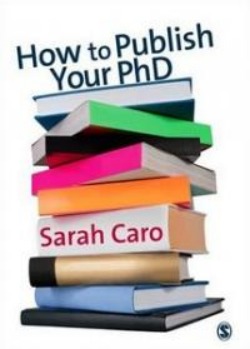
Review of How to Publish Your PhD

As a PhD student puzzled and disorientated by the seemingly impenetrable complexity of academic publishing, reading How to Publish your PhD by Sarah Caro was a balm for my anxieties. At present, I find myself occupying a point on the winding and erratic road to doctoral submission at which I am grateful (sometimes pathetically so) for advice, any advice, about demystifying academia. Having read several books on thesis writing early in my doctoral research, I had yet to discover a book that convincingly dealt with the practicalities of publishing a book from one’s thesis. In this ‘publish or perish’ world, it is really never to early to begin thinking about ‘the m word’. Monograph. Even reading the word itself gives me the willies.

This thin volume (a sprightly 136 pages) is packed with valuable material for the angst-ridden PhD student with no idea of where to start, or the confused early career academic staring down the barrel of their first monograph. Filled with sensible advice and divided into self-evidently useful chapters such as ‘Books or Articles?’ and ‘Revising your PhD’, Caro has created a text to be read, re-read and referred to when needed. Every chapter is summarised in point form, making quick checks exceedingly simple. As the current Publisher for Economics and Management journals at Wiley and obvious veteran of the publishing world, Caro is ideally suited to be the author of such a book.

The text provides the reader with a series of things that a would-be creator of an academic monograph can do to help themselves, with particular focus on small and yet oft-overlooked details. Attentiveness to these details, according to Caro, can mean the difference between a submission ending up in the ‘no’ pile or the ‘maybe’ pile (p. vi). To say that Caro has thought of everything in this book would naturally be an exaggeration, but it is definitely fair to say that the book contains all of the major aspects of importance to the author. Given that these points are based on years of experience, I am inclined to believe that they are significant. Read more

Weekly Wisdom #59 by Paul Gray and David E. Drew

JOB HUNTING IS A RESEARCH PROJECT and you should treat it as such. Gather as much information as possible. Read the ads. Contact sources. Follow up leads. Be aggressive. Use your contacts. The chance of landing a good appointment is higher if you search broadly than if you sit in your office waiting for one or two possibilities. Begin job hunting early and make it a project you do along with your other work. If you are a graduate student, don’t wait until your dissertation is finished to start looking.