This is a public worksheet/workshop for writing a draft of academic text in just 25 minutes. You’re invited to complete each task in the allotted time in your own Google/Scrivener/Word doc etc…. Set a timer for each writing task (1. 5 mins, 2. 15 mins, 3. 5 mins) and don’t go over! And then let us know in the comments how you go on.
Task 1: create a structure (in 5 minutes)
Take the ‘tiny text’ template I made based on the Thesis Whisperer (aka Inger Mewburn’s technique for kick-starting your academic writing)
Take an idea from your research (this could be the idea your entire thesis is based on, it might be the concept being presented in one chapter, or it might be an idea you haven’t worked out yet that may or may not end up being a part of your thesis/current project,
In just 5 minutes, write one sentence for each of the sections listed below.
Focus: Broadly important fact or relevant story (In….)
Literature: What has been said already? (It is argued that…)
Gap: What hasn’t been said already? (However….)
Methods: How (By analysing…)
Implications: What practical or philosophical impact will this have? (This research shows…)
(template credit: Gerald Graff, Barbara Kamler and Pat Thomson, Karen Kelsky, Inger Mewburn)
Task 2: build 3 core sections (in 15 minutes)
Now, spread out the tiny text you’ve written, or focus on the following sections: Literature, Methods, Implications
Focus: Broadly important fact or relevant story (In….)
Literature: What has been said already? (It is argued that…)
[write more here!]
Gap: What hasn’t been said already? (However….)
Methods: How (By analysing…)
[write more here!]
Implications: What practical or philosophical impact will this have? (This research shows…)
[write more here!]
Take the Thesis Whisperer’s ‘Thinking Bundles’ worksheet :
and use her ‘sentence scaffolds’ to write a brief paragraph for each of those sections,
You have 15 minutes to do this (5 minutes for each section plus reading time of a couple of minutes) – literally fill in the blanks with your own work!
Task 3: craft your paragraphs
Now, read the following worksheets by the Thesis Whisperer (you have a couple of minutes to do this):
‘PEELL’ gives you a paragraph that looks like this (it has a tight focus/ makes a point up front and then builds on that):
Pick which structure appeals best and write one brief paragraph from scratch. Make it something that fleshes out the next stage of the work. For example write a further paragraph of your literature review/methods section, or introduce a case study.
You have just 5 more minutes to do this.
For more help constructing your paragraphs, and finding the right phrases, see the University Manchester Academic Phrasebank.
OK, so it was probably a bit tight working on all this in just 25 minutes (it’s a bit like a Jamie Oliver 15 minute meal, not everyone will ever do it this fast) and academia is certainly not a race, quality thinking takes time, but this is one technique you can use to kick start your work.
I suggest you take a break straight after working on your 25 minute text and when you return, use ‘Task 3’ to fill out more paragraphs. You might like to continue by working on each paragraph for a set amount of time – this time will depend on how much preparation you’ve done – but the Pomodoro Technique of working in 25 minute time slots is a proven way of keeping on task.
Charlotte Frost and Jesse Stommel met (as they often do) in a Google Doc to do some writing. This time, however, they invited a group of people to join them, and they demonstrated how and why they write together in Google Docs. In the blog post below, you can read the text they generated, but the original Google Doc they used can also be viewed as can the video of them writing together (which we’ve included below). If you have any further questions ask away in the comments section of this post.
My name is Charlotte Frost and I am a Visiting Assistant Professor here at SCM in Hong Kong. I run lots of projects looking at writing in an academic context including PhD2Published and AcWriMo. My other work is focused on digital and new media arts and the history of net art (the latter of which was the subject for my thesis). Jesse and I regularly work in Google Docs together on all manner of things because apart from anything else its fun.
My name is Jesse Stommel and I’m a teacher and researcher working in the US. I teach Digital Humanities and Digital Literacies at the University of Wisconsin-Madison. I’m also the Director of Hybrid Pedagogy, a digital journal of learning, teaching, and technology. I’ve been working closely with Charlotte for quite a while, and we have begun to inhabit each other’s writing in such a way that we often finish each other’s sentences.
In this session we’re going to:
Use a Google Doc to show how we work together and discuss what works for us
Describe and give examples of public writing.
Show which parts of a Google Doc we use for what.
Address some of the difficulties we encounter as we work in this way.
Demo all of this in a meta-sort of way, so you can watch it unfold before your very eyes.
(And hopefully film this demo so you have something to look at and refer to afterward)
Why Write Collaboratively?
Accountability: Writing together is a huge procrastination crusher. There’s safety in numbers and it makes it much less daunting to look at a blank screen with someone else there – you are NOT alone! (cause someone else is right there with you, prodding your sentences into life!)
Camaraderie: Having someone to talk to and write with and even ask questions about all sorts of things helps (especially questions about writing and academia of course!). It can make it easier to get started (see above) and make the whole process a lot more enjoyable.
Instant Proof-reading and Peer-review: Your partner can read for sense AND mistakes – if they don’t get it, others won’t either. But also, let them find your mistakes and save your blushes later on.
Less Work: If you work on something like this together in a Google Doc (whether it’s a blog post, article, outline, etc.) you halve the work. And, if you’re working with someone like Charlotte [says Jesse] it’s even less than half, because she’s very very prolific.
Progression: It will move your thinking and writing forward AND fast. There’s a difference between ‘thinking writing’ and ‘doing writing’ the former helps you work something out, the latter helps you show what you’ve worked out. A collaborative document can be used for either, but if nothing else, use it for ‘thinking writing’. It’s a sandbox for making sense of something of something.
Why not? Learning is social and doing this kind of work with collaborators helps improve your work and your partners. Writing does not have to be solitary. Sure, some writing prefers to live alone, but sometimes writing wants to live right alongside its readers.
How to Write Collaboratively?
(there’s lots of stuff to consider as you get started, but sometimes the best thing to do is just start putting words on the screen and work the details out as you go). Here are some strategies we’ve found work well:
Time and Place:
Set up a Google Doc and a specific time to meet – as well as the duration of your meeting.
Your work can continue asynchronously outside the scheduled time (especially if you’re working in different time zones) but writing together at the same time is key – so try to do that regularly.
But perhaps only do it for an hour at a time, it’s a tiring practice if you’re working very collaboratively.
Permissions:
Establish the ‘permissions’ you’ll set for the document, who can edit, who can comment, who can read, etc.
Decide whether you want your document open to the web.
If you’re inviting more people to work with you, make sure that you make them ‘editors’.
[currently this document is set up to only allow folks aside from Jesse and Charlotte to view the document — or participate in the chat — though we often open up our documents to a wider group of editors at some point during our process.]
As well as writing your main body of text you’ll also be:
Using the chatbox for live discussion about all things writerly/academia and to arrange what you’ll achieve in your joint writing sessions.
Using the ‘comment’ function to select parts of the document to provide targeted feedback.
Navigation:
Decide how to navigate the various writing spaces together.
We meet in the chat box to get started and to arrange what we’ll do during a writing session, and we’ll often pop back into the chat box when we need to confer about our process.
We’ll also use the chat box as a space for dividing up what each of us will do during a writing session.
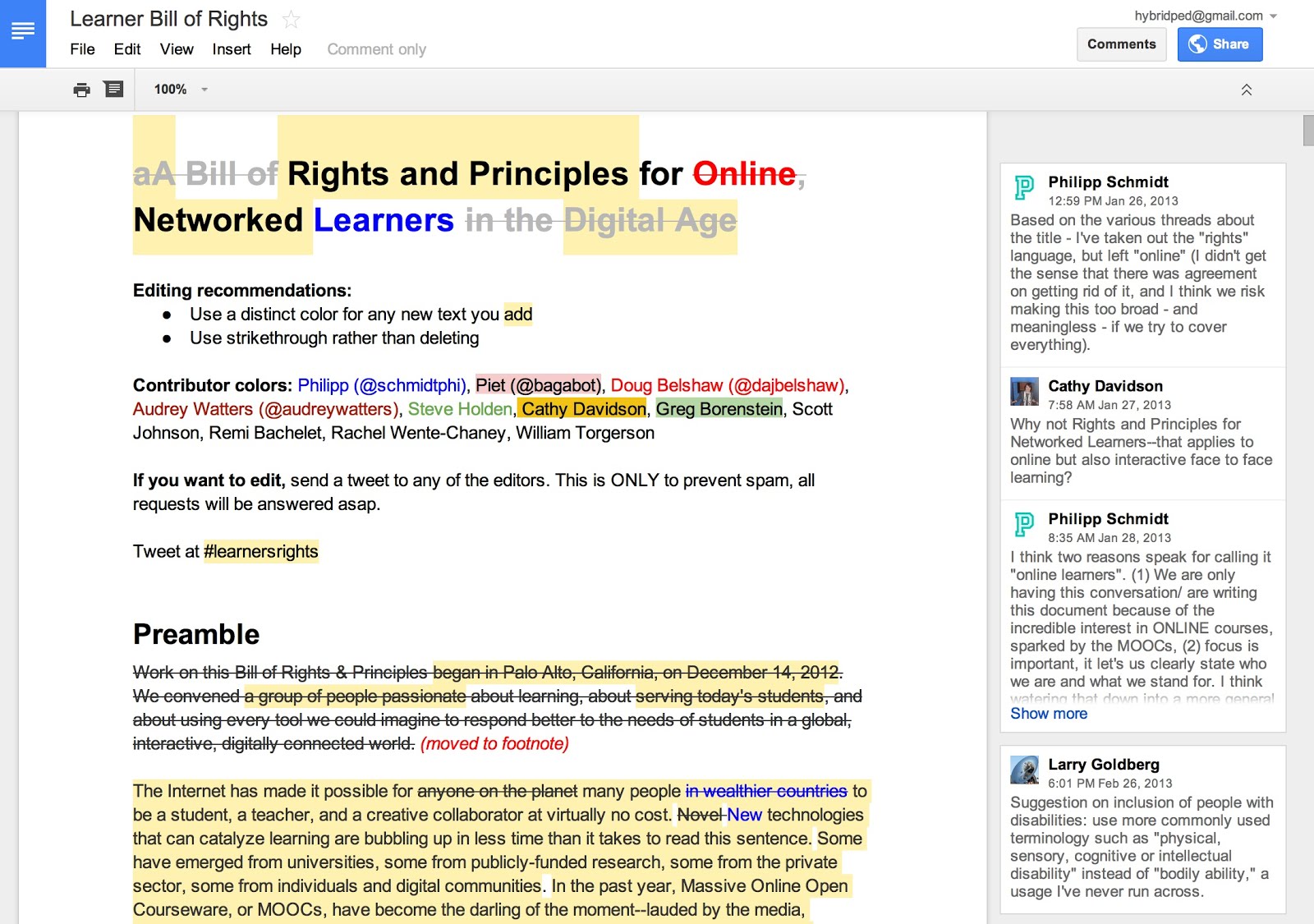
Sometimes, we will write in different colors just for fun to distinguish our voices. But we usually take that out as we polish the document.
Other examples of how you can use a Google Doc to work publicly and collaboratively:
Writing Buddy:
Partner with one other person and both use the same GoogleDoc to each work on a different project but so that your progress is witnessed and/or so you can get someone else to periodically review your work and comment on it, etc. (There are anxieties associated with writing in public in this way, so doing this work helps build trust.) Sometimes, Charlotte will work at the bottom of a Google Doc while I work at the top. This gives us some amount of privacy but the ability to “call each other” into our section of the document.
Public Peer-Review:
Write in a Google Doc and make it public for viewing and reviewing (you might allow people to comment but not rewrite the text itself). Offering up a piece of work to a specific group in this way is a great technique for obtaining instant peer review.
Example: Arts Future Book is one of Charlotte’s research projects and in this instance she wrote a paper and left it open to public peer-reviewing (using a blog rather than Google Docs though)
Sandbox:
Use one Google Doc for a large group as a sort of central repository for content.
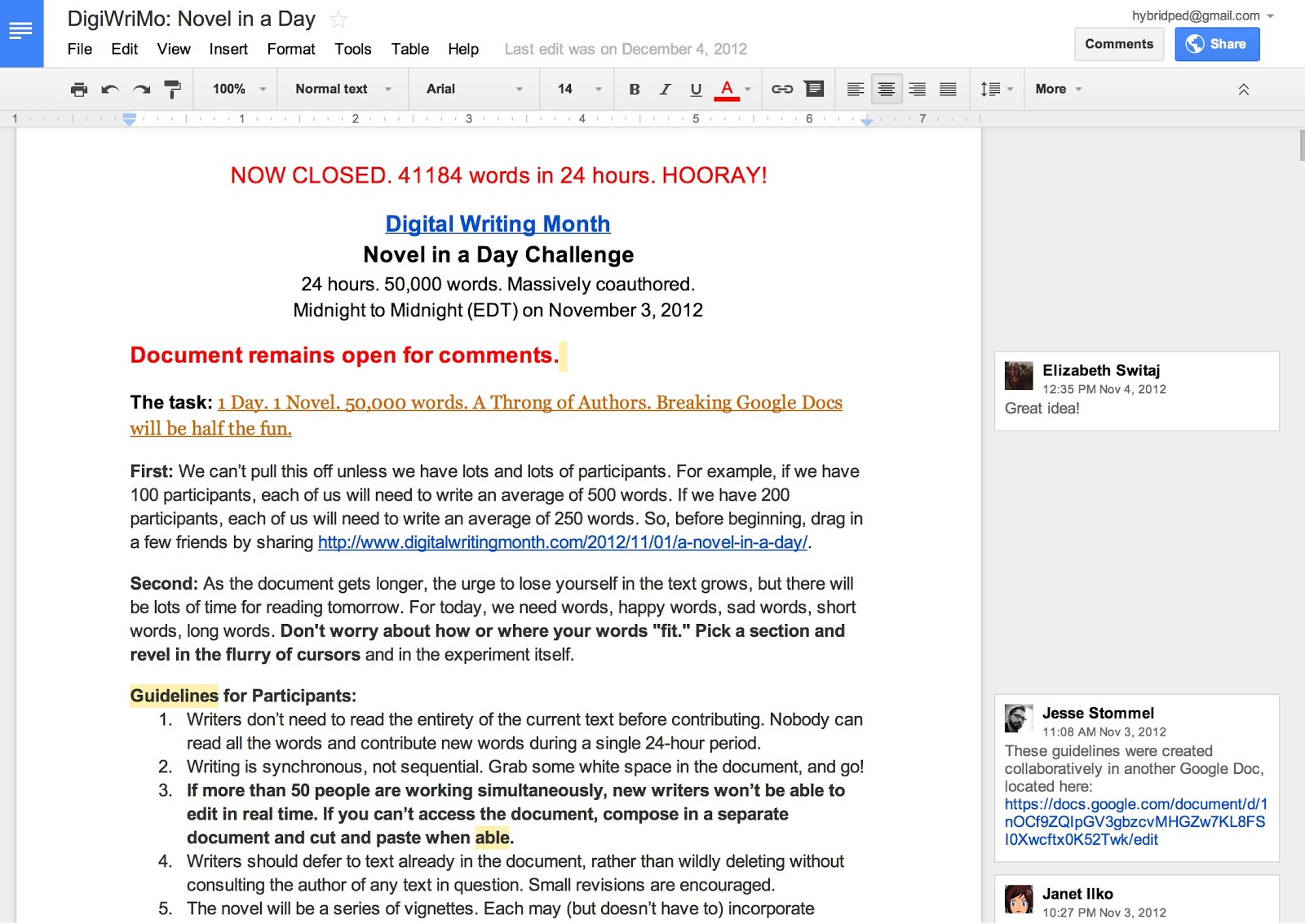
You can brainstorm in the same doc and share ideas. and shape it up into something later. An Extreme example:of this is DigiWriMoNovel in a Day (which had about 100 people working in one Google Doc.)
Collaborate:
Write collaboratively with one or more people. Take turns to draft sections of the doc (perhaps its an article you’re writing together) and use the comments to discuss each other’s sections and how to combine them better.
Take turns to draft sections but then work on the same paragraph at the same time to review, comment AND edit.
What Difficulties Do We Encounter When We Write Collaboratively?
Stage Fright: It will expose how many times you change a sentence before you finish it (or how many typos you make 😉 Charlotte likes to make typos, as do I. Luckily, we both find typos immensely charming.
Solution: If you see the other person writing at the speed of light you can lose your train of thought. Just carry on in your own way at your own pace until you feel comfortable. One of the most important things you can lean is that we all write differently and we have to find our own practice for ourselves.
Disagreements: It’s easy to get attached to your writing and hard sometimes to let someone else into your process. Occasionally, you will find yourself unable to share a common voice.
Solution: Decide in advance how you’ll resolve your writing issues with your writing partner. Agree to Skype, meet, or just agree to differ on what ever the issue is. Sometimes, you might decide that you want to write certain sections of a document independently, while continuing to collaborate on others.
Technical Problems: Technology can be temperamental. Occasionally, the gods of technology just don’t rule in our favor.
Solution: If you lose more than 15 mins to lost connections/Google Docs not refreshing it might best to just give up and work alone or on something else. But work out the next time you CAN meet and stick to it.
Ownership: Who owns this document? Who gets to decide its boundaries? When we work together in this way, who is the “author” of a document like this?
Solution: While we have both clearly been co-composing this particular example, what if one of us were writing and the other were primarily editing and offering feedback? If you set out to work on something together, even if one of your writes more of it, we think it’s probably best to just agree from the start that the work will be collaborative. This kind of work can’t be quantified in a cut and dry fashion. The production of one word is sometimes more difficult than the production of 10. Actual writing isn’t the only thing you bring to the table when you collaborate and we find that the balance of the work evens out in the end.
This Google Doc workshop was offered as part of the Improving Your Academic Writing workshop series Charlotte gave at the School of Creative Media, City University of Hong Kong as part of AcWriMo 2013.
Ellie Mackin is a third year PhD student in Classics at King’s College London, and is working through Wendy Belcher’s ‘Writing Your Journal Article in 12 Weeks’ while attempting to finish her thesis.
Half way! That’s right, things are finally starting to happen and my article is taking shape! This week was all about structure, and although I thought it was going to be a boring (albeit necessary) week, it actually turned out to be very interesting. The explanatory text for this week began with types of structure – what Belcher categorised as ‘micro’ and ‘macro’ structure. That is, the structure of your overall article and the structure within each paragraph. This started with five basic ‘organisational structures’: description, sequence, causation, problem/solution and comparison: I’m not sure what effect knowing this has had on my writing, but it certainly has made me a better reader this week, because I’ve been concentrating on identifying these structures within other texts I’ve been reading (and, in fact, I wonder if this whole process is not just making me a better writer but a better reader and researcher as well – I certainly notice things differently and read more carefully than I did before…). Belcher then goes though article structures, and I have to be honest, I didn’t read the ones aimed at Social Sciences (although perhaps I will go back and read them), but skipped straight though to the Humanities-themed structure. This is a very useful part of the book, and if you do nothing else then read though this section (Humanities is on pp. 180-182.). Not only does Belcher give the general structure but she gives an example of how the structure works in an actual article (it would be interesting to go though and read the article with the structure in hand and see how this works. I should have done this, probably, but I’ve been so busy this week as per usual). We then go though ways to solving structure problems, including prompts asking if you could use more subheadings or summary, if you use an appropriate structure, if you present your evidence properly, if your main argument appears in each paragraph and, if not, should you include it more, and whether you could develop your examples more successfully. The next main task is to outline a model article. I used an article I was about to read anyway, instead of the suggestion to read the model article that was identified in week one. I’m not sure if this was more or less successful than it could have been in the circumstances, but I got a lot out of the exercise, both in terms of what I got out of the article and being able to identify what worked and what didn’t in the model. Finally, before getting to your own article, Belcher asks you to outline your article using the examples outlined. And then, you guessed it, you have to implement the structure. This wouldn’t be a blog by me if there wasn’t at least one confession, so here it is: I am rubbish at editing. And this was no different. I struggled big time with this task, but I got there. My article needs a lot more revision, and the two days that Belcher put aside for this task weren’t enough for me, so I will have to take this though into the weekend as well. I have taken away some really valuable lessons from this week, and lessons that are more widely applicable than just for my article. I’m going to create a structure map of my thesis, as a whole and chapter by chapter, and see if I can improve it using Belcher’s system. All in all, an interesting and useful week! Hope AcWriMo is treating everyone well.
This is a guide by Charlotte Frost to the many different stages of producing a piece of academic writing. Often we lump all these stages together and get overwhelmed. Here you’re reminded there are at least 10 different stages to academic writing and that by treating each differently, you can break your writing into more manageable chunks. If you think we’ve missed a step or you have a different way of thinking about one of these 10 tasks then please tell us more in the comments section.
1. The mental preparation stage
Before you do anything, take 5-10 minutes to purge your mind. Write down everything that’s whirring around in your head from errands you have to run to things that are worrying you. It could take the form of a list, a scattered network of things or even a diary entry (why would so many people write diaries if it wasn’t so incredibly useful in making sense of your own head? And besides, therapists can be really expensive!) Sometimes we can’t see the wood for the trees, so sitting down and writing whatever comes to mind can be a good way of getting some of the distracting ideas out of your way. You might even turn up something useful for your work. But either way, empty your head of all these details before you start. You might also like to keep this page to hand while you’re working so you can continue to dump the distractions.
2. The note-taking stage
Never just read, never just take notes. Always make these as active and targeted as possible. I made my own summary cover sheet during my PhD without realising someone else had already devised a better one in the 1950s called the Cornell Note Taking System. There are 3 principles/parts of the Cornell note page. A large right-hand section for writing brief notes which you complete at the time of reading/listening. Two smaller sections to the left and to the bottom where you draw out the essential themes and questions of the piece and write a brief summary. There are even tools to create Cornell note page templates for yourself here and here.
4. The brainstorming stage
You might not need this stage. If you’ve got all your notes beautifully organised as per the Cornell and literature survey matrix techniques, all the arguments you want to make might be perfectly clear to you. It might be as simple as just taking each set of notes and fleshing them out. However, sometimes we get stuck or need to combine a lot of different ideas in one section. This might need a different approach. First brainstorm it. Give yourself five minutes and write down everything you can think of that relates to the topic at hand. Be as fast and as unfiltered as you can. Take no time to over-think any choice. Even if it seems random, put it down. And as long as you’re working on the same project, never destroy this early catchment area of ideas. Something that seems irrelevant for a long time can suddenly take on meaning later.
5. The mind mapping stage
Take your brainstorming and make a proper mind map with the ideas. This is the time when you organise the ideas and give them structure. The Thesis Whisperer uses a ‘spider diagram’ approach for mapping out ideas and has a worksheet to help you do this. Or there’s the Tony Buzan technique, which he claims is set out to mirror the way we think. For Buzan’s method, the key is that nothing by the central topic is enclosed in anyway, rather all ideas are written along the sides of each connecting line. This way, he says, everything has the potential to connect to something else. Really the main difference is that you can get more on a Buzan map, which is great for really complicated/intricate ideas or ideas you’ll want to add to as you go along. I’ve kept Buzan-style maps for topics and added over several months to keep an overview in once place.
6. The ‘Tiny Text’ stage
The Thesis Whisperer suggests that once you’re through researching and brainstorming, you write a ‘tiny text’. This is like a conference abstract that will give you the structure for the work you’re about to produce. I’ve combined several approaches to this and come up with a 7 part template. As soon as you’re ready to work on your paper/chapter/section, run it through this system writing just a sentence for each point.
Focus: Broadly important fact or relevant story (In….)
Literature: What has been said already? (It is argued that…)
Gap: What hasn’t been said already? (However….)
Urgency: Why is it important right now? (Without….)
Question: What needs to be asked? (This research asks…)
Methods: How (By analysing…)
Implications: What practical or philosophical impact will this have? (This research shows…)
Credit: Gerald Graff, Barbara Kamler and Pat Thomson, Karen Kelsky, Inger Mewburn
7. The splurge/spew stage
Open up a document and if you’ve collected lots of organised notes, copy and paste/type them into the document. Now write up all the connecting sections as fast as you can. Or, if you’re working without these prepared notes, just write as much of the argument as you can in one session. If you do it the second way round (without the organised notes) use [insert here] to leave yourself clear markers for the material that will need adding such as summaries of other texts, quotes or examples. (But either way, use the ‘tiny text’ as a structure to keep yourself on course and be quick about it).
or rather the thinking writing stage
This is the stage where you are using your writing to tell you what you’ve got. You aren’t ready to show those ideas to the world yet, instead, you’re going to think them through in words on a page. For many of us, it is only at this point that the actual ideas come out. You might know you want to connect so-and-so’s theory with such-and-such but it might not be until you try to do this in words that you see just what the implications of that connection are. The point is that this is the stage of writing where you make it work for you, you use the act of writing to think through your ideas.
or even the keep it pacey
If possible, you do it fast because you’ll see much sooner if you’ve got enough of an idea/argument. If you can do this rough draft in one sitting, you’ll know straight away if you can make this point/write this section with the research you’ve already done, or if it’s too thin and you need to read/think some more. But (as I’m about to say) don’t over-think this part, it’s about getting words and ideas down in what ever form they take.
and certainly it’s the uncritical stage
Indeed, this is also the uncritical stage. When trying to think-write and/or rough-draft, you just want to get ideas down and nothing more. Even if you can write a pretty solid draft at this stage (thanks to being well read/prepared) you want to just write it up and leave it alone – don’t even think about editing at this point. This is not the time for that! In her book from the 1930s, Becoming a Writer, Dorothea Brande described it as the stage of writing where you turn off your inner critic and let your thoughts run free. And she suggests that to make sure you don’t criticise your work, you shouldn’t read any of it back at this point. She urges you write your words and walk away. Tools for plain writing that can help with the uncritical, fast, splurgey stage of writing include: 750 Words; WriteRoom:DarkRoom.
8. The ‘doing writing’ stage/the draft
Another way to think about what happens after the ‘thinking writing’ is the doing writing. You’ve got your ideas down, you’ve read them through, there does seem to be a substantial argument to make and enough material to do it with. Now you turn your writing around. You’re not using the act of writing to think, you’re using it to do (to show, demonstrate, argue – fight, even). Look at each sentence and convert it from a thought or rough idea, to a statement that presents that idea clearly to others.
which might also be the therapy stage
I wrote a blog post for AcWriMo and PhD2published in 2012 on using 750Words as a writing therapist. Basically, when I get to a certain point, or when I get stuck, I use an empty doc/writing app to ask myself questions about what I’m doing and whether I’m achieving it. I literally ask myself: what’s the problem with this section? And then, as I answer myself, I find – and write my way out of – the issue. In the example I used for the blog post, I’d lost track of why I was trying to summarise ideas about new materialism. By the time I’d asked myself a set of questions about this, I’d found what I was stuck on AND I’d written about it and much of what I’d written turned out to be perfectly useable in the actual draft. Your supervisor can’t talk you out of every confusion so you need to learn to do it yourself.
9. The critical stage
If you follow Brande then at the very earliest, the next day is the first point at which you can turn your critical voice back on. This is when the editing begins and you’re invited to need to release your inner critic. If you’ve got a lot of writing done, preferably without over-thinking it, you now ask questions of that work and begin to shape the material into something more coherent. Let your critical side be a bit brutal, chopping irrelevant parts, making substitutions and forming better alliances between sections.
10 The darling-i-cide stage
‘Killing your darlings’ is the name given to the brutal part of editing when you take out the parts you love but which are clearly not contributing anything to the argument (a ‘darling’ is often an overly wordy or self-indulgent sentence/paragraph). In fiction this might even mean taking out an entire character, or some elegant phrases that don’t move the story forwards. In academic writing it’s probably a tangent or an idea that fascinates you but distorts the argument at hand.
or rather, darling exile…
There are two ways to make this easier on yourself.
1.Use strikethrough. That way you can read the document without these parts and confirm in your own mind that they do have to go before you actually delete them.
2.Don’t delete them at all, just banish them to another location. Start a document, note or folder for all the bits you take out. Trust me, for every thesis there’s a huge archive of unused material that means a great deal to the thesis writer (perhaps it even contains the nugget of an idea they started with). But you have to be tough. What your thesis needs to do is make a point and make it clearly. The best way to help yourself achieve that end goal is to remove anything that will get in the way of clarity.
Melanie Boeckmann, M.A. works as Research Fellow at the University of Bremen and pursues a PhD in Public Health at the Leibniz Institute for Prevention Research and Epidemiology – BIPS in Germany. You can find her on twitter @m_boeckmann.
Sometimes, you are just really really lucky. You get funding to go to an international conference, you network and all of a sudden you and a colleague (or several colleagues even) email about this great idea you have for a project. Yes, you think, we should write this article together. The caveat: You are at your institution, and your colleague is on a different continent in an inconveniently shifted time zone. The only solution: collaborating online.
Research thrives from exchange. So does writing: thinking and writing both profit from telling somebody about your thoughts, to receive input or (constructive!) criticism. In addition, collaborative work can lead to research that is beyond your original field of expertise, or in a subfield, and just in general allows you to broaden your horizon. Collaborative writing, then, is work requiring a tool box rather than a single tool.
Whether you are toying with the idea of suggesting a joint project to the colleagues you met at that (inter-)national conference, or are a pro at juggling time zones and document versions, here’s how a colleague and I successfully cooperated on an article that we are submitting:
1. Set a realistic goal
Ideally, we wanted to pump out a bunch of articles and apply for a huge grant. And we can, eventually. But the first step was to identify one area that interested us both, and to formulate a specific research question that we could actually achieve in one year.
2. Divide the tasks
Especially with interdisciplinary collaboration, one or several persons will be experts at different topics or methods. This way the splitting up tasks is fairly straightforward. If you are all from similar fields, maybe you can negotiate the sections and chores you are most interested in? And everybody should contribute to the tedious tasks, too!
3. Use interactive platforms
Options include mailing each other the documents, syncing devices like Dropbox or Spideroak, working on a google document together, or sharing the writing through other tools like github. The Profhacker blog over at the Chronicle of Higher Education usually has great introductory posts to software and tools such as these.
4. Version control
Sometimes you send something and you wait for feedback, but then you also have a great idea and you change some sections around in the document. Of course you can just send the document again with track changes and hope the other persons have not added many changes themselves yet. Nicer would it be to have everyone work on the same document without danger of erasing what the other person has just written. This works with google docs, but for the next project I hope to learn how to use github, because I hear their version control is excellent: one worry less!
5. Keep in touch!
I found this to be one of the most important aspects of our collaboration. Obviously don’t over-do it, but checking in once in a while, especially if you don’t have fixed deadlines, is helpful.
What about you? Do you have any online collaboration success stories to tell?
Coming up soon, Charlotte Frost and Jesse Stommel will show you how they work together using collaborative tools across continents and time zones!
Ellie Mackin is a third year PhD student in Classics at King’s College London, and is working though Wendy Belcher’s ‘Writing Your Journal Article in 12 Weeks’ while attempting to finish her thesis.
I can’t believe I’m almost half way through the programme now, and my article is starting to take shape and I am starting to feel good about writing – both the article and more generally, which is lovely.
This week has been crazy. I ended the week pretty close to having a full first draft of my PhD, which I’m hoping to submit in two weeks. Some parts are a lot closer than others but it’s coming together and I’m feeling confident about it. As a result I was glad that this week’s tasks had a lot of reading components, because I knew I wouldn’t want to do too much writing other than my thesis. That’s also why this post is a little bit late.
This week started with a pep-talk that I really needed, the gist of which is DON’T FEEL GUILTY! Don’t feel guilty if you’re not working as much or as hard as you ‘think’ you should be working, because that guilt makes it even harder to get going. In that vein I’m going to share with you my answer to Belcher’s request this week to write something positive about your own writing: ‘My prose is improving, my editing is improving, my ability is improving. I’m not there yet, but writing is not as scary as it used to be.’ Okay, so not the overwhelmingly positive gush that it could be, but considering how I felt about writing in the week one tasks, I think I’m made some pretty significant improvements.
This week I went through revising the relevant literature, by first learning about the types of literature that there are: original (or primary, of which I have a fair amount!), derivative (or tertiary sources, or ‘classroom’ articles, encyclopaedias, etc. – should not be used!), contextual (for background information on the context of your topic), methodological, theoretical (both, I think, self-explanatory), and related literature (that is, scholarly work that is directly related to your topic.) Belcher then goes into how to read two specific types of literature: theoretical and related. Honestly, I wish I’d read the section on reading theoretical literature six years ago before I started my undergraduate thesis. My life would have been a whole lot easier then and now. One tip in particular, which I’m sure many students (and scholars) feel inadequate when and if they do it, is using reference books. I know this from first-hand experience of reading Kant and needing not only a book to explain the book, but a book to explain the language used in the book explaining the book! An interesting suggestion from Belcher is to read biographies of the theoreticians, which I had never considered but is actually a great idea!
Belcher moves on to how to read related literature and this is a much longer section, understandably. Belcher suggests that you limit your reading. This goes against what we’re always told, and what many scholars feel they need to do, but it does make sense. She suggests several ways of limiting research, and states that your article doesn’t need to be the comprehensive last-word on your topic. Next she talks about finding your way into the scholarship and how to start the conversation – the analogy here is that you wouldn’t walk into a party and just start talking about yourself, you need to engage first. I found a lot of this stuff common sense, but it’s always a good thing to revise (in fact, that’s a pretty good way to describe this whole week, particularly the section on avoiding plagiarism, which is always good to remind yourself of!).
For the first time in this process, I found the tasks to be a little bit tedious. I understand the point of going through citations, but seeing as I started with a piece of writing that was fairly comprehensive anyway I found it a bit over the top. One of the tasks (‘Identifying and reading the related literature’) was something I’d done pretty recently, and I am the kind of person/researcher that adds in new information and references as I find them, so my article is fairly up to date. Finally, I am not the sort of reader that appreciates an extensive literature review in an article (certainly some literature review is good, but too much just eats into the article’s own argument) and so I found the drafting of a literature review that I probably wouldn’t use most of a bit over the top.
The week certainly made me think about some things that it’s good to review, but so far this was, I think, the least successful week. Perhaps if I didn’t have so many other things going on I would have appreciated it more.
Here are Charlotte Frost’s top 10 tips on how to form good writing habits.
1. Have a schedule
If you try and tag writing on at the end of the day when all tasks are done, there’ll never be any writing time. It just won’t happen. So make sure it’s part of your schedule every day.Try and carve out a block of writing time every single day. Plan for it ahead of time by blocking it out in your diary/calendar. Even setting aside 25 minutes of uninterrupted writing time can make a huge difference if you focus for that time. And to be honest, starting small is often best. Add small chunks of writing time to your schedule and build up once you get in the habit.
2. Make a habit of it
OK, so you’ve learned to plan the time and sit down and work. Now you just keep doing that over the next few weeks. These don’t have to be long torturous sessions, it’s best to keep them brief and productive. But keep them going. You’ll peak and trough during that time of course. There’ll be some days when the time flies by and you finish with extreme satisfaction at having written well. Other times even though you’ve only got 25 minutes to write something, it’ll seem like forever. You’ll have trouble formulating ideas and words won’t flow. Well guess what?
A) That was still productive time because even if the words aren’t there, the thinking has been done and
B) you stuck to a routine. And that’s the really important part!!!
If you carried on regardless of the difficulties, it means it’ll be all the easier to sit down tomorrow and get more work done. Try to keep this daily writing routine no matter what else is going on. So, even if you’re traveling, consider setting aside just a small amount of time to do some writing, even if you’re just pecking letters into the notes app on your smartphone. Writing sessions are like rabbits – they breed like crazy. If you put two together, you’ll get a third and fourth and before you know it, there’ll be a whole line of cute furry writing sessions behind you and, look what’s in front of you, a finished piece of work – and that’s even cuter!
3. Plan
Never sit down to write without knowing ahead of time what you’re sitting down to write! Many people believe that writer’s block and or procrastination come from an empty or muddled mind. Even if you’ve set aside some writing time, shut down all distractions, and approached your desk rested and coffeed up, you might still stare at a blank screen for the next 5 hours if you don’t know what it is you’re supposed to be writing. Firstly you can help this by making sure you’re well prepared. It can help to schedule reading time in advance of writing time. Some people find that they write best in the morning and read well in the afternoon. If this is the case, when you have your afternoon reading session, end it by making a brief plan of what you’ll write up the next day. But whatever happens, make sure you keep an up-to-date plan of what needs writing next. If you’re working on a literature review, list the books and amount of writing time you’ll allocate to each and tick them off. If you’re working on another section, divide it up and again allocate portions of time for each.
4. Have a back up plan
Sometimes with the best will in the world you can’t quite wrap your head round your work. Even the worst writing session can pay off if it means you’ve somehow (even without quite realising it) thought something through. You might not have many words on a page to show for it but they’ll fall out of your fingers next time you write. However, if you really think you’re being unproductive or you think it’ll break your writing spirit to sit another minute without having achieved something tangible, go to your back-up list of tasks. This is a list you’ll make of things that always need doing. This might mean doing some research, editing a section, checking footnotes…Have this back up list so you never lose momentum. Although you should only use it when you really need to feel productive, otherwise this will become your procrastination weapon of choice.
5. Limit desk time
As the mighty ‘Thesis Whisperer’ Inger Mewburn says, the less time you have at your desk the more productive you’ll be when you are there. Don’t do all your socialising and online shopping at your desk and then try to work from it too, all you’ll feel is that you’ve been at your desk for hours. Try to use another tool or location for your online life (a tablet, a smartphone) and keep your desk as ‘pure’ as possible. If you have to use the one machine/location for all, absolutely don’t do it in the same sitting. Make sitting down to work a ‘fresh’ thing to do.
6. Limit hours
Even if you can write all day, you can’t be productive all day, so think about how much of that time has been wasted on words you won’t use. Limit the amount of time you work to manageable chunks. Again, it’s the Thesis Whisper who reminds us to be mindful of the 2 hr rule – that you only have about 2 productive working hours in you per day. She urges you to get them out straight away. So sit down to write, and write more or less for 2 hours. That said, it’s also a good idea to keep to brief time slots and refresh yourself in between.
One of the best methods for this is the Pomodoro Technique. The Pomodoro Technique is a productivity method that applies to almost any task. You take a timer (the technique is named after the iconic tomato-shaped kitchen timers), set it for 20 minutes and go full throttle. Stop for five to visit the toilet and get refreshments. This 25 minute slot is called a ‘pomodoro’. If you try to divide your working hours into these tomato-timed units you’ll stay refreshed and productive throughout. And now here’s the thing. When you’re done for the day, you’re done. Walk away. Even if – actually especially if – you’ve reached a thorny subject. Leave it! Even if – actually, especially if – you’ve hit your stride. Make notes for the next day and, leave it! Don’t over do it or burn out because it’ll take its toll in another writing session and erode the habit you’re building.
Apps for timing and counting your progress include:
Maybe writing in time slots doesn’t work for you. Perhaps the timer goes off just as you get going. Try instead to set word-count-based targets for yourself. But be kind! Some people can dash off a thousand words in an hour and will go back and edit it later. Other people plan each word on the page and might take an hour to hit 50 words. First, notice which way your write. Then test yourself over a week or so. Record how many words you’ve written at the end of each day, average it and there’s your word count for each day of the next week. Record your results and decide if you need to drop your target word-count to make it easier to achieve or if you can put it up a bit to stretch yourself. Just don’t push too far. Try to stay within the realms of the realistic or you’ll break your writing spirit.
8. Just do it!
If you schedule writing time and sit down ready to write (even if you been doing urgent work email for the last hour, get up, get a quick break and signal your good intentions by sitting down refreshed for this important new task) you must now write. This sounds so easy in theory and it’s so much harder in reality, but block out those nagging thoughts of failure and don’t you dare touch that browser address bar. Remind yourself you’ve only got to get 25 minutes of work done and just do it. Get up, get a coffee. Sit down and do it again. If you force yourself to stick to this simple act of just starting (and remember, starting anywhere is fine) you’ll soon find you can get work done and – crazy as it may sound – repeatedly get work done without much stress.
9. Write anything
Writing regularly is the key. It almost doesn’t matter what you’re writing because regular writing will improve your communication skills in all areas of your work and ward off that dreaded writer’s block. And let’s face it, there’s always writing to be done in academia, whether it’s your thesis, or a paper, or a blog post, a lesson plan or conference abstract. If tackling your thesis is too much to begin with, use your allotted writing time/space to work on anything that needs to be written. Every bit of writing we do helps hone our craft. But as soon as you start to nail your writing habit, phase in some project writing. Perhaps alternate to start with going backwards and forwards between two pieces of work.
10 . Remember that routine?
The single most important slayer of procrastination is having a routine and sticking to it. OK so we’ve all sat down to work, let our minds wander and ended up 2hrs/40 cat videos later feeling like we’re worthless academic failures. Maybe that’s going to happen now again. But if you set aside productive time, and keep it that way, the cat video might never come to call. Keeping to set times and not focusing on one task for too long helps you to make sure you are productive (and then who cares what you do with the rest of your time. Although, ever noticed how a successful writing session kills any desire to search for cat videos?) In fact, have you ever noticed how being productive in one area propels you forwards into being productive in another area. You might find a great writing sessions ends with a bunch of errands run in record time and an evening or a weekend doing something truly fulling.
Find some new music. If there’s one space of disagreement among preferences for the writing environment, music and background noise might top the list. A friend who grew up in a noisy household takes her laptop to a bowling alley. Another insists on getting as close to silence as possible. Still another puts on Spanish-language television, even though he’s rather monolingual. The dialogue stops the mind wandering and provides a rhythm without distraction. A few other options: very familiar music you listen to all the time can be evocative (in the days of audiocassettes, I had a mix tape that I named “sanctity songs”). Consider classical, jazz, or electronic music. No lyrics, less distraction. Folk, country, or opera may also suit you. See where the music might take you. A variety of wind chime apps are also available for iPhone or Android. If you prefer, noise cancelling headphones are also widely available.
Ellie Mackin is a third year PhD student in Classics at King’s College London, and is working though Wendy Belcher’s ‘Writing Your Journal Article in 12 Weeks’ while attempting to finish her thesis.
It seems habit that I start each blog with a confession now, although this confession is the exact opposite to the one I made last week. I am writing. A lot. It is #AcWriMo after all!
I am just not doing a lot of writing on my article. Probably lucky that this week was all about choosing an journal to submit to, so I am still mostly on track with my article. There is a good lesson to be learnt here about not letting setbacks set you back. What I mean is that you can take a small setback and let it become a big one by taking on an attitude of ‘well, I’ve already slipped this week so I may as well not do x, y, z either!’ Or, you can just take it in your stride, ‘I didn’t do a, but I can still do b and c.’ This is one of the things I’m finding nice about Belcher’s book: it is set up into easily manageable sized chunks of work each week, so it’s easy get back on track.
This week, as I said earlier, was all about picking a journal, and therefore the front pages of the week are packed full of information about different types of journals. Belcher breaks the section up into ‘Nonrecommended Publishing Outlets,’ which includes newspapers, trade publications, and conference proceedings, ‘Questionable Publishing Outlets,’ which includes non-peer reviewed journals, graduate, note, review and local journals and – surprisingly to me – chapters in edited volumes and electronic journals (though I assume that the field of electronic journals has changed significantly even since 2009, but I’ll still heed the advice for now!). Finally, ‘Preferred Publishing Outlets’ including regional, newer, field, interdisciplinary and disciplinary journals. Belcher asks you to identify one journal from each of these categories that might be suitable for your article, and I admit I struggled to come up with an interdisciplinary journal so I just left that blank.
The next task is to properly identify some journals that your article might be suitable for, just by searching. By asking colleagues and advisors/supervisors, the ‘old fashioned’ self search, journals that your article cites from, and electronic databases. Belcher gives some really good information about electronic searching, and a bunch of tips that will make the job a lot easier. Tips include varying search words, and searching for not just the topic of your paper but your methodological approach, or theory, or broad discipline keywords. The next day’s task is all about evaluating the journals you’ve uncovered during this searching process, and Belcher gives a great many criteria to think about when evaluating journals – she suggests spending ‘an hour’ (although I found it too longer than this) and that you look at print versions of the journals in question (which I did) rather than looking online for the information. The criteria include things like being peer-reviewed, reputable, from her recommended publishing outlet list, if the copy editing is good quality (that is, that the journal is not filled with typos and design problems), if it is timely in production, the journal size and number of articles published, how long it might take for an article to be published from acceptance, whether it is indexed online and who reads it. As you can see, this is quite a long list of things to look into, and some are as easy as flipping though a few issues to see for yourself and skim reading an article or two. When you have a list of half a dozen journals to look though, though, this process can take more time that Belcher has allowed you for the task, particularly when you take into account some of the things which are harder to find out on site – like how long it might take to publish an accepted article or how rigorous the peer-review process is – just something to keep in mind as you come up to this particular task. There is a handy form that you can use that will ensure that you don’t miss anything when searching, and that you can use for easy comparison between the journals.
Finally for this task you’re asked to review the forms and pick a journal – or several suitable journals in a ranked list! Then, the easy (and fun, I think!) part: read the journals. Belcher asks you to read though a few of the journal articles in a couple of recent editions of the journal(s) you’ve chosen. Take note, this exercise is not just about reading the articles you like but about scoping out what the journal is like (and perhaps finding a relevant article or two to cite in your own article). This is so you can really look at the direction of the journal, see whether your article can fill a gap in their recent issues, whether there is a trend to the topics and whether any of the recently published articles cover similar ground to your article – her general rule of thumb is that if it’s been done in the last three years the journal might not want to revisit the topic again so soon, unless your article is significantly different. Blecher almost tacks on the end to also look at the length of notes and bibliography, but I personally found this to be one of the most interesting differences in the journals I looked at – some had long, explanatory notes and some were just simple references, likewise some had many pages of bibliography and others had much shorter bibliographies – what I got from this little section is that you want your article to fit in to the overall feel of the journal, and I think this could make a difference to the place I choose to submit to.
Now – to return to the start of my post and my neglect. I confess: I haven’t done the day 5 task. I ran out of time because I was writing thesis-work. I am going to do this over the weekend and will put it in the next blog post, but I’ll run though briefly what the task is.
The task is to write a query letter to the editor(s) of your chosen journal(s). Belcher covers what you should ask editors, and gives a few sample letters, before running though what this kind of letter can do for you.
I’ll report more about that next week, until then – Happy AcWriMo everyone!
This is a guide by Charlotte Frost to setting up a regular communal writing session. The focus here is on the type of group that meets primarily to write with company, get support, and hold themselves accountable. If you run other types of writing group – where you offer feedback or target different writing tasks – please tell us more in the comments section.
Time
To run a regular writing group you need to start by arranging at least one set time a week that a group of you can all meet, at a designated location, for about 2 hours. Usually it takes a least 2 hours for a writing session to be productive. Using a Doodle Poll can help you narrow down your time-slot options.
Location
To begin with, make sure you have a regular location so people can get into a routine. Consider in advance if there is a kitchen close-by where participants can store and prepare refreshments and also whether the space you have chose permits the consumption of food and drink. You might also consider the availability of power points and how the room is set up – for example can you all sit together or will you be distributed around a busy library? If the latter, you might find your writing group doesn’t really feel like a group and the support and accountability working together can provide will be diminished.
Refreshments
You should also get everyone to agree to rotate who brings refreshments or each contribute to a refreshment kitty. If you have a kitchen nearby tea and coffee runs will be easy. We all have writing rituals and having the right hot drink often features heavily in these so don’t miss this part out. And remember that the odd indulgent cake doesn’t go a miss when you’re struggling with a section of writing.
Format
To build a format for the session, it’s worth beginning each week with everyone taking just a couple of minutes to each publicly identify the following:
What the ongoing project is.
What you have achieved since the last session.
What will be achieved during this writing session.
What is proving problematic (this can range from theory you’re struggling to understand to getting your citations in a tangle, just say what’s bothering you.)
When everyone has announced their goals and issues, agree to work for an hour without interruption. If people wish to eat or drink during this time, they must agree to keep noise and disruption to a minimum. After the hour is up, everyone is given 15 minutes to get something to eat or drink, to chat, visit bathrooms and generally refresh themselves.Agree to work for the remaining time (if in a 2 hour session) or for the next hour and then take a break again. You might even consider buying a timer so that everyone can see (and hear) where you’re all at in the session. It could even be a Pomodoro timer and you could run your group in 25 minute sessions. If you do do this, remember that, initially, some people might struggle to get the hang of working in such short blocks.
Routine
Its really important to make writing group meetings habitual. Encourage all participants to be consistent and attend every session. Help them see you must all take joint responsibility for making the group work. Of course sometimes there’ll be a schedule conflict or an emergency, but try making playful punishments up for no-shows – like they owe everyone a cookie or some proof reading next session.
Ground Rules
At the start of the session remind everyone to turn off/silence their mobile phones and to bring headphones if they want to listen to music. Let people know upfront that they are allowed to leave the session at any time, but they are not permitted to make or recieve calls and if they are working in pomodoros to take their 5 minute breaks very quietly and wait for the whole group to break before making too much noise.
Mix It Up
Location. Although it’s useful to have a set location, if everyone can make it, why not try a new venue every once in a while. How about all meeting in a coffee shop or at someone’s house. Different locations can refresh your thinking.
Games. Get everyone to write a writing task on a piece of paper (these might include footnotes, editing, introduction, conclusion…). Fold up all the task papers and put them in hat/cup/jar. At half time, invite everyone to take a task out, announce it, and commit to working on that for the rest of the session.
Themes. Sometimes you might like to dedicate a writing session to a particular issue or project type. If you’re doing your PhD how about a literature review session. If you are early career academics why not have a session where you all work on job applications together. If you do a themed session, be sure to leave some time to discuss the issues you faced.
Procrastination jar (as devised by Dimitrina Kaneva). Tell everyone that each time they get distracted they must write down what distracted them on a piece of paper, fold it up and put it in a hat/cup/jar. At the end of the session, pass the receptacle around and get everyone to read out at least one distraction. This provides light relief but it can also help you stay focused next time as you’ll have had a public reminder of what gets in your way.
Free-write/brain-dump. All take 10 minutes at the start of the session and write down everything you can think of that relates to your writing project. Just get it all out onto paper or into a Word document (or similar) and don’t you dare think structurally or critically. This will clear your mind and give you a number of places – literally listed on a piece of paper/screen – to start.
Readers
If your group is willing, you might all agree to become a test audience for each other’s work. You might dedicate a writing session to giving each other feedback on previously circulated material. Or you might all agree to offer feedback on any drafts emailed to the group. However, if doing this, set some ground rules. Perhaps everyone is only permitted to share one draft per writing project and only with a long lead time.
Small Scale
If you can’t assemble a whole group of other writers to meet and write with you, find just one. Buddy-up with another writer and try and work together using the same principles described above. And when you can’t write together, make a point of checking in with each other to listen to problems and progress. Your email/call to check on your writing buddy might mean the difference between them finishing a draft this month or next.
Virtual
And if you can’t write as part of a group in a physical location, use the #acwri (#acwrimo during November) tag to keep in touch with other writers virtually.
Stand your ground. Standing desks are increasingly popular: sitting is bad for the body, causing achy muscles and back strain. You don’t need to invest in a standing desk immediately: most kitchen counters are at a reasonable height for the kind of work you might do in writing, typing, and reading (along with the chopping and stirring for which they are designed). Standing also gives you an actual new perspective on your work and might yield that different angle you’ve struggled to find. Also music is very important!
Ellie Mackin is a third year PhD student in Classics at King’s College London, and is working though Wendy Belcher’s ‘Writing Your Journal Article in 12 Weeks’ while attempting to finish her thesis.
I need to start with a confession today: I am still not writing every day. I used to be in the habit – and writing is a habit, and that’s reinforced time and again in Belcher’s book – but lately I’ve been so overwhelmed by the task of writing that I still struggle. I certainly didn’t get enough done last week, which I was feeling terrible about but as soon as I opened the Week Three chapter I felt better:
If you didn’t get as much writing done last week as you hoped, join the club. Very few scholars ever feel that they have done enough.
Yep. That’s me. I never feel as though I’ve done anywhere near enough, and I bet many of you feel the same. In the first exercise of this week I was asked to reflect on what I’d learned from the previous week. I wrote: ‘I am still intimidated by writing.’ But, as Belcher very clearly states, the goal is not perfection but productivity, and as long as I keep being productive then I’m going okay. I hope.
This week started with a long explanation about types of articles that get rejected, with some concrete points. At the end of each section (which are things like ‘too narrow’ and ‘not scholarly’) you’re asked to reflect on your own article and see how you might address any or all of the problem points raised in the section. I found this really helpful, not because my article was a lot of one category or another, but because I could see that there were a small number of things from each category that I could improve my article by addressing. The main part of this section is about articles having no argument – which leads on to the week’s main exercises.
Day two starts with exercises on finding out what your article actually is about, i.e. what’s the argument and what’s the evidence. After you’ve identified your main argument (and this is a straightforward ‘In this article, I argue that…’ type of construction, so nothing super fancy but still very useful) and written down a short list of the evidence you’ve collated to prove your argument, Belcher asks you to go back to your abstract and revise it, in light of what you’ve written about your argument.
And then, as seems to be a theme here, you’ve got to share it again, this time with three different people (I confess I only shared mine with two…) and ask them to pick out what they see as the argument.
Well, this exercise did a lot for my abstract but not much for my writing confidence! My argument was more or less picked out by both and after a second revision (which I just did, it’s not in the book) it was significantly easier to spot.
(As a side note, and some proof of this book’s wide range, I’m about to start writing the conclusion of my PhD thesis – I’m going to modify the exercises from this week and put each of my chapters though the ringer, as it were, and use the ‘abstract’ created to draft my conclusion.)
Now, the task is to try and put that argument into your article, so the week ended with writing a list of revision tasks for each section of the article (that is ‘introduction’ ‘body’ ‘conclusion’ but also with headings ‘early’ and ‘evidence’) and then spending the last two days of the week revising the article, with these points and your (by now very clearly set) argument in mind.
I think my article is coming on – I feel that I’m making progress after this week, although my prose is still a point of contention (in my own mind, that is). I definitely feel that I’ve got a better base to start working from now, though.
All in all, a very good week (but not as much writing as I’d have liked) and my article is certainly coming along. This coming week is all about journal selection, and I wonder how my idea of appropriate journals will change after this!
Looking askew and anew at the writing process for tweaks and inspiration.
Let the committee in your head cheer you on. Whether it’s your thesis committee, journal editors, or collaborators, we can let ourselves be intimidated by the people who will judge our work. Imagine instead that they are there to support you, because indeed they are.
I never thought I’d say this, but I have something in common with Cinderella. Not the puffy dress, or the glass shoes. Just that before 12 o’clock is when the magic happens. Obviously my 12 o’clock is noon, and hers was midnight, but let’s not dwell on details.
I’m going to suggest that you have a period of the day when the magic happens and that you need to figure out when it is and make sure you make the best of it. A bit like Cinderella did. Because all time isn’t equal. For Cinderella, everything after 12 o’clock wasn’t worth much – certainly not as much as time before 12 o’clock. Similarly, everyone has times when the work comes easily and times when work is a euphemism for having a word document open behind facebook. Identifying when the valuable time is, so that it isn’t squandered, is really important.
For me the most valuable time is 9 in the morning till midday. I’ve properly woken up and I haven’t yet gotten distracted by lunch. But maybe yours is 7pm till 10, or 2pm till 6pm. When are you at your best? When is it easiest to stay focused?
I’ve learnt recently that if something has to be done, it needs to be done in that magic time. Therefore writing goes into that slot. Not
browsing the internet. Not faux work activities either (emails, conference schedule planning, marking etc.). Only things that are
research and need focus. Why not try for a few days only putting in your magic time things that directly contribute to you publishing a paper or completing the thesis?
The great thing is that this is a quick way to prioritise your day. Figure out when your most productive bit of the day is, then put the
most key thing you need to do in a day in it. Simple. The dregs, emails and lost shoes will still be there when you’re done with the
important things.
Ellie Mackin is a third year PhD student in Classics at King’s College London, and is working though Wendy Belcher’s ‘Writing Your Journal Article in 12 Weeks’ while attempting to finish her thesis.
After feeling great about finishing Week One and ready to overcome all of my writing demons, I struck a problem. Writer’s block. My thesis wasn’t going anywhere, my article wasn’t going anywhere, even my personal blog wasn’t going anywhere. But this will (I hope) highlight one of the great things about this book. The first day of Week Two I didn’t do the proscribed task (that’s why I’m now a day behind), but I went back and re-read the section on overcoming writing obstacles, I identified why I was feeling badly about writing, and in the end I just forced myself to write (and yes, I did delete everything I wrote that day, but the point was I wrote.)
And then I came, fresh and feeling good, to Week Two. The first task is to identify what type of article you are writing – predictably, I am writing an ‘humanities research article.’ Belcher covers every type of article imaginable, some of which I have never come across in my field, which was interesting if not useful (this, I suspect, is a feature of this book and the reason that it is relevant to so many people, because of the breadth of information Belcher provides – there will be some picking and choosing relevant information, but I think this is better than having a very narrowly focused book).
What came next is, I think, the most interesting information from this week’s tasks: Myths about Publishable Journal Articles, followed by What Gets Published and Why. I admit – I held some erroneous notions about what gets published and what makes an article publishable, and I am feeling significantly better about my own article after reading these. Articles do not have to be heavily theoretical, with an overload of ideas which are entirely original. Instead, Belcher suggests, three types of article get published: those which approach new evidence in an old way, those which approach old evidence in a new way, and those which pair an old approach and old evidence but in a new way. The key: something old (which makes your article relevant) with something new (which makes your article useful for others). So, I’ve identified what’s ‘old’ and what’s ‘new’ in my article, and discovered that I need to work on linking my findings to previous scholarship in order to make my article both relevant and useful.
The tasks then move on to writing an abstract, which I admit I was taken aback by. An abstract? Before I’ve written the article?!? But, it was a very useful exercise which went something like this: learning what makes a good abstract (hint: it’s not the same as a conference abstract!) Then, you have to talk your abstract – that is, sit down with someone and start by saying ‘My article is about…’ and though that process you get to a one sentence description of your article. Belcher then invites you to reflect on this process (which I found very handy, I have never been in the practice of reflecting on my own writing and I am quite enjoying doing it in this process). Following this, you must read your paper twice – once straight though, and once making notes. I found reading though without making notes both hard and useful. It allowed me to get a sense of the overall picture that my article was/is trying to present. I found it make the next activity, writing a list of revision tasks, much easier. Then you get to draft your abstract. Easy, right? No. Wrong. I found this so painfully difficult (I should have read ahead in the book!) because I wanted to get it ‘just right.’
But I didn’t need to, because then I had to send it to a reviewer. And they tore it apart (but in a good, nice, constructive way). And, so I finished the week rewriting my abstract, and reflecting on the process.
I’ve learned this week that I am a terrible re-reader, and if I am going to produce good, clean writing then I need to force myself to stop and look at the bigger picture. I’m looking forward to next week, where I get to start really tackling the argument of my article and making some of the changes I highlighted during the re-reading this week. I think that will be fun. As long as I don’t get writer’s block again!




 By 21133841@N03 via Flickr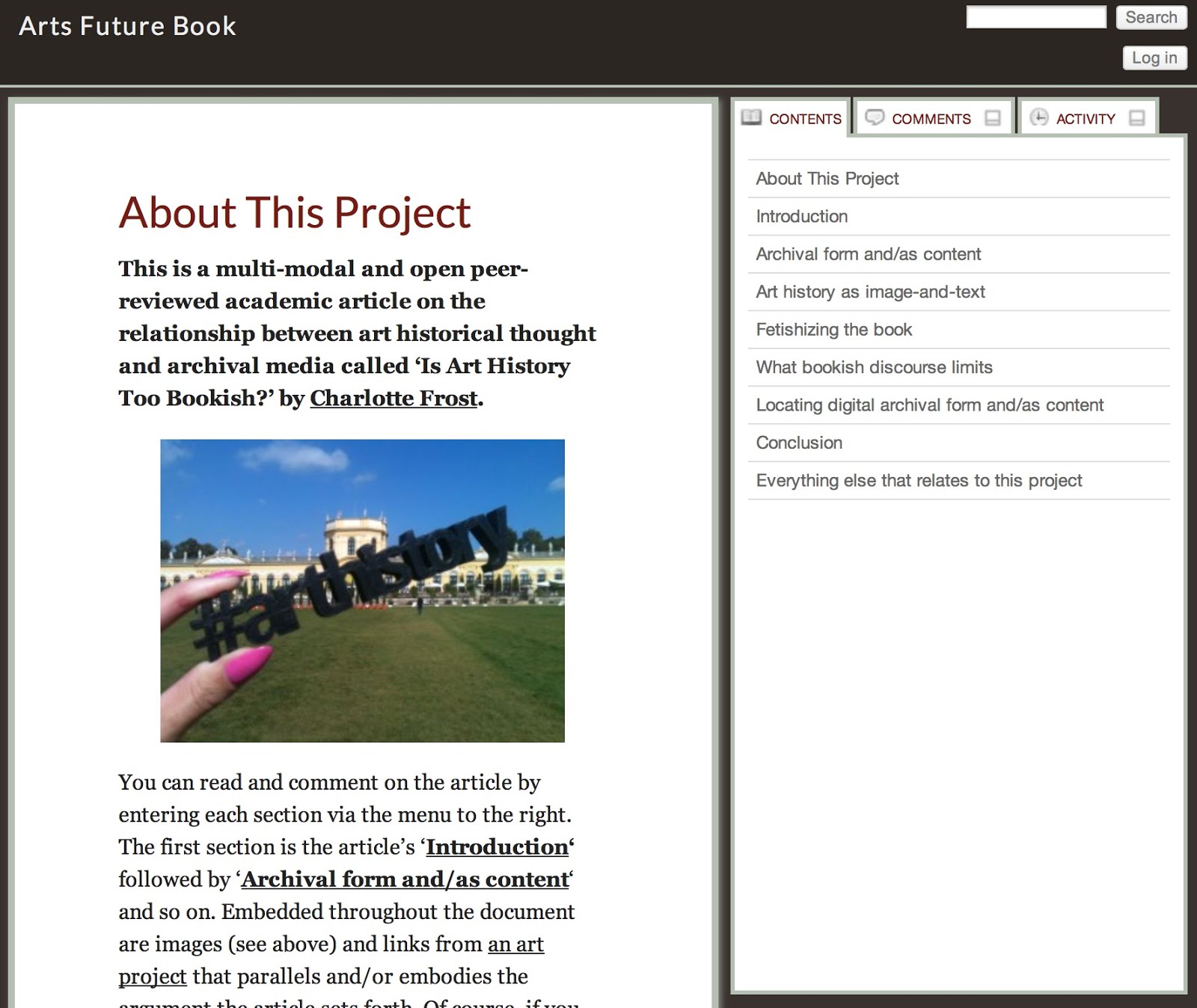

 By scott_williams via Flickr
 By koalazymonkey via flickr

 Joris_Louwes

