Exact matches only
Search in title
Search in content
Search in comments
Search in excerpt
Search in posts
Search in pages
Search in groups
Search in users
Search in forums
Filter by Categories
Academic Practice
Academic Writing Month
AcWri
AcWriMo
Blogging and Social Media
Book Editing
Book Literature Review
Book Marketing and Impact
Book Planning
Book Proposals
Book Publishing
Book Writing
Books
Citations and Referencing
Collaboration
Community
Conference Paper Abstracts
Conference Paper Editing
Conference Paper Literature Review
Conference Paper Marketing and Impact
Conference Paper Planning
Conference Paper Presenting
Conference Paper Writing
Conference Papers
Digital Publishing
Experimental Digital Publishing
Grant Abstracts
Grant Completion Reporting
Grant Impact Statement
Grant Literature Review
Grant Methods Section
Grant Writing
Grants
Journal Article Abstracts
Journal Article Editing
Journal Article Literature Review
Journal Article Marketing and Impact
Journal Article Peer Review
Journal Article Planning
Journal Article Writing
Journal Articles
Networking
News
Open Access
Productivity
Reading and Note-Taking
Reseach Project Planning
Resources
Tools
Uncategorized
Website
How to be a Hackademic #2 by Charlotte Frost & Jesse Stommel
Image by http://www.flickr.com/photos/fiddleoak/ under this licence: http://creativecommons.org/licenses/by-nc-sa/2.0/deed.en_GB

Hybrid Pedagogy’s Jesse Stommel and our very own Charlotte Frost rethink academic life and writing productivity in this on-going series of hints, tips and hacks.

DON’T WASTE. Make sure that what you do outside of your professional life is both a respite and also feeds your academic work. If an extracurricular project you’re working on is monopolizing too much of your time, find a way to elevate it to a serious component of your research. For example, if you are an English professor and find yourself spending too much time making self-produced b-movies with your iPhone, why not do some research on the history of low-budget filmic experimentation. Find ways to instantly apply new discoveries or re-purpose tasks to add value. If you have a pile of grading to do, why not create a quick project that allows you to reflect on assessment? Did you just write a new bio for a conference? Where else can you put that new bio? Have you had an article rejected? Can you turn at least some of it into a blog post for a site with a large audience?


Want to be a full-time Hackademmic ?Get on track and read this tips.

How to be a Hackademic #1 by Charlotte Frost & Jesse Stommel
Image by http://www.flickr.com/photos/fiddleoak/ under this licence: http://creativecommons.org/licenses/by-nc-sa/2.0/deed.en_GB

[Photo by Flickr user fiddle oak]http://www.flickr.com/photos/fiddleoak/6908080437/

Hybrid Pedagogy’s Jesse Stommel and our very own Charlotte Frost rethink academic life and writing productivity in this on-going series of hints, tips and hacks. 

WRITE. Establishing a writing lifestyle is perhaps the most important step you can take in securing your successful academic career. If you devise a routine right from the start, it’ll seem like second nature. There are all sorts of ways of doing this, but suffice to say you must build writing into your working week. In fact, preferably, you should make writing a part of your daily routine. Once you’ve gotten into the swing of things, writing will no longer seem like a chore, your productivity will increase, and you’ll excel in your field. And it really can be as simple as just pulling up a chair and writing. In fact, we’re guessing there’s a writing project you should be doing right now, so our first tip is to stop reading this and write at least 250 words on any project you have underway. And, yes, we do mean right now! Want more tips on Hackademic? Click here!

#acwri Live chat Open Topic: 16.08.12

Our latest #acwri live chat on Twitter was open topic so we didn’t have any pre-set topic choices. Both me and Jeremy chaired this chat. With our now well established community this resulted in a heady mix of discussion focusing on a variety of academic writing related topics. These have been summarised as always on Storify by Jeremy and you can read it below. The aim is too provide some really helpful tips, to encourage thinking about academic writing and kick start thinking about the one of the key foundations of academic life/work; writing.

#AcWri Twitter Chat, 19th July: Why Do We Write?

Today’s summary of our #acwri Twitter live chat is all about why academics write, and not just because we have too! The idea of the chat topic was to encourage the community to really think about the reasons for writing as a way of motivating us but also having an open and frank discussion about the things we write and the ways we disseminate our ideas. This resulted in a great discussion, of which the key points are listed below:

Book and Other Reviews by Raphael Susewind
Image c/o Eric Lanke


Image c/o Eric Lanke

is a political anthropologist at the Universities of Bielefeld and Oxford. He works on Muslim belonging, the ambivalence of the sacred and diplomatic culture in India – and blogs and tweets about these issues and academic life in general. Today’s post also gave him a good excuse to further delay his seventh book review

In her last post, Laura Pasquini suggested that publishing book reviews provides not only writing practice, but also improves one’s reading skills and habits. Today, I want to highlight one more synergy: book reviews prepare you for grading student papers (and probably also for other kinds of reviews) and vice versa. I learned this lesson when I recently had to write a stack of concise narrative evaluations of undergraduate disserations; the next book review flowed from my pen (well, keyboard) like a charm. Pleased about this, I discovered three similarities:

  • Firstly, as Laura emphasized, book reviews require analytical reading – and they are best if you are able to concentrate on one key point only (which should be the key argument, if present). The same holds for grading student papers: for speedy marking alone, you need to read analytically rather than sequentially – and students generally prefer one major and substantive suggestion for improvement over a heap of nitty-gritty details of what else could have been better, too. Though admittedly finding the key point in student papers can be harder than in a good monograph…
  • Secondly, and again going back to Laura, book reviewers should evaluate. There are good books, and there are not so good ones – your readers want to know your reasoned opinion. Likewise, lecturers have to decide in the end which mark to assign. If all book reviews and marking sheets screamed excellence, the whole point of the exercise were lost. Because they are rare, review editors in fact love differentiated evaluations (almost as much as submission on time); one even called me up to congratulate me for my balanced, but in the end negative review. My judgement balance now stands at two excellent, two good, one “ok” and one terrible book – which about reflects the state of publishing in my field.
  • Finally, book reviews and narrative evaluations of student papers (as well as other kinds of reviews) share the same basic structure: one introductory sentence, a weighted summary highlighing one particularly mentionable section or chapter, an evaluation of the key argument, a comment on style and presentation (only if particularly commendable or really dismal, in my opinion), and a final mark/recommendation. Practicing this structure in book reviews will make your grading more effective; and evaluating student work can improve your review style.

Importantly, the two formats have differences as well however. Above all, they are written with different audiences in mind: other readers in the case of book reviews, but authors in the case of student papers (or other kinds of reviews). This difference needs to show:

  • In book reviews, your suggestions on how to improve should preferably target the field at large, not the specific work under review. The book has been published and cannot be changed anymore: it is as good as it is. If it isn’t good, it is sufficient to point out why; you need not make the author suffer by demonstrating that you could do better within your 800 word review. But more can always be done by others, and lessons can be learned by the whole discipline. Focus on these. In contrast to books, however, student papers can be resubmitted – and it is only the student him- or herself who hopefully learns a lesson. This should render different kinds of suggestions.
  • And book reviews are of course public, so being nasty or sloppy is not an option (and will most likely backfire, too). Oh wait – shouldn’t “being nice and careful” be an integral part of teaching, grading (and journal refereeing) as well, precedent notwithstanding? How could I forget…

Finally, there is a last similarity between book reviews and teaching: neither count for much on the academic career ladder. Which is another good reason to be rather efficient about them (and efficiency stems from practice, and from synergies such as the one pointed out above). But going back to Laura’s earlier post, both teaching and reading (and by extension book reviews) are also seedbeds for ideas: they may not count directly, but practicing them will ultimately help you achieve what counts.

Academic Writing: The Foundation of Academic Publishing
http://www.flickr.com/photos/smithsonian/2422570279/

http://www.flickr.com/photos/smithsonian/2422570279/

You may have noticed that PhD2Published has been very busy recently chairing live chats on Twitter (#acwri) and collecting various blog posts, all concerned with the process of academic writing. Charlotte initially set up PhD2Published to find out more about academic publishing and to make use of it as a space built around peer-to-peer sharing. As Managing Editor I have tried to emulate this ethos and have found this to be incredibly useful so far. With this in mind, I am currently engaging in regular dialogues through both this site and other forms of social media to learn more about what is essentially the foundation of academic publishing; writing.

Spurred on to some extent by Charlottes AcBoWriMo initiative back in November 2011 and a chat initiated by Dr Jeremy Segrott on Twitter, it is clear that many academics have the desire to discuss and explore issues around their shared experiences of academic writing and how this may subsequently lead to different forms of written publication. In participating in this newly established online community and with the desire to share what I am learning, I have come across several useful resources that focus on just this topic and I wanted to share one in particular here today. Carol Smart’s discussion of academic writing is interesting because she explicitly confronts the particular challenges and problems faced by academic writers and offers potential shifts in thinking that may make dealing with these challenges more workable.

In The Emotional Challenges of Writing (available as a video and a written transcript) Carol draws on personal experiences to think about how difficulties in writing may be overcome. It is initially helpful that she acknowledges that writing can be challenging, even for those who are technically gifted or very experienced. I often feel frustrated that I can’t get words down on a page even though I know how to do it, so it is comforting to recognise that this is not just an issue with me.  Carol argues that the reasons for these challenges often stem from the kinds of emotional questions that inevitably arise when embarking on a new project or writing task; what will my peers think? Am I as good as my peers?, and so on. She also recognises that academic writing produces often contradictory feelings and insecurities in individuals and that it can be depressing and overwhelming at times. Her suggestion for overcoming this is to try to become more aware of your personal writing rhythms, no matter how peculiar they may be and lighten up a bit about what you want to say. As she rightly points out, writing is about being part of a conversation rather than setting something down in stone.

I particularly like what she has to say about getting stuck with writing. Quite often when I write I have little idea what it is I am trying to argue and I worry that this is wrong or means my thinking and writing lacks rigour. Carol suggests though that she also does this, particularly when deriving ideas from data.  While at times this may lead to dead ends, this can actually become part of the creativity of writing (and thinking) that also makes it very enjoyable.

Even though Carol’s full discussion is available online, I have briefly reviewed this resource as a way of opening up a dialogue on the PhD2Published site about academic writing. Not everyone is on Twitter or is able to join the live chats so this post is intended to be a catalyst for continuing a conversation about academic writing online and extending its reach. I genuinely believe, as do others, that academic writing is the foundation of academic publishing, yet it is also fraught with emotional and technical difficulties that are easier to acknowledge and hopefully overcome in a peer-to-peer sharing space.  Please do post any useful resources that focus on academic writing that you come across here and do raise questions and discussion. What are the main challenges you face as an academic writer? What kinds of writing do you find most challenging? What do you want to learn more about from more experienced writers?

Finding Motivation to Write. A Summary of the Latest #AcWri Live Chat with Jeremy Segrott

The latest #acwri live chat was conducted on Twitter on Thursday 10th May 2012 and Jeremy chaired it.

Through a Tweet poll the community cast their votes on a choice of four topics to discuss this week; finding motivation to write, writing an academic blog, collaborative writing and grant application writing. Interestingly there was a tie for discussing writing an academic blog and finding motivation to write so we decided to go with finding motivation first (which is of course fundamental to all forms of academic writing) and we shall be discussing writing an academic blog next time (come and join us Thursday 24th May 2012, 6PM GMT). We are really keen that the community has as much of as a say as possible about the topics we discuss so if you’re on Twitter, keep an eye out for our links to the topic polls and to the final summaries.

Until then, here is the really useful summary of finding motivation to write:

Read more

Weekly Wisdom #87 by Paul Gray and David E. Drew

YOUR DISSERTATION IS A PUBLISHING ASSET. You should receive a return on your investment for the time spent on your dissertation. Avoid advisers who insist on joint authorship on all papers that result. They are exploiting you.

Weekly Wisdom #85 by Paul Gray and David E. Drew

DEADLINESMany graduate students and professors hate deadlines even though they pervade academic life.  If your dissertation isn’t completed and approved by a specific date, you do not march at graduation.  Requests for proposals require submission by a date certain.  Book publisher’s contracts and professional meetings set deadlines for submitting a polished draft. Grades are due shortly after the end of the semester or trimester. The list goes on. The truth is that deadlines are friends, not enemies.  They force you to finish and free your mind to move on to the next task. We know academics who lament that, were it not for a deadline, their article or proposal would bemuch, much better.  We doubt that.  We estimate that three additional months spent on an article or proposal improves a paper by, at most, 15%. Better an excellent paper completed than a perfect paper never finished.

Latest #AcWri Live Chat Summaries

Since the AcWri live chat officially launched on Twitter recently, Jeremy and I (Anna, PhD2Published) have been summarizing the chats with the aim of generating a useful and lasting resource for all academic writers. From now on, the plan is that each summary will be posted to both the PhD2Published site and Jeremy’s own personal blog so that everyone can access them after each event. The first of the chats have already happened and provide some great information, hints and tips about academic writing. The summaries for these from previous weeks can each be individually accessed using the following links:

Thursday 16th February 2012: The very first chat initiated by Jeremy: Starting a chat

Thursday 23rd February 2012: With PhD2Published, the second chat involved further exploration of potential academic writing related topics to discuss during the chats, including some initial discussion about academic writing issues. See the summary here.

Thursday 5th March 2012: Writing Journal Articles

It is hoped that these provide a great online resource and introduction to the AcWri community. If you are an academic writer, or a writer more generally, please do get involved. The bigger the community, the more ideas and questions we can discuss and the more support we each gain. Acwri live chats are run on Twitter on Thursdays at 6pm GMT every fortnight.

The latest #acwri live chat held on Thursday 12th April 2012 is summarised below and is available here:

It was identified that there is very little information on the subject of actually writing conference papers (P2P found one useful one during the chat and I am sure there are many more – please do share!). Predominantly focus is on presenting them. This is a significant gap given that presentations are so important in trying out new ideas and networking, and are also another form of academic writing:

Weekly Wisdom #82 by Paul Gray and David E. Drew

BE SURE TO SPELL-CHECK AND GRAMMAR-CHECK AND FACT-CHECK your work. Your degrees certify you as a literate, educated person. Grammatical or spelling errors in a résumé or in an article submitted for publication turn off reviewers who are making judg­ments about you. For example, in a résumésent to one of us as an outside reviewer for tenure we found the following: “My research activities has centered on . . .” and a reference to the journal Group Decision and Negotiation wound up as Group Decision & Negation.

Weekly Wisdom #81 by Paul Gray and David E. Drew

LEARN THE FINE POINTS OF ENGLISH. With multiple degrees in hand, you are assumed to be an educated person. Writing and speaking mistakes turn off your students, reviewers, and the editors of journals. If you need help, buy a copy of Fowler’s Modern English Usage and William Strunk Jr. and E. B. White’s The Elements of Style. Read them. When in doubt, consult them. A well-written paper is more likely to be accepted than a poorly written one. For example you should: Know the difference between assure, ensure, and insure, and between affect and effect. Recognize that criteria is plural and criterion is singular

Weekly Wisdom #80 by Paul Gray and David E. Drew

LEARN HOW TO WRITE CLEARLY. Some graduate programs do their best to stamp out this skill, persuading doctoral candidates that a ten-syllable word is better than a two-syllable word. Reviewers are more likely to persevere to the end of your journal submission or your grant proposal if they can easily follow what you say. They are also more likely to give you a favorable review.

Writing Accountability Part 1 by Jennifer Lim: How It Works

Today’s post complements our new #AcWri project and is written by Jennifer S. H. Lim, a Computer Science graduate, currently working on her final submission of her dissertation as part of the fulfillment for her Master in Computer Science at University of Malaya, Malaysia. In the first of a two part series, Jenn introduces her now established academic writing initiative. She also blogs about her studious life and tweets as Studious Jenn @mystudiouslife.

I love writing. I use it to share ideas and information with the hope that it engages people in conversations that generate more ideas. That’s why I also love blogging, where I can write freely about topics that interest me whenever I like. However, academic writing is a different story. I still write topics that interest me but the need to actually write is more intense than merely writing a blog post. Academic writing projects are usually longer and more time consuming and no matter how much I love writing, when it comes to writing academically, the process can become overwhelming. Most of the time, writing just doesn’t happen at all. Procrastination ensues and then I just panic and write  last minute, which doesn’t meet any quality control.

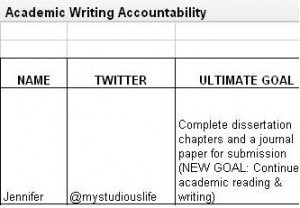
This approach just doesn’t work well for me, especially at the point when I needed to write at least 10,000 – 30,000 words of a dissertation over a period of time. Although there was no set due date in that situation, I knew that the longer I delayed writing, the longer I would take to finish it. My biggest problem is that when there is no one to ‘force’ me to write I eventually procrastinate more. Hence, in order to succeed, I have to take actions. I need to be the one who ‘forces’ myself to write and I must be accountable for my own progress and success. This is the reason I started the Academic Writing Accountability initiative, where writing goals are shared in a spreadsheet and progress are updated daily. This initiative revolves around a Twitter community made up of anyone who is interested in academic writing and is willing to share their writing progress. Hopefully, this initiative helps as many people as possible to become more productive in writing to achieve their goals.

It all started when I was feeling ‘blocked’ while I was writing my last few dissertation chapters. I thought I couldn’t write because I didn’t have enough time to write for long hours due to my full-time job. When PhD2Published started the Academic Book Writing Month (#AcBoWriMo) project last November however, I was glad to join so many in the initiative to achieve my goal. My writing goal at that moment was to complete two chapter and by the time November ended I had completed Chapter 4 and started Chapter 5. I realized that such an initiative had actually helped me progress better even though I didn’t achieve my goal completely. I still continue to be in touch with the writing community.

Eventually, #AcWri was formed because there were still people (including me) who were keen to continue the writing initiative. One day, I was tweeting about how to improve academic writing productivity. After some tweets, I suggested using Google spreadsheet to share productivity progress so we can keep track of our own goal and progress online and at the same time let others  hold us accountable. Once the spreadsheet was created, a few of the #AcWri regulars joined the initiative by sharing their ultimate/daily goals and their updated daily progress.

Why writing accountability? I have a few beliefs that motivated me to start this initiative:

  1. Daily writing habit is essential for academic success and this habit can be cultivated through practice. This is the practice where you become the one to ‘force’ yourself to write daily.
  2. Be accountable for your own writing by publicly sharing your writing goal: ultimate goal (i.e. complete a dissertation) and daily goal (i.e. write 500 words). By sharing your goal, all will know what you are trying to achieve and you are being hold accountable for achieving your goals.
  3. Productivity will increase when it is being measured or monitored. By keeping a record of what you have done, it’s good for reflecting and planning to improve your productivity.
  4. Peer support is the best motivation in academic writing. Knowing you do not struggle alone in the writing process is helpful.

Does accountability in writing work for everyone? The answer will vary among individuals but most importantly, you can just give it a try and see for yourself. It works wonderfully for me. My ultimate goal of completing dissertation chapters and a journal article was achieved using this initiative. Regardless of what you choose to do, be sure it works for you in achieving your goals. If you have any other ideas about increasing writing productivity, I would love to hear from you.

Writing Across Boundaries – introduced by Bob Simpson and Robin Humphrey

Today’s post, which includes some useful links to blogs about academic writing in the social sciences, introduces an exciting writing initiative currently being run by Project Leaders Bob Simpson [Durham University] and Robin Humphrey [Newcastle University]. The Writing on Writing link in particular provides great advice for doctoral students and academic writers alike. Bob tells us more about the project;

Doing a doctorate in the social sciences involves reading a lot of words, thinking up a good question and, in methodological terms, figuring out how to answer it, and then doing fieldwork or some other form of data collection and analysing it all and then comes the ‘writing up’.  In our experience, a lot of energy goes into preparing students for all these challenges, except, that is, the last one.  ‘Write me a draft of chapter three’ can be a very troubling request for a student perched at that tricky point between analysis and writing.

In recognition of the difficulties that might arise in negotiating this gap in the training of doctoral students we initiated  a series of workshops [with the help of an ESRC Researcher Development Initiative grant]. These were aimed at exploring some of the challenges faced by researchers writing a thesis which would draw on qualitative data of some kind.  The Writing Across Boundaries project held its first workshop in 2007 and for four years thereafter.  The workshops were extremely successful in bringing together researchers from a range of social science disciplines, who are all post-fieldwork, who could set about the specific task of reflecting on their own and others’ writing strategies.  From the feedback we have had, the opportunity to focus over two days on the business of writing and analysis has proved very useful for PhD students in their quest to produce texts that are engaging, accurate and analytically insightful.   Crucially, the workshops have dealt with some of the more personal challenges faced in producing text for others to evaluate as well as covering the practicalities of writing.  The workshops will now place annually, open to all, but organised within the ESRC North East Doctoral Training Centre.

Accompanying the workshops is a Writing Across Boundaries website which provides open access support for those writing up qualitative data.  The main sections are as follows:

  • Writing on Writing is an initiative in which scholars who have made a significant contribution to the social science literature offer personal reflections on the process of writing.
  • In Postgraduates on Writing, we publish short pieces from research postgraduates on any aspect of the process of writing in doctoral study.
  • In the Resources section are sections dealing with Drafting and Plotting, the Data-Theory Relationship, Narrative, Rhetoric, and Representation. We have also included a general section containing Hints and Tips on Writing.

Check it out!