Exact matches only
Search in title
Search in content
Search in comments
Search in excerpt
Search in posts
Search in pages
Search in groups
Search in users
Search in forums
Filter by Categories
Academic Practice
Academic Writing Month
AcWri
AcWriMo
Blogging and Social Media
Book Editing
Book Literature Review
Book Marketing and Impact
Book Planning
Book Proposals
Book Publishing
Book Writing
Books
Citations and Referencing
Collaboration
Community
Conference Paper Abstracts
Conference Paper Editing
Conference Paper Literature Review
Conference Paper Marketing and Impact
Conference Paper Planning
Conference Paper Presenting
Conference Paper Writing
Conference Papers
Digital Publishing
Experimental Digital Publishing
Grant Abstracts
Grant Completion Reporting
Grant Impact Statement
Grant Literature Review
Grant Methods Section
Grant Writing
Grants
Journal Article Abstracts
Journal Article Editing
Journal Article Literature Review
Journal Article Marketing and Impact
Journal Article Peer Review
Journal Article Planning
Journal Article Writing
Journal Articles
Networking
News
Open Access
Productivity
Reading and Note-Taking
Reseach Project Planning
Resources
Tools
Uncategorized
Website
Weekly Wisdom #83 by Paul Gray and David E. Drew

EDITING YOUR OWN MATERIAL. As you write your dissertation or a paper it is natural to make changes and major revisions. You are, in effect, editing your own material. That’s good and bad. It is good because you add intellectual capital, you clarify, and you consider the knowledge (or lack thereof) of your readers.  It is bad if, like most of us, you become infatuated with the sound of your own words.  It is difficult, if not impossible; to change language or ideas you labored over long and hard. Just like job application letters, have at least one (preferably more) people read what you wrote and suggest improvements. If a word, a paragraph, or a section is unclear to them it is likely to be unclear to others. Better to receive critiques and suggested improvements from your peers than from referees or decision makers.

Weekly Wisdom #82 by Paul Gray and David E. Drew

BE SURE TO SPELL-CHECK AND GRAMMAR-CHECK AND FACT-CHECK your work. Your degrees certify you as a literate, educated person. Grammatical or spelling errors in a résumé or in an article submitted for publication turn off reviewers who are making judg­ments about you. For example, in a résumésent to one of us as an outside reviewer for tenure we found the following: “My research activities has centered on . . .” and a reference to the journal Group Decision and Negotiation wound up as Group Decision & Negation.

Josie Dixon – From Planet PhD to Destination Publication: A Traveller’s Guide. Part 3. Passenger vs Driver
http://www.flickr.com/photos/library_of_congress/2163470598/#/

http://www.flickr.com/photos/library_of_congress/2163470598/#/

This post is the third in a series by Josie Dixon, a consultant with 15 years’ experience in academic publishing, as Senior Commissioning Editor at Cambridge University Press and Publishing Director for the Academic Division at Palgrave Macmillan.  She now runs her own business, Lucian Consulting, and gives training workshops on publishing and other forms of research communication for postgraduates, postdocs and staff in over 50 universities internationally, alongside her training and consultancy work in the publishing industry. In this set of blog posts for PhD2Published, Josie examines some of the polarities between Planet PhD and the world of publishing, and offers strategies for how to bridge the gap. 

A publishing proposal needs to make clear the project’s contribution to work in the field, and define its originality with reference to what has gone before.  You aren’t working in a scholarly vacuum, so you will need to contextualise your research in the discipline, but in a very different mode from that of a PhD literature review.  Coverage of secondary sources is no longer of interest for its own sake: your mastery of the field can now be assumed, rather than requiring demonstration at every turn for the benefit of your examiners.  As an editorial colleague once put it, ‘A publisher is interested in what you think, not what you think other people have thought’.   The journey from PhD to publication involves rethinking not just the quantity, but also the quality and manner of your citations.

In the first blogpost in this series, I referred to an article by Peter Barry which offers equally useful observations in this context.  Barry complains, rightly, that ‘much academic writing seems to hamper its own flow by footnoting, quoting or citing in almost every sentence. Its own argument never gathers any proper momentum or direction, like a car being driven with the brakes half on’. He pinpoints in particular the problem of ‘constant self-interruption (“as X has argued”, “as Y points out” and so on)’.  Barry’s stylistic point is a good one, but I would go further, since I have additional reservations about ‘as X has argued’ as a critical manoeuvre, in terms of what it suggests about the author’s confidence in their own independent contribution to the field.

A PhD has been traditionally viewed as an apprenticeship for an academic career, and that sense of being an academic underling working in the shadow of the established authorities often betrays itself in formulaic citations of this kind, in which you can risk overplaying the homage to senior figures in the field (X and Y are typically gurus like Foucault or Habermas).  The ‘as’ in ‘as X has argued’ suggests an alignment of your own point with one that has already been expressed by someone else, and this formula usually introduces a main clause which recycles their point (likewise ‘According to X’) in the attempt to bolster your own argument.  Too much of this kind of ‘straight’ citation in order to agree suggests a dependent or derivative relationship, and insufficiently novel or critical thinking on your part.  Turn that around with a different formulation – ‘whereas X has argued…’  – and you automatically make space for your own new and different contribution to take centre stage in the sentence – a much stronger form of argumentation.

A similar principle applies to framing material outlining the relationship of your work to predecessors, models, or sources of methodological and theoretical inspiration.  Too many would-be authors characterise their project as ‘drawing on’ or ‘following’ the work of existing authorities in the field, suggesting a position that is derivative or lags behind.  Editors want to publish the leaders in their field, not the followers!  So a stronger pitch would be to characterise your project as ‘building on’ its predecessors, making clear that their work is only the starting point for yours, which pushes further forward and achieves something more.

So have the courage of your own convictions here – Foucault, Habermas & co have enough disciples, and you won’t distinguish yourself by adding to their number.  Rather than joining the chorus, make sure you are singing solo.  Don’t be a passenger on other people’s bandwagons: be the driver of your own!

Here are five writing tips, to help you manage your relationship to secondary sources in ways that foreground your originality to best effect:

i) Avoid ‘as’ and ‘according to’ when introducing citations – concentrate on differentiating your viewpoint, rather than aligning it with others’

ii) Beware ‘c.f.’ and referencing sources without making explicit the relationship of your viewpoint to the ones being cited – the risk is that you will appear to be recycling others’ views uncritically

iii) Avoid too much summary of critical debate without your own intervention – this can make you look like a bystander or commentator rather than an active participant, and at worst turns into a bibliographical laundry list

iv) Use dynamic rather than passive verbs – you will make a more compelling case for your contribution if you make clear how your project challenges or overturns previous work, rather than simply complementing it (too neutral), filling the gaps (too humble) or drawing on your predecessors (derivative rather than critical)

v) From problem to solution: while you will of course need to give credit where it’s due, you will make a stronger and more positive case for what you bring to the scholarly party by explaining the deficiencies in existing scholarship which your research aims to remedy, and making clear the pay-off for your distinctive approach

Weekly Wisdom #81 by Paul Gray and David E. Drew

LEARN THE FINE POINTS OF ENGLISH. With multiple degrees in hand, you are assumed to be an educated person. Writing and speaking mistakes turn off your students, reviewers, and the editors of journals. If you need help, buy a copy of Fowler’s Modern English Usage and William Strunk Jr. and E. B. White’s The Elements of Style. Read them. When in doubt, consult them. A well-written paper is more likely to be accepted than a poorly written one. For example you should: Know the difference between assure, ensure, and insure, and between affect and effect. Recognize that criteria is plural and criterion is singular

Weekly Wisdom #80 by Paul Gray and David E. Drew

LEARN HOW TO WRITE CLEARLY. Some graduate programs do their best to stamp out this skill, persuading doctoral candidates that a ten-syllable word is better than a two-syllable word. Reviewers are more likely to persevere to the end of your journal submission or your grant proposal if they can easily follow what you say. They are also more likely to give you a favorable review.

Why so Shameless? On Self-Promotion and Networking by Amber K.Regis

Todays post is about the value of blogging and promoting research through social media. It is written by Amber K. Regis who completed her PhD in Victorian life-writing at Keele University. She is an Associate Lecturer for the Open University and teaches English literature at the Universities of Chester and Liverpool John Moores. She blogs at Looking Glasses on Odd Corners on life-writing and life-narratives across different media. She has published work on John Addington Symonds, Virginia Woolf and Vita Sackville-West. You can follow her on Twitter: @AmberRegis

I started a research blog in the final months of 2011 in a wave of enthusiasm. I was going to become an overnight internet sensation; I was going to get my research ‘out there’, reach new audiences and make a name for myself! And do you know what? I thoroughly enjoyed the act of blogging, and while I’m still waiting go viral, I have managed to share ideas and start conversations with a multitude of readers (including many beyond the ivory tower of academe). But blogging is also a commitment that takes up time, and in recent weeks time has been desperately lacking.  Like so many other post-PhD researchers, I’m juggling multiple jobs while I seek the ‘holy grail’ of a permanent academic appointment. Prepping, marking and commuting has taken its toll and I’ve been neglecting my blog.

But, rather surprisingly, the blog has remained active during my absence. Others have started to take notice.

Shameless self-promotion?

I’ve already admitted that increasing my online presence was a key motive in setting up my blog, and it has received several special mentions in recent weeks:

  • A post on material objects and life-writing was quoted by Charlotte Mathieson, an Associate Fellow in English at the University of Warwick, in a recent piece on literary tourism for the Journal of Victorian Culture Online.
  • A keynote speaker at a recent Victorian Studies conference referred to a post on souvenirs and collecting. I was sitting in the audience. It was all terribly flattering, but I blushed and looked at my feet.

As a means of self-promotion, blogging appears to be paying off. Each special mention resulted in increased traffic and a number of Google search hits. Internet sensationdom is just around the corner…

But why is this kind of ‘self-promotion’ so consistently paired with the pejorative ‘shameless’? And why did I blush when my blog was mentioned at a conference? After all, wasn’t this what I wanted? But alas, was my face now registering the inevitable ‘shamelessness’ of attention seeking in the blogosphere?

Not-so-shameless self-promotion?

I do not believe that self-promotion is a shameless or even a necessarily selfish activity. Indeed, the three instances above demonstrate a range of benefits to increasing online visibility and engaging with social media. Attention has been drawn to my work, yes, but I have also engaged directly with other researchers, forging connections with peers and more senior academics. Social media have thus transformed self-promotion into a mode of continual networking—formerly an oft-dreaded activity that required awkward conversations over coffee cups during breaks in conference schedules. But networking can now extend beyond the temporal and physical space of a conference; conversations can start before an event and continue long after, mediated online.

So yes, all this blogging and tweeting is a form of self-promotion, but it is certainly not shameless. The clue is in the title: social media and the social web. Making connections, forming communities, offering support; in getting your name ‘out there’, you are not a voice crying out in the wilderness. Self-promotion in the age of the social web is very much a team sport; plugged-in academics are networked and networking all the time.

Writing Accountability Part 1 by Jennifer Lim: How It Works

Today’s post complements our new #AcWri project and is written by Jennifer S. H. Lim, a Computer Science graduate, currently working on her final submission of her dissertation as part of the fulfillment for her Master in Computer Science at University of Malaya, Malaysia. In the first of a two part series, Jenn introduces her now established academic writing initiative. She also blogs about her studious life and tweets as Studious Jenn @mystudiouslife.

I love writing. I use it to share ideas and information with the hope that it engages people in conversations that generate more ideas. That’s why I also love blogging, where I can write freely about topics that interest me whenever I like. However, academic writing is a different story. I still write topics that interest me but the need to actually write is more intense than merely writing a blog post. Academic writing projects are usually longer and more time consuming and no matter how much I love writing, when it comes to writing academically, the process can become overwhelming. Most of the time, writing just doesn’t happen at all. Procrastination ensues and then I just panic and write  last minute, which doesn’t meet any quality control.

This approach just doesn’t work well for me, especially at the point when I needed to write at least 10,000 – 30,000 words of a dissertation over a period of time. Although there was no set due date in that situation, I knew that the longer I delayed writing, the longer I would take to finish it. My biggest problem is that when there is no one to ‘force’ me to write I eventually procrastinate more. Hence, in order to succeed, I have to take actions. I need to be the one who ‘forces’ myself to write and I must be accountable for my own progress and success. This is the reason I started the Academic Writing Accountability initiative, where writing goals are shared in a spreadsheet and progress are updated daily. This initiative revolves around a Twitter community made up of anyone who is interested in academic writing and is willing to share their writing progress. Hopefully, this initiative helps as many people as possible to become more productive in writing to achieve their goals.

It all started when I was feeling ‘blocked’ while I was writing my last few dissertation chapters. I thought I couldn’t write because I didn’t have enough time to write for long hours due to my full-time job. When PhD2Published started the Academic Book Writing Month (#AcBoWriMo) project last November however, I was glad to join so many in the initiative to achieve my goal. My writing goal at that moment was to complete two chapter and by the time November ended I had completed Chapter 4 and started Chapter 5. I realized that such an initiative had actually helped me progress better even though I didn’t achieve my goal completely. I still continue to be in touch with the writing community.

Eventually, #AcWri was formed because there were still people (including me) who were keen to continue the writing initiative. One day, I was tweeting about how to improve academic writing productivity. After some tweets, I suggested using Google spreadsheet to share productivity progress so we can keep track of our own goal and progress online and at the same time let others  hold us accountable. Once the spreadsheet was created, a few of the #AcWri regulars joined the initiative by sharing their ultimate/daily goals and their updated daily progress.

Why writing accountability? I have a few beliefs that motivated me to start this initiative:

  1. Daily writing habit is essential for academic success and this habit can be cultivated through practice. This is the practice where you become the one to ‘force’ yourself to write daily.
  2. Be accountable for your own writing by publicly sharing your writing goal: ultimate goal (i.e. complete a dissertation) and daily goal (i.e. write 500 words). By sharing your goal, all will know what you are trying to achieve and you are being hold accountable for achieving your goals.
  3. Productivity will increase when it is being measured or monitored. By keeping a record of what you have done, it’s good for reflecting and planning to improve your productivity.
  4. Peer support is the best motivation in academic writing. Knowing you do not struggle alone in the writing process is helpful.

Does accountability in writing work for everyone? The answer will vary among individuals but most importantly, you can just give it a try and see for yourself. It works wonderfully for me. My ultimate goal of completing dissertation chapters and a journal article was achieved using this initiative. Regardless of what you choose to do, be sure it works for you in achieving your goals. If you have any other ideas about increasing writing productivity, I would love to hear from you.

Writing Across Boundaries – introduced by Bob Simpson and Robin Humphrey

Today’s post, which includes some useful links to blogs about academic writing in the social sciences, introduces an exciting writing initiative currently being run by Project Leaders Bob Simpson [Durham University] and Robin Humphrey [Newcastle University]. The Writing on Writing link in particular provides great advice for doctoral students and academic writers alike. Bob tells us more about the project;

Doing a doctorate in the social sciences involves reading a lot of words, thinking up a good question and, in methodological terms, figuring out how to answer it, and then doing fieldwork or some other form of data collection and analysing it all and then comes the ‘writing up’.  In our experience, a lot of energy goes into preparing students for all these challenges, except, that is, the last one.  ‘Write me a draft of chapter three’ can be a very troubling request for a student perched at that tricky point between analysis and writing.

In recognition of the difficulties that might arise in negotiating this gap in the training of doctoral students we initiated  a series of workshops [with the help of an ESRC Researcher Development Initiative grant]. These were aimed at exploring some of the challenges faced by researchers writing a thesis which would draw on qualitative data of some kind.  The Writing Across Boundaries project held its first workshop in 2007 and for four years thereafter.  The workshops were extremely successful in bringing together researchers from a range of social science disciplines, who are all post-fieldwork, who could set about the specific task of reflecting on their own and others’ writing strategies.  From the feedback we have had, the opportunity to focus over two days on the business of writing and analysis has proved very useful for PhD students in their quest to produce texts that are engaging, accurate and analytically insightful.   Crucially, the workshops have dealt with some of the more personal challenges faced in producing text for others to evaluate as well as covering the practicalities of writing.  The workshops will now place annually, open to all, but organised within the ESRC North East Doctoral Training Centre.

Accompanying the workshops is a Writing Across Boundaries website which provides open access support for those writing up qualitative data.  The main sections are as follows:

  • Writing on Writing is an initiative in which scholars who have made a significant contribution to the social science literature offer personal reflections on the process of writing.
  • In Postgraduates on Writing, we publish short pieces from research postgraduates on any aspect of the process of writing in doctoral study.
  • In the Resources section are sections dealing with Drafting and Plotting, the Data-Theory Relationship, Narrative, Rhetoric, and Representation. We have also included a general section containing Hints and Tips on Writing.

Check it out!

Josie Dixon – From Planet PhD to Destination Publication: A Traveller’s Guide. Part 2. Micro vs Macro
http://www.flickr.com/photos/jopeattie/4012370776/

http://www.flickr.com/photos/jopeattie/4012370776/

This post is the second in a series by Josie Dixon, a consultant with 15 years’ experience in academic publishing, as Senior Commissioning Editor at Cambridge University Press and Publishing Director for the Academic Division at Palgrave Macmillan.  She now runs her own business, Lucian Consulting, and gives training workshops on publishing and other forms of research communication for postgraduates, postdocs and staff in over 50 universities internationally, alongside her training and consultancy work in the publishing industry. In this set of blog posts for PhD2Published, Josie examines some of the polarities between Planet PhD and the world of publishing, and offers strategies for how to bridge the gap. 

It’s well known that PhD stands for ‘piled high and deep’.  What’s sometimes harder to admit is that depth is usually achieved at the expense of breadth.  Burrowing down that scholarly rabbit hole inevitably limits the audience for a PhD, so when you’re thinking about publication, it’s vital to come up for air and look around at the larger field in which your burrow is located.  Managing the relationship between the ‘micro’ dimension (where the project is most specifically defined) and the ‘macro’ (where its broader applications may lie) will be key to maximising your chances of getting published.  Commissioning editors’ instinctive reaction to most thesis topics is that they’re too narrow to find a viable market in book form.  So unless you’re happy to publish in specialist journals, developing the macro dimension will be essential to making the transition from PhD to publication.

It’s worth recognising that the distance between the two has grown over the last couple of decades.  Universities have been under pressure to improve PhD completion rates, and one major instrument in a successful crackdown on this problem has been tighter control over the choice of thesis topics.  Today’s PhDs are better focused, but narrower than the more ambitious projects which waylaid academic career development in previous generations.  Meanwhile, in the publishing world, monograph sales have been falling year on year, and publishers’ efforts to shore up the viability of this form of publishing have focused on filtering out over-specialised titles and concentrating on broader topics.

The narrower focus of today’s PhDs is often exemplified in case studies.  Social scientists are generally taught to recognise, make explicit and theorise case-study research, to understand its value and also its limitations.  It’s not always readily acknowledged that this applies to the humanities too.  The study of a particular figure or theme or work (of art, literature, music, philosophy or theology) will be a limited exercise unless we explore its relationship with broader phenomena – the development of the genre, the culture of the period, wider intellectual movements or philosophical ideas.   To that extent, our chosen works or examples become case studies for these broader phenomena which are otherwise too large and diffuse to give meaningful boundaries to a project.  Without some version of the case-study principle, we’d all be embarking on that archetypally impossible search for the key to all mythologies.

When it comes to publishing, there’s a bigger imperative to develop and make explicit what your research yields beyond the terms of your case-study material.  If you are studying a topic which has received little attention to date, the very factor which helps to secure the originality of your research will also limit its audience (and the market for a publication), unless you can show what difference it makes to the mainstream of your discipline.  How will a new study of Charlotte Lennox change our view of eighteenth-century fiction or the development of women’s writing?  What impact will a study of Guicciardini have on our understanding of early modern political thought?  It’s easy to forget the need to elaborate on these larger implications when you have spent years burrowing down your own scholarly rabbit hole, but this factor will make a vital difference to the size of your audience and the level of interest you will be able to raise outside the circle of paid-up, card-carrying fellow-specialists in your sub-field.

The same is true when it comes to applications.  A typical linguistics PhD, offering a grammar and morphology of an endangered language with a tiny number of native speakers, would have an impossibly small market if pitched only to fellow specialists in that language.  But if the analytical framework developed can be applied to the study of other languages, then that macro dimension – in this case methodological – will open up a far wider potential readership with clear benefits for other scholars’ research.

Here are five key questions, to help you to take the macro perspective on your research:

i) Understand the limits of your PhD – first define your thesis topic at its most micro, according to all the relevant parameters such as region, time period, language, genre, approach, and the specific examples you have chosen to study in detail.  Then you will be better able to work outwards towards the macro.

ii) What is the larger significance of your research? Think about ways to locate your chosen topic in a broader context.   What is the contribution made by your research in relation to its own and related sub-fields, the larger discipline, methodological school, etc?

iii) How can you do justice to that breadth?  Think about ways to widen your coverage and bring those connections to the fore.

iv) What do you see as its larger implications? These can often be explored more freely in a publication than a PhD.

v) What will be its applications, in the hands of your readers?   Remember, the PhD was for you (and written for a couple of examiners), but publishers will want to know more about what value a publication offers to the reader, and what broader purposes your research will serve for them.

Weekly Wisdom #77 by Paul Gray and David E. Drew

DEVELOP A POOL OF RESEARCH REFERENCES STORED IN YOUR COMPUTER. It is one of the most useful things you can do. You will use the same references over and over as you do research, as you write pa­pers, and as you teach. You will add to this list as you read new articles and books in the literature. We personally recommend the software called EndNote although other similar kinds of software are on the market. Software for references contains three useful features: It provides a standard form for entering references so that you remember to include all the necessary data. Separate forms are provided for each type of reference (books, articles, newspa­pers, Internet URLs, etc.). It automatically converts the format to the reference style of the journal to which you are submitting. Lots of different styles are available. Since you may be sending an article to several journals sequentially before it is accepted, this au­tomated feature saves you hours of drudge work in converting reference formats. It provides space for including abstracts and notes so that you can record what the reference was about for future retrieval.

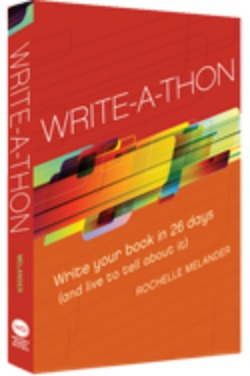
Rochelle Melander, ‘Write-A-Thon: Write your book in 26 days (and live to tell about it)’ – A Review by James Smith

“You have to do the work. Tired, angry, worried or overwhelmed: You need to write. You have to work in the midst of your complicated life. There will never be a perfect time to write the book bubbling within you. Sometimes you just have to work at the big things while the little ones pile up around you.” (p. 6)

I would like to take the time to explore Rochelle Melander’s Write-A-Thon: Write your book in 26 days (and live to tell about it) from the perspective of a PhD student. At the start of a new year and at the beginning of many new ventures in writing, this book has provided many timely pieces of advice. The merits of the Melander’s book for the PhD student are two-fold: First, Melander sets out to disabuse any potential writer of every excuse that one could possibly think of for delaying, procrastinating or otherwise sabotaging the decision to write. As I’m sure we can all agree PhD students are serial offenders in this regard. Second, the book sets out a veritable arsenal of tools for shaping and creating a book-length piece of writing, many (although not all) of which are highly relevant for PhD writing. The book shames the tardy writer into action while simultaneously encouraging strategies to ease the strain of writing. It is a toolbox full of useful devices for writing, some highly relevant to the academic, others less so.

During the month of November of last year, the PhD2published community embraced AcBoWriMo (Academic Book Writing Month for the uninitiated) with great gusto, featuring a series of blog posts and a vigorous #AcBoWriMo tag on Twitter. As part of the experience, Charlotte presented us with a series of four posts based around Write-A-Thon (i ii iii iv), each of which I highly recommend that you read. As you will apprehend, the book is extremely good at seeking out excuses and stripping them away, anticipating your paranoia and soothing it, pre-empting your mistakes, correcting your mistakes, anticipating your confusion and providing answers. Writing is an inherently uncertain endeavour, and yet Melander’s confidence in the power of human motivation provides many useful strategies for boosting one’s writing. The blurb promises to teach the reader how to start out well prepared, maintain their pace and bask in their accomplishment.

Although aimed at anyone interested in writing any kind of book and inspired by the annual NaNoWriMo (National Novel Writing Month) initiative, Write-A-Thon has several virtues that recommend itself to the graduate student, early career academic or seasoned academic in need of motivation and inspiration in the face of a writing project. This recommendation turned out to be highly convenient, for it helped me write this review. I turned (not without a certain amount of irony) to the first section of the book I was to review, entitled ‘Attitude Training: Get Rid of the Excuses’ (pp. 9-25). It helped; a fact to which the existence of this review can attest. Melander always seems to have something to say to the PhD student, a category of writers constantly plagued with motivational problems and doubts. We all need a constant stream of encouragement and exhortations to write when struggling with a thesis deadline. The section ends with a section on the healing power of writing, reminding us that writing need not be a chore. As Melander puts it, “Write now, get healthy!” (p. 25). On the topic of health, the PhD student will also be drawn to a section entitled ‘Life Training: Schedule the Marathon’ (pp. 103-129) in which the reader can find useful advice on shaping one’s writing environment, measuring one’s progress and maintaining one’s schedule.

Melander offers a great deal to any PhD student faced with one of those inevitable ‘crunch time’ moments when there appears to be far too many words to write and not enough hours in the day in which to write them. Open Write-A-Thon on any given page and you will find a tool to write coupled with games, tricks and strategies to avoid commonly encountered pitfalls in writing. In the second part of the book, entitled ‘The Write-A-Thon’, the book schools the reader in the avoidance of writing phenomena such as ‘Monkey Mind’ (p. 138). Although a great deal of the material in this section is perhaps more suitable for fiction writing, it covers many problems shared by all writers regardless of background. This was a refreshing dose of perspective, for it reminded me that all writers, any writers, experience these problems regardless of what they are attempting to write. The final section of the book, entitled ‘Recovery’ (pp. 202-218), contains some general information about revising your writing and pitching it to a publisher. Whereas the PhD student would perhaps be better served by the more specific advice in ‘How to Publish your PhD’ by Sarah Caro, there is some good common sense information in this section that should be of interest to the PhD student.

In summary, Melander’s book contains much of interest to the doctoral student in need of strategies specifically tailored to the purpose of writing a great deal in a very short amount of time. Melander functions as a writing guru and a source of moral support in equal measure. Although the timeframe and the nature of the project proposed by the NaNoWriMo style project of the book differs from the PhD experience, the reader will find that Write-A-Thon has a great many features that will appeal. I will leave you, as the book does, with a piece of advice that we should all keep in mind.

“And so, dear writers, the journey is not over. You have finished one race. Be proud and happy for what you have accomplished. But know this: You have more races to run, more books to write. Take a break, celebrate, and begin again!” (p. 219).

Weekly Wisdom #76 by Paul Gray and David E. Drew

TENURE COMMITTEES LOOK ALMOST EXCLUSIVELY AT REFEREED PUBLICATIONS that appear in peer-reviewed journals or in scholarly books. It is, in a sense, a tragedy that you get much more credit for what appears in a “write only” journal (i.e., a journal with minute circu­lation) than for what appears in a high circulation, widely read pop­ular magazine. But that is the way the game is played.

Should You Make Your Thesis Available Online? Part 4: Introducing EthOS by Sara Gould

Today’s post, which contributes to our series about publishing dissertations and theses online is written by Sara Gould. Sara is the EThOS Service Manager at the British Library, UK. She is managing the transition of this e-theses website to a sustainable Higher Education shared service.

Anna has been wondering whether to publish her thesis. Or if not ‘publish’ then put it online somewhere to share the results of her work more widely, and gain the benefits she mentions, like raising the level of interest in her research and making connections with like-minded researchers.

EThOS is the UK’s e-theses website that gives instant access to 55,000+ doctoral theses. Pretty much all UK universities have their theses listed in EThOS so there’s around 300,000 records in all, with a variety of routes to get hold of the full text if it’s not already available.

That’s a fantastic resource for students and all researchers, not just to be able to dig deep into research that’s already happened, but to see who’s researching what and who the key players are – individuals, departments, institutions, even funders.

It almost goes without saying that open access to research theses is a ‘good thing’ for new researchers, for those looking for source material. But what about for thesis authors themselves? Should Anna try to make sure her PhD thesis appears in her university’s repository and/or EThOS, or not?

Here are a few frequently expressed concerns:

1.    It’ll spoil my publication chances later

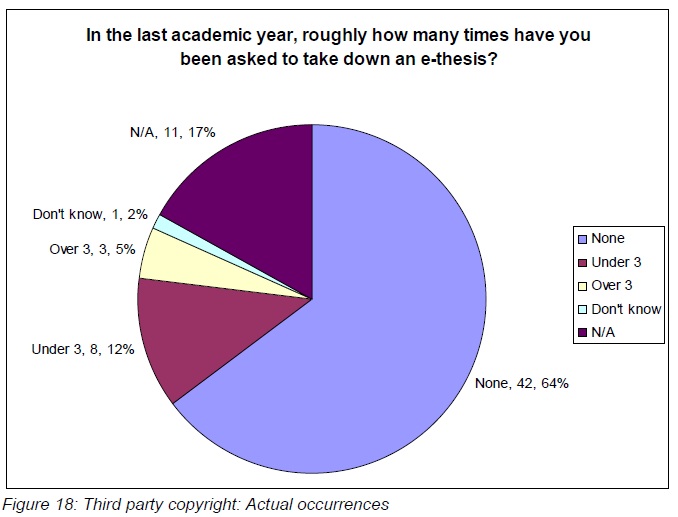
Well, it might, but in a recent survey only 7% of institutions cited this as a frequent concern amongst their students, and no concrete examples were found of publication being refused because the PhD thesis had been added to an open access repository. If reassurance is needed, then an embargo period can be applied, with may be the record plus abstract still being available to all.

2.    My work will be plagiarised

It’s possible, but then again people can plagiarise from printed theses too, and in those cases there’s no automated way to detect the crime.

Allowing open access to your thesis does open it up to all sorts of people who may come along and use the content in whatever way they like. But plagiarism detection services can help to mitigate the risks, and in EThOS at least, users have to register their details, so we could if necessary track all users of a particular thesis. So far that’s never been needed. And as people get more and more used to open access and theses become increasingly available in institutional repositories, it may be that the login process is becoming a tiresome deterrent to use and has had its day.

Brown J. (2010) Influencing the deposit of electronic theses in UK HE: report on a sector-wide survey into thesis deposit and open access. UCL. http://eprints.ucl.ac.uk/116819/

3.    All that hassle with third party copyright

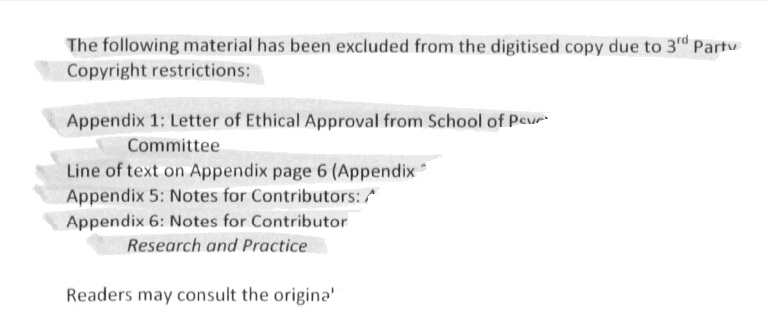
We do need to take copyright ownership seriously and it can be really time-consuming to seek permissions from any third party for permission to publish. Some university libraries are able to support their students to make sure any third party copyright is managed properly, but most don’t have the resources to undertake such a massive task. Take-down policies and embargoes come into play here, and digitisation services, whether through EThOS or another route, will carefully redact any sections, diagrams etc that aren’t copyright cleared on instruction from the institution.

List of redactions from a 2002 thesis held in EThOS.

The world of repositories and open access is moving fast. EThOS celebrated its third birthday last month. When it launched – on the same day as another auspicious event – theses were held in paper format in the university library and a microfilm copy held by the British Library. Now those microfilms have been packed away, and an average of 450 people a day download a copy of a full-text thesis from EThOS. With possibly the same number again accessing copies held directly in university open access repositories, it appears that full-text open access is here to stay.

Weekly Wisdom #75 by Paul Gray and David E. Drew

COMMUNICATING YOUR FIELD TO THE PUBLIC. Those who can communicate ideas from their discipline clearly to the public hold an important place in our society.  If you develop this skill, you can become a “public intellectual”.  Some highly successful public intellectuals in the recent past included astronomer Carl Sagan (Cornell) who had a television series, Daniel Patrick Moynihan (Harvard) who became a United States senator, and Stephen Jay Gould (Harvard) a broadly published a paleontologist and evolutionary biologist. Listed by your school’s PR department as an expert in your field, you can expect local (and sometimes national) media will ask for your comment.  If you are good on TV, you will be asked about all kinds of subjects, many beyond your expertise. Be careful not to pontificate about subjects where you know next to nothing.

Should You Make Your Thesis Available Online? Part 3: Thinking about Publishing

You have made your thesis available online, but does that affect whether or not it will get accepted for publication as a monograph? Academic publishers have varying opinions about this…

This is a very important issue for postdocs who are planning how to disseminate and publish the findings from their PhD research and an increasingly common question that academic publishers are now being asked. It was this question that originally kick-started my desire to run this blog series and start this conversation (#onlinethesis). I know that I am not the only one who has been dealing with this question either. One of the comments made in relation to Part 1 of this series was that a thesis that is available online is something that may be seen as problematic to publishers if a monograph based on a PhD is proposed. Others on Twitter are also interested in how publishers responded to this question. I contacted several publishers to find out more about this and these were the responses.

Jay Dew of University of Oklahoma Press informs me that this is a question he is frequently asked and his response is in favour of making theses online:

“On the whole, I don’t believe that having a dissertation or thesis available online works to the detriment of publishing a monograph. Indeed, more and more dissertations and theses are available online through library databases such as Dissertation Abstracts, etc. A dissertation and a book are two different things, with two different and distinct audiences. The revisions that are almost always necessary to bring a dissertation into book manuscript form are usually substantial enough that one need not cannibalize the other. There may be exceptions, of course, especially in the hard sciences, but at least for my press and the kinds of books we publish, this is not a problem.”

John Yates of University of Toronto Press extends this debate further arguing:

“I believe the situation in North America is different from yours [in the UK]. I understand that here all PhD thesis are licensed to ProQuest. I also understand that in Canada, theses are posted on-line by University libraries. Consequently scholars have quite a bit of work to do to convert their thesis into a scholarly monograph since libraries are not interested in purchasing titles that are effectively a thesis with minor revisions.

In your situation, if there is no requirement to post the thesis on-line and you’d like to have it published it as a monograph, I would think by not posting it on-line you’d be able to have the monograph published sooner, since fewer changes would be required than if the full thesis was publicly available on the web.”

The responses I have received in relation to this issue support the idea that making a thesis available online is generally acceptable to academic publishers, as long as the proposed monograph is substantially different to the submitted PhD thesis. Nonetheless, concerns are still evident amongst authors and researchers and it is recommended that potential publishers are contacted in advance of proposing a monograph to find out how they view this because opinions may vary depending on discipline and research topic. A more specialised research topic for example with a smaller market and audience may be seen as more problematic for some publishers if the material is already accessible online. It is possible to embargo the publication of your thesis in university depositories if this is considered an issue and you plan to propose a monograph but it is increasingly important to make this decision before the thesis is submitted, and made available electronically.

The key message then, is that the monograph based on a PhD thesis should be in substantially different format to the submitted PhD. Publishing houses from different countries are in agreement about this as presented here but it is important to be aware that making it available in an online depository may slow down the process of writing a book. It is also important to check the position of publishers who you wish to write book proposals for, to ensure that your decision is well informed. In a period of increased debate over open access to research, making the thesis online should not be, and doesn’t appear to be, a barrier to publishing a monograph but is certainly a consideration.