Browsing the archives for the Publishers tag

Part 3: Should you make your thesis available online? Thinking about publishing
Posted by atarrant

You have made your thesis available online, but does that affect whether or not it will get accepted for publication as a monograph? Academic publishers have varying opinions about this…

This is a very important issue for postdocs who are planning how to disseminate and publish the findings from their PhD research and an increasingly common question that academic publishers are now being asked. It was this question that originally kick-started my desire to run this blog series and start this conversation (#onlinethesis). I know that I am not the only one who has been dealing with this question either. One of the comments made in relation to Part 1 of this series was that a thesis that is available online is something that may be seen as problematic to publishers if a monograph based on a PhD is proposed. Others on Twitter are also interested in how publishers responded to this question. I contacted several publishers to find out more about this and these were the responses.

Jay Dew of University of Oklahoma Press informs me that this is a question he is frequently asked and his response is in favour of making theses online:

“On the whole, I don’t believe that having a dissertation or thesis available online works to the detriment of publishing a monograph. Indeed, more and more dissertations and theses are available online through library databases such as Dissertation Abstracts, etc. A dissertation and a book are two different things, with two different and distinct audiences. The revisions that are almost always necessary to bring a dissertation into book manuscript form are usually substantial enough that one need not cannibalize the other. There may be exceptions, of course, especially in the hard sciences, but at least for my press and the kinds of books we publish, this is not a problem.”

John Yates of University of Toronto Press extends this debate further arguing:

“I believe the situation in North America is different from yours [in the UK]. I understand that here all PhD thesis are licensed to ProQuest. I also understand that in Canada, theses are posted on-line by University libraries. Consequently scholars have quite a bit of work to do to convert their thesis into a scholarly monograph since libraries are not interested in purchasing titles that are effectively a thesis with minor revisions.

In your situation, if there is no requirement to post the thesis on-line and you’d like to have it published it as a monograph, I would think by not posting it on-line you’d be able to have the monograph published sooner, since fewer changes would be required than if the full thesis was publicly available on the web.”

The responses I have received in relation to this issue support the idea that making a thesis available online is generally acceptable to academic publishers, as long as the proposed monograph is substantially different to the submitted PhD thesis. Nonetheless, concerns are still evident amongst authors and researchers and it is recommended that potential publishers are contacted in advance of proposing a monograph to find out how they view this because opinions may vary depending on discipline and research topic. A more specialised research topic for example with a smaller market and audience may be seen as more problematic for some publishers if the material is already accessible online. It is possible to embargo the publication of your thesis in university depositories if this is considered an issue and you plan to propose a monograph but it is increasingly important to make this decision before the thesis is submitted, and made available electronically.

The key message then, is that the monograph based on a PhD thesis should be in substantially different format to the submitted PhD. Publishing houses from different countries are in agreement about this as presented here but it is important to be aware that making it available in an online depository may slow down the process of writing a book. It is also important to check the position of publishers who you wish to write book proposals for, to ensure that your decision is well informed. In a period of increased debate over open access to research, making the thesis online should not be, and doesn’t appear to be, a barrier to publishing a monograph but is certainly a consideration.

1 Comment Posted in Academic Life, Future of Academic Publishing, Online Thesis, Pitching & Publishing, Publishers, Research, Self Promotion, Uncategorized
Tagged , , , , , , , ,
The Now Frontier: Posting Dissertations Online
Posted by atarrant

A note from Anna: As part of a series of blogs on PhD2Published about Online Theses, Will Deyamport, III explains why he will definitely post his dissertation online. To engage in this conversation on Twitter please use the Online Thesis hashtag #thesisonline

Will Deyamport, III is an Ed.D student in Educational Leadership and Management at Capella University. He is the founder of peoplegogy.com, a blog that focuses on life and career developments. He is a monthly contributor to MyPathfinder Career Blog, where he writes about higher education. Currently, Will is writing his dissertation on how Twitter can support the professional learning needs of teachers.  You can follow him on twitter @peoplegogy.

This digital world we live in isn’t going anywhere. We pay bills online, we shop online, we make phone calls online, we date online, and now we’re streaming movies and going to school online. So why wouldn’t I post my dissertation online?

Has the academy become so insular that it has failed to understand and embrace the realities of this digital age? Has it become so arrogant that it believes that it can remain the sole guardian of academic knowledge? Or has the academy so blindly held on to its beliefs of what scholarly work is that it refuses to see this work being published on a daily basis on blogs around the globe?

Whatever its reasons, I plan to publish my dissertation online and here’s why:

  • I happen to have a passion for digital media and most of what I read is read online.
  • What I do and want to do for a career is done online. I’ve been a social media strategist, I blog, and I am earning my doctorate online. So for me the online space is a place of isn’t some separate entity. It’s a part of who I am and how I express my ideas.
  • I am a digital citizen. As such, I see the online world as the way for mobilizing the world towards a common humanity.
  • I routinely seek out information online. Whether it is via Youtube, LinkedIn, or my personal learning network on Twitter, I am able to gain access to experts from a variety of fields and disciplines.
  • I believe that academic knowledge belongs to the masses and should be made available and given freely to those who seek it.
  • My dissertation is on teachers using Twitter to support their own professional development.  The topic doesn’t belong is some bound book. It was meant to be posted online and shared with scholars and practitioners alike.

The ivory tower and those who worship at its feet need to understand that education is no longer insular. Holding information hostage does nothing for the academy or the betterment of society. In order to truly build a thriving academic knowledge-base and further the continued and expansive research expected in academia, technology has to be a part of how that research is shared and disseminated. Using emerging technologies, schools have the capacity to expose its students’ research to every corner of the globe. It is with this type of free exchange that the academy can reinvent itself and lead the way in today’s growing global economy and workforce.

Moving forward, I would like to see every doctoral student publish their dissertation on ProQuest or some other online platform. Just like TED has revolutionized the conference model, as current and future scholars, we have an opportunity to revolutionize the way people think, learn, and are taught about academic research.

1 Comment Posted in Academic Life, Future of Academic Publishing, Online Thesis, Publishers, Self Promotion
Tagged , , , , , , ,
Should you make your thesis more widely available online? Part 1
Posted by atarrant

A brief note from Anna: Being Managing Editor of PhD2Published has been a fantastic opportunity for me so far. It has introduced me to lots of interesting people and has helped me to think about key issues I am facing post-PhD. My current thinking is about whether or not to make my PhD thesis more readily available online. This post, which is the first in a series, explores this idea in more detail.

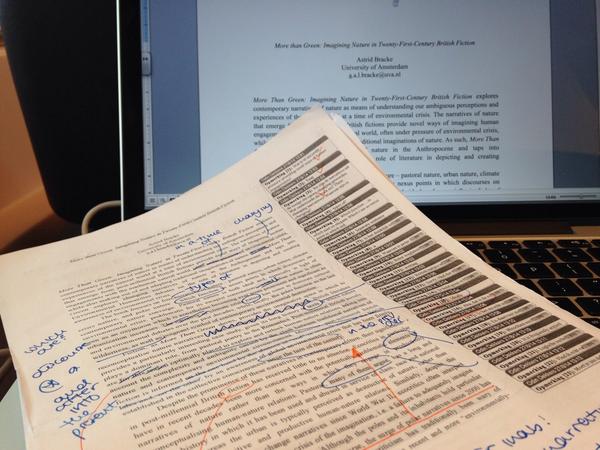
Impact has increasingly become an academic buzzword and requirement, which has led me to think much more about my PhD thesis, its accessibility and the impact it could (and should) have on a variety of audiences, both academic and public. I have heard from several colleagues that the only people who are ever likely to read the actual thesis are yourself and your supervisor (my family and friends certainly haven’t read it!). Frankly this seems wasteful and a bit sad (just look at the picture!), especially considering all of the hard work that went into it, including by myself, my participants and my supervisors. Even with the potential of developing publications and monographs from it in different formats, later on, in its unpublished form, my thesis is meaningful to me and took time and effort to construct.

This thinking prompted me to consider how I could make my thesis more accessible and more widely read, particularly in an age of social media and open access. Before launching into making it available online however, I wanted to do some research into the potential barriers to publishing online and the current debates that will inform this decision.

Following these musings, I posted this question on Twitter: “What are people’s opinions on making theses available online?” Several interesting and important issues and questions were raised. While limited,  there is already an emerging debate about the digital dissertation, which you can read about in this interesting and informative post by Alex Galarza for @GradHacker. There are several positives for doing this, and indeed many universities are now making it a requirement, if it isn’t already. @Gradhacker outlines that online material such as the unpublished thesis for example is still protected by copyright, useful to know if there is concern about the acknowledgement of your work. At the same time, in being overly cautious about protecting your thesis/dissertation you may risk restricting the development of your academic identity, online and otherwise. Furthermore (and some publishers may vary on this) putting your thesis/dissertation online may actually aid in the communication and appeal of your research to a variety of audiences and may even encourage sales of subsequent published work should you wish to publish it elsewhere in a different form. Twitter follower Christina Haralanova (@ludost11) has also received positive replies from people who have read hers.

Despite the many positives, I still think it is important to consider the range of different issues relating to putting a PhD thesis out there; issues that I will explore in a short series of blogs that will be posted here on PhD2Published in the coming weeks. These include posts I have constructed myself, and also opinion posts, and feedback from academic publishers. If any of this resonates and you have anything to add that has occurred to you, please do get in touch, either by Email or Twitter (@PhD2Published). Should you wish to join an online discussion on Twitter about the debate please use hashtag thesisonline (#thesisonline).

1 Comment Posted in Academic Life, Authors, Future of Academic Publishing, Online Thesis, Pitching & Publishing, Publishers, Self Promotion, Uncategorized
Tagged , , , , , , , , ,
Scientist Meets Publisher
Posted by Charlotte Frost

“Your manuscript has been accepted by the journal I own. Just sign here.”

1 Comment Posted in Academic Life, Future of Academic Publishing, Pitching & Publishing, Publishers, Video
Tagged , , , ,
We Ask Ken Wissoker: Do We Need to Rethink Academic Publishing?
Posted by Charlotte Frost

Image from: http://www.flickr.com/photos/pumpkincat210/with/3416918382/

Continuing to gather responses to the Guardian article by George Monbiot on the broken model of academic publishing, we asked Ken Wissoker, Editorial Director at Duke University Press, to wade into the debate. Here’s what he had to say:

I thought Monbiot’s article was very valuable for getting the word out about how the big publishers – especially Elsevier – but also Taylor and Francis and Wiley-Blackwell have extracted as much money as possible from university libraries. Elsevier pioneered this, coming up with big packages of journals that universities needed and pricing them as high as possible.  Universities with researchers in those areas (mostly science and medicine) had to pay or they weren’t supporting their professors. Since every journal was unique intellectual property, there was no competition and no market. If a library wanted to cancel a journal, Elsevier didn’t lower the price of the collection. This really was wealth extraction in a frightening and damaging form. So the article’s account of all that was a good wake-up call for those, including many academics, who were not aware of these changes over the last ten or fifteen years.  He is totally right about the infuriating way these arrangements cut out anyone without access to a university library. Continue Reading »

1 Comment Posted in Future of Academic Publishing, Market, News, Publishers, Uncategorized
Tagged , ,
We Ask Martin Paul Eve: Do We Need to Rethink Academic Publishing?
Posted by Charlotte Frost

In his Guardian article, George Monbiot makes an excellent case against the existing academic publishing industry. Knowing that Martin Paul Eve would have much to say, we asked if he’d like to address Monbiot’s points in advance of his talk at the UKSG next year.

George Monbiot builds a good case against the corporate publishing machine that dominates the academic world and his article has had portions of the Twittersphere buzzing. I am due to speak in the opening plenary of the UK Scholarly Group conference next year – the biggest gathering of librarians and academic publishers – to make a similar argument: we don’t need academic publishers. While I won’t reiterate every aspect of Monbiot’s piece, there are several aspects, here, that are worth unpicking, especially where I diverge from Monbiot’s stance.

Firstly, Monbiot approaches, but never directly engages with, the driver of prestige in academia. He mentions the necessity of publishing with high impact factor journals and states that we can “start reading” new OA journals, but can’t “stop reading the closed ones”. Actually, we can, but only if people stop publishing therein. This will not happen in the UK because of the Research Excellence Framework and its insistence that the higher “impact” band a journal, the more weight a piece will have. This is a delegation of the critical task of the researcher into the arms of a commercial entity. While peer review serves as a useful filter, merely trusting this, based on journals which achieve their prestige based on rejection rates, is a foolish move, driven by the equally foolish baseline of a research assessment dependent on corporations. The REF, alongside competition for academic jobs, drives this system.

Secondly, publishers are able to use institutional libraries as a shield to hide a researcher’s autosubversive behaviour. Consider that, by publishing in a closed, proprietary journal, a researcher actually limits his or her own access to material by constricting his or her own institution’s library budget. This is not how it appears to the researcher, though, because the spend is at one remove. Researchers publish for prestige and it is the library’s fault if material is not forthcoming. Open Access supported by commercial entities does make a researcher aware of the problems, because in this case they will be asked to pay up front. However, most reactions from researchers to this tend to be: “I don’t want to pay, let us revert to the model where I didn’t pay”. In this way, publishers have built a “command and control” system for an entity that functions, in its obfuscation, distribution and resilience, in a mode most akin to a piece of computer malware. Libraries must educate researchers of their own complicity in this web. Continue Reading »

7 Comments Posted in Future of Academic Publishing, Market, News, Publishers
Tagged , ,