Exact matches only
Search in title
Search in content
Search in comments
Search in excerpt
Search in posts
Search in pages
Search in groups
Search in users
Search in forums
Filter by Categories
Academic Practice
Academic Writing Month
AcWri
AcWriMo
Blogging and Social Media
Book Editing
Book Literature Review
Book Marketing and Impact
Book Planning
Book Proposals
Book Publishing
Book Writing
Books
Citations and Referencing
Collaboration
Community
Conference Paper Abstracts
Conference Paper Editing
Conference Paper Literature Review
Conference Paper Marketing and Impact
Conference Paper Planning
Conference Paper Presenting
Conference Paper Writing
Conference Papers
Digital Publishing
Experimental Digital Publishing
Grant Abstracts
Grant Completion Reporting
Grant Impact Statement
Grant Literature Review
Grant Methods Section
Grant Writing
Grants
Journal Article Abstracts
Journal Article Editing
Journal Article Literature Review
Journal Article Marketing and Impact
Journal Article Peer Review
Journal Article Planning
Journal Article Writing
Journal Articles
Networking
News
Open Access
Productivity
Reading and Note-Taking
Reseach Project Planning
Resources
Tools
Uncategorized
Website
Josie Dixon – From Planet PhD to Destination Publication: A Traveller’s Guide. Part 2. Micro vs Macro
http://www.flickr.com/photos/jopeattie/4012370776/

http://www.flickr.com/photos/jopeattie/4012370776/

This post is the second in a series by Josie Dixon, a consultant with 15 years’ experience in academic publishing, as Senior Commissioning Editor at Cambridge University Press and Publishing Director for the Academic Division at Palgrave Macmillan.  She now runs her own business, Lucian Consulting, and gives training workshops on publishing and other forms of research communication for postgraduates, postdocs and staff in over 50 universities internationally, alongside her training and consultancy work in the publishing industry. In this set of blog posts for PhD2Published, Josie examines some of the polarities between Planet PhD and the world of publishing, and offers strategies for how to bridge the gap. 

It’s well known that PhD stands for ‘piled high and deep’.  What’s sometimes harder to admit is that depth is usually achieved at the expense of breadth.  Burrowing down that scholarly rabbit hole inevitably limits the audience for a PhD, so when you’re thinking about publication, it’s vital to come up for air and look around at the larger field in which your burrow is located.  Managing the relationship between the ‘micro’ dimension (where the project is most specifically defined) and the ‘macro’ (where its broader applications may lie) will be key to maximising your chances of getting published.  Commissioning editors’ instinctive reaction to most thesis topics is that they’re too narrow to find a viable market in book form.  So unless you’re happy to publish in specialist journals, developing the macro dimension will be essential to making the transition from PhD to publication.

It’s worth recognising that the distance between the two has grown over the last couple of decades.  Universities have been under pressure to improve PhD completion rates, and one major instrument in a successful crackdown on this problem has been tighter control over the choice of thesis topics.  Today’s PhDs are better focused, but narrower than the more ambitious projects which waylaid academic career development in previous generations.  Meanwhile, in the publishing world, monograph sales have been falling year on year, and publishers’ efforts to shore up the viability of this form of publishing have focused on filtering out over-specialised titles and concentrating on broader topics.

The narrower focus of today’s PhDs is often exemplified in case studies.  Social scientists are generally taught to recognise, make explicit and theorise case-study research, to understand its value and also its limitations.  It’s not always readily acknowledged that this applies to the humanities too.  The study of a particular figure or theme or work (of art, literature, music, philosophy or theology) will be a limited exercise unless we explore its relationship with broader phenomena – the development of the genre, the culture of the period, wider intellectual movements or philosophical ideas.   To that extent, our chosen works or examples become case studies for these broader phenomena which are otherwise too large and diffuse to give meaningful boundaries to a project.  Without some version of the case-study principle, we’d all be embarking on that archetypally impossible search for the key to all mythologies.

When it comes to publishing, there’s a bigger imperative to develop and make explicit what your research yields beyond the terms of your case-study material.  If you are studying a topic which has received little attention to date, the very factor which helps to secure the originality of your research will also limit its audience (and the market for a publication), unless you can show what difference it makes to the mainstream of your discipline.  How will a new study of Charlotte Lennox change our view of eighteenth-century fiction or the development of women’s writing?  What impact will a study of Guicciardini have on our understanding of early modern political thought?  It’s easy to forget the need to elaborate on these larger implications when you have spent years burrowing down your own scholarly rabbit hole, but this factor will make a vital difference to the size of your audience and the level of interest you will be able to raise outside the circle of paid-up, card-carrying fellow-specialists in your sub-field.

The same is true when it comes to applications.  A typical linguistics PhD, offering a grammar and morphology of an endangered language with a tiny number of native speakers, would have an impossibly small market if pitched only to fellow specialists in that language.  But if the analytical framework developed can be applied to the study of other languages, then that macro dimension – in this case methodological – will open up a far wider potential readership with clear benefits for other scholars’ research.

Here are five key questions, to help you to take the macro perspective on your research:

i) Understand the limits of your PhD – first define your thesis topic at its most micro, according to all the relevant parameters such as region, time period, language, genre, approach, and the specific examples you have chosen to study in detail.  Then you will be better able to work outwards towards the macro.

ii) What is the larger significance of your research? Think about ways to locate your chosen topic in a broader context.   What is the contribution made by your research in relation to its own and related sub-fields, the larger discipline, methodological school, etc?

iii) How can you do justice to that breadth?  Think about ways to widen your coverage and bring those connections to the fore.

iv) What do you see as its larger implications? These can often be explored more freely in a publication than a PhD.

v) What will be its applications, in the hands of your readers?   Remember, the PhD was for you (and written for a couple of examiners), but publishers will want to know more about what value a publication offers to the reader, and what broader purposes your research will serve for them.


Josie Dixon – From Planet PhD to Destination Publication: A Traveller’s Guide. Part 1. Ivory Tower vs Shopping Mall

This post is the first in a series by Josie Dixon, a consultant with 15 years’ experience in academic publishing, as Senior Commissioning Editor at Cambridge University Press and Publishing Director for the Academic Division at Palgrave Macmillan.  She now runs her own business, Lucian Consulting, and gives training workshops on publishing and other forms of research communication for postgraduates, postdocs and staff in over 50 universities internationally, alongside her training and consultancy work in the publishing industry. In this new set of blog posts for PhD2Published, Josie examines some of the polarities between Planet PhD and the world of publishing, and offers strategies for how to bridge the gap. 

In this series:

  1. Ivory Tower vs Shopping Mall
  2. Micro vs Macro
  3. Passenger vs Driver
  4. Process vs Afterlife
  5. Features vs Benefits

There’s a great article by Peter Barry which appeared in the Times Higher Education under the headline ‘Footnotes and Fancy Free’.  Among many useful insights, Barry caricatures very effectively two opposing worldviews or value systems in academic research.  For residents of the Ivory Tower, it’s all about pure intellectual excellence, never mind who (or what) it’s for.  For those who inhabit the Shopping Mall, there needs to be a clear benefit to an identifiable audience, and ultimately some form of commercial value for a paying market.  Barry diagnoses a fundamental problem in the fact that all too often PhDs (particularly in the arts and humanities) are supervised and examined by Ivory Tower standards, yet at the postdoctoral stage, researchers are suddenly pitched headlong into the Shopping Mall.  This is of necessity where publishers live, since their business is dependent on realising a commercial return on the investment that is made in every new publication.

Profitability – at whatever level – is key to a sustainable publishing business, and even university presses (whose non-profit model is the least commercially driven in the industry) can’t avoid this fundamental pillar of the Shopping Mall.  The sources of subsidy which have long shored up large sectors of university press publishing (particularly in the US) are running dry, and editors are looking ever harder at the commercial factors which position a prospective publication on the right or wrong side of the margins of viability.  At the other end of the scale, many major players in the academic publishing industry are fully commercial businesses accountable to shareholders with steep demands when it comes to the return on their investment.  It’s a fine balancing act to reconcile editorial values based on intellectual quality (those ivory tower sympathies which bring graduates into publishing in the first place) with tough financial imperatives, but that’s the daily challenge for commissioning editors at commercial academic presses like Palgrave Macmillan, Routledge, Blackwell, Ashgate or Continuum, to name only a few.

So the first stage in your journey from PhD to publication has to involve stepping out of the Ivory Tower and into the Shopping Mall, in order to see your project from the publisher’s point of view.  Here are five key questions to ask yourself, to help you to take this more commercial perspective on your research:

  1. What’s your USP (unique selling point)?  Can you sum up the original contribution of your research in a few accessible sentences, and make it into a selling point?  Imagine a blurb in a publisher’s catalogue – your sales pitch needs to be aimed at non-specialists in the book trade and the library supply business, not your end-user academic readers.
  2. Who are you writing for?  Publishers respond best to projects pitched at a well-defined readership.  Beware losing focus by trying to be all things to all people, either in terms of level (a research monograph is not a textbook or a trade book) or subject (interdisciplinary projects run the risk of being peripheral to several markets and central to none).
  3. Why do they need it (and will they pay)?  In tough market conditions like the present, there is very little room for discretionary, nice-to-have purchases.  Even libraries are having to prioritise very carefully after severe budget cuts, so there must be a clear demand for your research before they will consider buying it.  This is closely related to the next question:
  4. What benefit does your research provide?  (not to you, but to the reader!) Think about the applications of your research – how will it be used, and where will it make a difference?  Is there a problem (intellectual or otherwise) to which your research offers a solution?  Are there methodological tools or reference features which your readers will find helpful?  Publishers are looking for something more tangible than ‘another new interpretation’ of the subject, or research that ‘fills a gap’.
  5. How international is its focus and appeal?  The UK is a small market, and these days even the US is insufficient to carry the commercial viability of an academic publication.  Publishers will be thinking about the appeal to international markets, so you need to, too.

For more detailed guidance on these and other factors essential to maximising your chances of success in a competitive publishing climate, come to one of Josie’s publishing workshops or contact her direct. 

Reflections on Taking the Intellectual Carving Knife to Your PhD Thesis by Mark Carrigan

Today‘s post follows a Twitter conversation @dratarrant had with our post author Mark Carrigan (@mark_carrigan) about the challenges and choices faced by those making the decision of how best to publish the material from their thesis. Mark is a doctoral researcher in the Department of Sociology at Warwick University and his own website can be viewed here. He also has his own podcast series here.

The tag line for this post?: “That awkward moment when you find yourself standing over your PhD thesis with an intellectual carving knife wondering what to do…”

I remember very distinctly the moment when I first took a figurative carving knife to my PhD thesis. I was in a careers workshop at a conference and a senior academic had just explained how the oh-so-rational metric of the REF placed the same value on monographs and journal articles. From the start of my PhD I’d always been drawn to the prospect of publishing it as a monograph, drawing together years of work and sending it out into the world in a pretty package with a shiny cover. I liked the idea of turning my thesis into something which would be read by people other than my parents, supervisors and examiners. Perhaps even something that people responded to? Yet I also wanted a job and, at the same time as I was growing attached to the idea of the monograph, I was also rapidly internalizing that horrible motif which plagues the psyches of aspiring academics everywhere: publish or perish. As much as I liked the idea of a monograph, I liked the idea of getting a job more. So upon learning the value of a monograph relative to a paper, I picked up the intellectual knife and started to ponder how many choice cuts I could get from my thesis.

After an afternoon of hacking away at my planned thesis, it turned out I could spin off a lot of papers. Sure there would be repetition and overlap but that’s inevitable, right? In the months since then, this sense of inevitability has troubled me. I realized how quickly and deeply I’d come to accept the ‘rules of the game’, making plans that were entirely contrary to what I believed and cared about because I couldn’t see any choice other than submitting to the logic that defines the contemporary academy if I wanted a career within it. Which left me with the obvious question: did I want a career within it? The perverse eagerness with which I instrumentally carved up my long treasured post-PhD monograph became symptomatic of everything I disliked about the modern university. The fact that just three years of a PhD, framed in terms of ‘playing the game’ in order to win autonomy within it, had left me able to be so thoughtlessly instrumental truly worried me. If this was what academia would do to me then I didn’t want to be an academic.

Since then I’ve relented somewhat, partly due to realizing that there was no need to see it as a matter of being entirely in or entirely out of the university. But mostly through talking to  friends, some in similar situations and others with no connection to higher education, about these questions and why they troubled me. If we want academic careers after we finish our PhDs then, inevitably, we have to make some sacrifices. If we want to be employable then we, at least to some extent, have to make choices that fit the imperatives of institutions within which we seek employment. But if we’re doing this because we care about it then we need to constantly ask ‘why?’ at every stage. We need to be clear that we’re doing what we do because we CHOOSE to rather than because we’ve internalized a set of perverse imperatives which actively erode the values that motivate us. We have to continue to look for alternatives to passively reproducing the demands of neoliberal academia. Otherwise I fear we’re going to look in the mirror twenty years from now and wonder what the point of it all was.

Weekly Wisdom #68 by Paul Gray and David E. Drew

REUSE THE LITERATURE SEARCH FROM YOUR DISSERTATION. If you conducted a thorough literature search for your dissertation, you will never need to do one again as long as you write in the same area. If you write in an adjacent field or on an adjacent topic or want to include the latest reference, your cycle time for the literature search is much, much shorter. Remember too that your students or graduate assistants will perform some of the slogging that needs to be done.

Weekly Wisdom #65 by Paul Gray and David E. Drew

PREPARE AN “ELEVATOR SPEECH”. Throughout your PhD studies, your professors grounded you in your discipline and taught you all the caveats and disclaimers that must accompany your scholarly research.  Then, in the dissertation defense, and afterwards, for example when you seek a job, you will be asked to succinctly summarize your work and what it means. Imagine that you are attending a national conference.  You step into an express elevator on the 45th floor of the building, and push “lobby”.  the only other person in the elevator is, say the senior Federal policy maker in your area of interest, for example, the National Endowment for the Humanities or the President’s Science Advisor, or the chair of the department you really want to interview for a job.  He or she says that they heard that you completed an important dissertation study.  S/he explains that s/he would like to know about your research, but,given a packed schedule, only has this elevator ride to learn about your work.  What do you tell them?


Weekly Wisdom #62 by Paul Gray and David E. Drew

PUBLISH EARLY AND OFTEN as they say in Chicago. Begin writ­ing for publication while you are still in graduate school. Data shows that people who publish while still in graduate school usually con­tinue to publish at a faster rate after they graduate than those who didn’t publish while still a student. Furthermore, published papers and monographs help you get your first job.

Weekly Wisdom #61 by Paul Gray and David E. Drew

WRITE A CROSS-OVER BOOK. Professors build their reputations by publishing articles and books in their specialty. Almost always, their only readers are other professors, graduate students, and their own family. Sometimes, however, a faculty member produces a successful crossover book, a work respected by, and receiving laudatory reviews from, his or her academic colleagues while also selling well with the general public.

Such books are difficult to write, however. If your book is to fly off the shelves at bookstores such as Barnes and Noble, it has to be both readable and entertaining. Few people reach the level of clear and creative writing required. Furthermore, even among highly skilled professional nonfiction writers, New York Times best sellers are rare. Nonetheless, some university scholars have written best sellers. They include  Peter Drucker, Margaret Mead, Paul Krugman, Gail Kearns Goodwin, and Stephen Hawking. We believe that professors who produce crossover books perform a valuable public service. Unless you become a world-class public intellectual like the people in the above paragraph, you may be denigrated by your academic peers as a mere popularizer. A false equation that does not work mathematically, but still describes the behavior of many misguided professors:  excellent technical productivity plus commercial success is respected less than excellent technical productivity alone.

Editors Love Authors Who Understand Publishing – Patrick H. Alexander in the Chronicle
http://www.flickr.com/photos/kavo1/526298447/
http://www.flickr.com/photos/kavo1/526298447/

Patrick H. Alexander (Director of Pennsylvania State University Press) has written a really useful article for the Chronicle entitled:  The Less-Obvious Elements of an Effective Book Proposal. He points out all the important things about getting your pitch right, making a thesis-based manuscript less thesis-y and, of course, not making any silly spelling mistakes.

Perhaps particularly interesting, however, is that he mentions the need for scholars to understand publishing and ‘get involved’. Regular readers of PhD2Published will know that this is one of the main reasons I set up this website. It seemed crazy for me to pitch a book to a publisher without knowing more about what publishing entails. How could I hope to be a part of a publishing engine if I didn’t understand what all the other parts did and how we’d work together? So I was really pleased to see Alexander point out that ‘editors love authors who understand publishing’. Read more

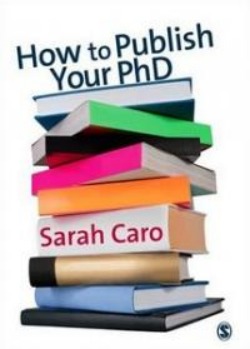
Review of How to Publish Your PhD

As a PhD student puzzled and disorientated by the seemingly impenetrable complexity of academic publishing, reading How to Publish your PhD by Sarah Caro was a balm for my anxieties. At present, I find myself occupying a point on the winding and erratic road to doctoral submission at which I am grateful (sometimes pathetically so) for advice, any advice, about demystifying academia. Having read several books on thesis writing early in my doctoral research, I had yet to discover a book that convincingly dealt with the practicalities of publishing a book from one’s thesis. In this ‘publish or perish’ world, it is really never to early to begin thinking about ‘the m word’. Monograph. Even reading the word itself gives me the willies.

This thin volume (a sprightly 136 pages) is packed with valuable material for the angst-ridden PhD student with no idea of where to start, or the confused early career academic staring down the barrel of their first monograph. Filled with sensible advice and divided into self-evidently useful chapters such as ‘Books or Articles?’ and ‘Revising your PhD’, Caro has created a text to be read, re-read and referred to when needed. Every chapter is summarised in point form, making quick checks exceedingly simple. As the current Publisher for Economics and Management journals at Wiley and obvious veteran of the publishing world, Caro is ideally suited to be the author of such a book.

The text provides the reader with a series of things that a would-be creator of an academic monograph can do to help themselves, with particular focus on small and yet oft-overlooked details. Attentiveness to these details, according to Caro, can mean the difference between a submission ending up in the ‘no’ pile or the ‘maybe’ pile (p. vi). To say that Caro has thought of everything in this book would naturally be an exaggeration, but it is definitely fair to say that the book contains all of the major aspects of importance to the author. Given that these points are based on years of experience, I am inclined to believe that they are significant. Read more

Pip Bruce Ferguson On “Getting Published” – a Workshop for PhD Students and Staff at the University of Waikato
http://www.flickr.com/photos/barbourians/5365888653/

http://www.flickr.com/photos/barbourians/5365888653/

This post is by Pip Bruce Ferguson, Teaching Developer at The University of Waikato. Hamilton, New Zealand”

Two weeks back I facilitated a workshop that was advertised to a combination of PhD students plus staff at this University, where I work as a Teaching Developer. While my unit doesn’t work directly with PhD students nor supervise them, we do offer ‘Supervisory Conversations’ in conjunction with our Pro Vice Chancellor (Postgraduate), and have done for a couple of years now. These have been an effective way of supporting our supervisors, but have rarely included PhD students. We offer them in a beautiful location on campus, away from main teaching rooms, and provide a finger-food lunch.

Hospitality is important in New Zealand, and getting away from the hustle and bustle of ‘normal’ work and having time to discuss and reflect is very important to our supervisors, who can participate in cross-disciplinary discussion at these events.

Because of the pressure for staff to publish under our Performance-Based Research Fund (the New Zealand equivalent of the U.K.’s Research Assessment Exercise, but funded by rating individuals rather than units) we decided to offer a workshop on how to get published. This was also advertised to PhD students, and the workshop attracted a significant cohort of these, mainly international students. As with the conversations mentioned above, we offered morning tea, some resources such as hardbound notebooks and highlighters to help with the inevitable handouts (!) and an environment where people could ‘come apart’ from their normal workplace. Read more

Weekly Wisdom #57 by Paul Gray and David E. Drew

PUBLICATIONS ARE THE ONLY FORM OF PORTABLE WEALTH.  Teaching is a great personal satisfaction and an important public good that you perform. It is an important, necessary condition but not a sufficient one for being hired or tenured.

Claire Warden – Interdisciplinarity: Variety Is the Spice of (Academic) Life

In this post Claire Warden, lecturer in Drama at Lincoln University, returns with another guest post, this time looking at the issues surrounding interdisciplinarity. You can follow Claire on twitter here. Recently I went to an Iron Maiden gig in Nottingham. Earlier in the day I had attended a yoga class and had then grabbed some sushi for lunch. Not owning an ‘Eddie’ top I decided to wear my Peter Gabriel 2003 tour t-shirt instead. An insightful friend called me ‘eclectic’ and I must admit that in all areas of life I rejoice in my slightly unusual day-to-day combinations: a lover of progressive rock but also a former classical soprano, a devotee of professional wrestling but also a reader of verbose Victorian novels. My friend is clearly right…I am nothing if not eclectic. This approach (call it eccentric if you will) actually impacts my work daily and I am starting to feel its effects more and more keenly.

In my last article for ‘PhD2published’ I briefly mentioned the importance of developing an interdisciplinary approach, of connecting our work with (or at least reading it alongside) the ideas of others outside of our immediate field. In this article I want to briefly begin to explore why and how this can be done. Read more

Kevin Ward – Writing an Academic book – Some Thoughts

Following on from my appearence on the panel at RGS Postgraduate ForumAnnual Conference Training Symposium (PGF-ACTS) last week I present the first of three posts from the speakers on publishing. Todays post looks at writing and academic book and is brought to you by Professor Kevin Ward. Kevin is Professor of Human Geography at Manchester University and has been the Editor of Area a journal published on behalf of the Royal Geographical Society (with The Institute of British Geographers) since 2010.

So, you’ve decided that you are going to write an academic book.  Well, here are five tips:

1. It is worth considering the sort of book you want to write.  Look at publishers’ websites and consider the following: 

– Does the publisher produce the type of book that you want to write in your field?

– Are hardback and paperback versions of the book published simultaneously?  If not, how many hardbacks does your book have to sell before the publisher will commission a paperback run?

– What marketing and distribution system does the publisher have?

– Does the publisher send out copies to academic journals for review?

– Does the publisher attend large academic conferences and participate in book exhibitions? Read more

PhD2Published @ Royal Geographical Society Annual Conference

As a Geographer I am very proud to say that today I will be representing PhD2Published at the Royal Geographical Society Annual Conference. I have been asked to be on the panel for the Postgraduate Forum Annual Conference Training Symposium (PGF-ACTS). The purpose of the postgraduate forum is outlined below: Read more

Getting from PhD to Published at InterFace 2011
I was really excited to speak at the amazing InterFace 2011 humanities and technology conference on the 29th July at UCL. It was organised by a really diverse and highly-skilled group of PhD students and it was such a pleasure to be involved with.
I spoke on ‘Getting from PhD2Published’ as part of a session on publishing. My Prezi is below and for the rest of the contributors head over to the publishing page on the InterFace website.