Exact matches only
Search in title
Search in content
Search in comments
Search in excerpt
Search in posts
Search in pages
Search in groups
Search in users
Search in forums
Filter by Categories
Academic Practice
Academic Writing Month
AcWri
AcWriMo
Blogging and Social Media
Book Editing
Book Literature Review
Book Marketing and Impact
Book Planning
Book Proposals
Book Publishing
Book Writing
Books
Citations and Referencing
Collaboration
Community
Conference Paper Abstracts
Conference Paper Editing
Conference Paper Literature Review
Conference Paper Marketing and Impact
Conference Paper Planning
Conference Paper Presenting
Conference Paper Writing
Conference Papers
Digital Publishing
Experimental Digital Publishing
Grant Abstracts
Grant Completion Reporting
Grant Impact Statement
Grant Literature Review
Grant Methods Section
Grant Writing
Grants
Journal Article Abstracts
Journal Article Editing
Journal Article Literature Review
Journal Article Marketing and Impact
Journal Article Peer Review
Journal Article Planning
Journal Article Writing
Journal Articles
Networking
News
Open Access
Productivity
Reading and Note-Taking
Reseach Project Planning
Resources
Tools
Uncategorized
Website
Writing the Second Book—Week 1 by Allan Johnson

Writing the Second BookAllan Johnson is Assistant Professor in English Literature at City University of Hong Kong.  He is the author of Alan Hollinghurst and the Vitality of Influence (Palgrave Macmillan, 2014) as well as articles and chapters on an array of writers including James, Stoker, Conan Doyle, Shaw, Forster, Woolf, Eliot, Cather, Waugh, Doctorow, and Hollinghurst.  You can find ot more about Allan at his website: http://thisisallan.com, and follow him on Twitter @thisisallan.  Below is his reflection of writing process.

I was fairly certain that my second book would be rather a lot more straightforward than my first.  My first book, based largely on my doctoral thesis, began life during three chaotic postgraduate years throughout which I seemed to be writing every moment of the day, was next completely reshaped once I began my first academic job, and then finally went through several more revisions while working with editors and readers at Palgrave Macmillian.  It was nearly six years of false starts, abandoned topics, and the sort of writerly malaise that frequently besets persons of the tweed.

Surely the second book was going to be an easier undertaking…

For AcWriMo 2015 I have committed to finishing my second book, which, after nearly two years of flat-out work, is now nearly complete.  I began the project certain that I had learned from my previous mistakes and knew how to independently manage a book project.  When I was writing my first book I became obsessed with time management strategies, and read nearly every book on the topic (David Allen’s Getting Things Done is still a classic, and should probably be required reading for every new postgraduate student).  I learned how to manage goals, track progress, and plan my time, and with the constant, supportive motivation from my supervisor and the rest of my PhD cohort I was able to achieve what I had set out to do.  But when it came time to begin my second book, I realised that the core support network surrounding research student was no longer there, that no one would be pushing me to finish, and that suddenly I had to apply a very different type of energy to the project.

After several months of settling into a new city and trying somewhat unsuccessful to get to work on my second book, I began to read about the difference between time management and energy management, a theory developed by business writer Tony Schwartz.  If my second book was ever going to see the light of day, I needed to understand how to manage the energy required for the project, and, indeed, figure out what that energy even was.

Wisdom abounds about the difference between the drafting and rewriting stages of the writing process—it’s one of first things that composition students learn about—but to my mind, and especially when considered in the context of long-form writing, the vital difference between drafting and rewriting is the nature of energy involved.  Each stage relies on radically different forms of thinking, focus, and commitment, and taxes your intellectual and emotional reserves in rather distinctive ways.

Drafting Rewriting
Creative exuberance Analytical precision
‘Right-brain’ invention ‘Left-brain’ evaluation
Finding the connections Shaping the argument
Imagining the big picture Focusing on the details
Writing to think Writing to be understood


It’s a rare, perhaps completely imaginary, academic who can spend six uninterrupted hours committing words to the page in a first draft; equally as rare is someone willing to spend the same length of time revising and editing an early draft.  We’ve all managed to do that a few times with a looming deadline or a conference presentation the next morning, but ultimately it is not sustainable.

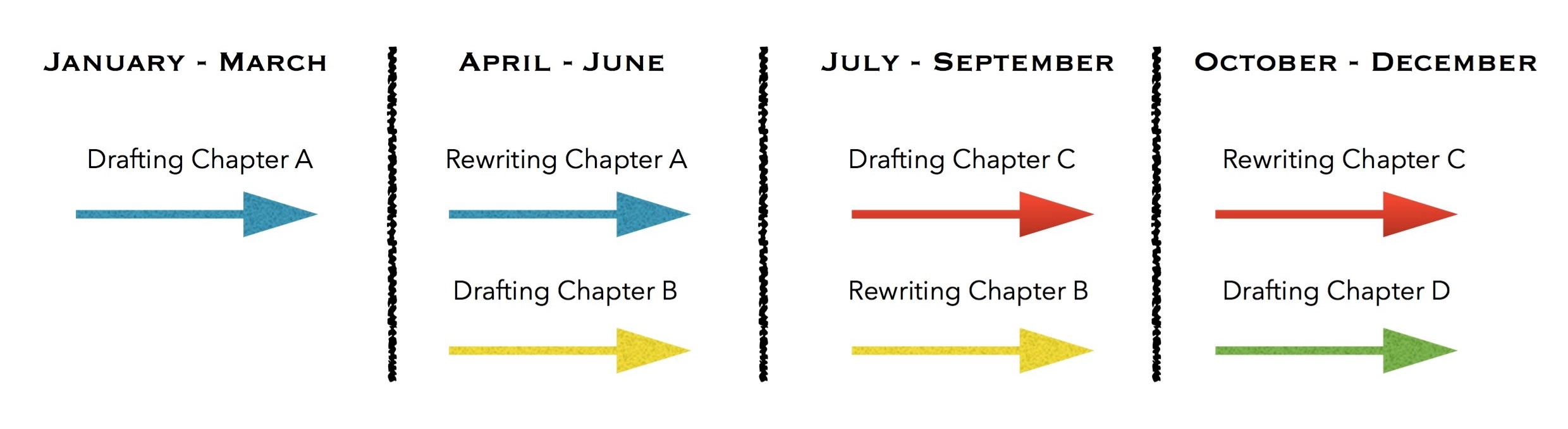
What is sustainable, however, is managing energy in a way which allows for these two processes to be interwoven.  With a bit of focus, it’s not too difficult to spend three hours drafting in the morning and then three hours rewriting something else later in the afternoon.  The schedule that I set for myself took this into account, and tried to make best use of my energy resources by dovetailing these two distinct aspects of the process.

Dovetailing the Writing Process (The Plan)
aj1


The schedule I set for myself broke down the year into quarters, and aimed to allow time for the creative exuberance of drafting alongside the analytical precision required of rewriting without burning out.  Managing my energy by dividing my attention between these two unique taxing stages of writing meant that I could produce three chapters each year, and, ideally, a full manuscript in two years.  In practice the process was a bit less orderly.

Dovetailing the Writing Process (The Reality)

aj2


I have kept an Evernote note to organise and record progress on my research since I began my job at City University of Hong Kong.  For three years I have reviewed and updated the table at the end of each month.  While the table reminds me that I am very close to finishing the second book, it also doesn’t allow me to forget that my writing in 2013 moved around chaotically between several different projects.  There was no clear strategy.   Two of the articles in which I invested some considerable time (referred to here vaguely as ‘Gatiss’ and ‘Joyce’, and about which no more shall ever be said) ultimately had to be abandoned.  I became quickly dazed during drafting and, with no clear sense of how to proceed with the work, left them behind.

But in January 2014 I began my first attempt at dovetailing the writing process in order to better manage my energy and avoid sacrificing any more writing.  Although my final record of work isn’t quite as orderly as my initial plans, I did manage to largely achieve what I had set out to do, and (if my AcWriMo goal is achieved) do it with one month to spare. By managing my energy rather than my time, I was able to produce considerably more work of publishable quality than I did during the wholly discouraging year before I began the second book.


Weekly Wisdom: Brought to you by the Letter Q

BoxesQuestion your questions. Your research question is the first step to putting your ideas into action. The process involves forming viable research questions that address what interests you, indicate a trajectory for your research, and make a contribution to the field. Yet the first questions you articulate may not be the final questions you answer. Throughout your research, be sure to question your questions. Are you asking the best questions? Might your research take a novel approach if you ask it another way? Does your question have an easy answer? Does it get you where you want to go?


Weekly Wisdom: Brought to you by the Letter M

BoxesHave a meeting. Rather than have a meeting about your project, have a meeting with your project. Maybe you’ve assigned a pet name to your research project, or otherwise seen that it has some anthropomorphic qualities. Imagine that your project has a persona. Fix it a cup of coffee or a cup of tea. Write an agenda if it would be helpful. Then you two can talk. What’s going well? Where does Project need more help? How has Project been successful? What resources can Project benefit from? What are your concerns? What do you need from Project? How can you help it along? It’s best recommended to not have this project meeting in public spaces…and you both might appreciate some privacy for your discussion.

#acwri Twitter Chat: Dealing with Reviewer Comments
Weekly Wisdom: Brought to you by the Letter K

BoxesKeywords. Every discipline has its jargon, as well as its most significant keywords that are used frequently by scholars and others. Yet meanings shift over time, and certainly change from one discipline to another. Your use of these keywords includes all of the possibly connotations and interpretations by scholars who come before you. It is up to you to define your keywords specific to your usage and context. Those definitions can offer clarity, and can also indicate new directions in your research and findings.


Weekly Wisdom: Brought to you by the Letter I

BoxesBe inspired. This may seem like an impossible request for those of us who struggle to come to the page and begin writing. However, where inspiration appears difficult, it can be made simple. Imagine your positive outcomes. Imagine your success. Imagine yourself deeply engaged in the flow of writing and thinking, and how satisfying that feeling can be. Some of us are inspired by process, others by product. Figure out what works for you and imagine yourself in a space where your goals are easily achieved. It may seem far-fetched, but it can also be inspiring.

Weekly Wishdom: Brought to you by the Letter H

BoxesIt’s going to be hard. If writing and research were easy, would we value our publishing successes so much? There is quite a lot of advice across the Internet (and certainly plenty here at PhD2Published) about how we might make these processes easier. But the work might begin best by acknowledging that it is hard. Perhaps that can minimize the frustrations that arise when what feels like it should flow ends up stalling, and when it is hard to find the place to start.


Weekly Wisdom: Brought you by the Letter F

BoxesFinish. Consider finish as both a verb and a noun. Many Western cultures lack good means for coming to closure, whether in telephone conversations or in wrapping up a writing project. The old adage “nothing inspires like deadlines” is as much about creating a terminus as it is about expediting one’s work on the page. Set a date to finish your writing project, and stick to it. When you meet your deadline, celebrate it.

Looking at finish as a noun is also to look at final, as in final chapters. A wise scholar once suggested that beginning your reading with the final chapter of a scholarly book will demonstrate whether the book is useful for your research. The finish line of a good monograph reviews all of the arguments, the conclusions, and the shortcomings of the preceding text. Start at the finish and save yourself some research and reading time.


Weekly Wisdom: Brought to you by the Letter C

BoxesCraft and care. It’s sometimes difficult to find the best word to describe what we do when we’re engaged in academic endeavors. Terms like “craft” seem to fall into the domain of creative work, with responsible ownership by the poets and novelists of the world. “Writing” and “research” lack the aspects of craft, care, and concern that academic authors bring to what they create. It’s more than “work” too: that word evokes a kind of drudgery that falls short of embracing the deep immersion, the discovery, and the pleasures that academic craft can bring about. Would it be revolutionary to think of ourselves as academic craftspeople? A different term might bring a different perspective–not only for others, but also for ourselves.

Weekly Wisdom: brought to you by the Letter B

BoxesBe bold. Look back through your draft and see how frequently you use hedging language. How often does the word “seems” appear? Is there a good bit of “maybe” and “might”? If you have invested substantial time, intellect, and creativity in developing your argument and arriving at your conclusions, be bold in reporting your results. If you seem doubtful or skeptical, your readers will be as well.


Weekly wisdom: tips and tweaks #61 by Linda Levitt

Diorama_-_19_(8126284371)Forgo resolutions and write a statement of purpose instead. With the new year around the corner, many of us have given thought to what we hope to accomplish in 2015. From quitting one habit to adopting another, many aspirations are affirmed on new year’s eve. While we often resolve what to do, how often do we articulate why we want to do it? As a writer, researcher, and scholar, what is your fundamental purpose? Examining why we do what we do can facilitate progress and productivity. Your statement of purpose can also be a reminder to stay on track when struggles arise.


Weekly wisdom: tips and tweaks #59 by Linda Levitt

Diorama_-_19_(8126284371)Put a new spin on your research topic. Filmmaker and artist Ze Frank describes his process for getting unstuck by considering the extremes of something: What if we had a scarcity of X? What if we had an overwhelming amount of X? Sometimes it is difficult to step away from our set relationship with our topics and see things from a different perspective. Yet doing so can provide new insight into our areas of research expertise. Even ridiculous questions can yield helpful perspectives. If aliens landed on earth and I had to explain X, what would I say? If a baby put X in its mouth, what would it taste like? What color would this thing be? If it were part of a cargo cult, why would it be revered? Do we cherish X? Do we deplore it?


Reflections on #AcWriMo by Matt Lawson
Creative Commons photo by Michael Coghlan

Creative Commons photo by Michael Coghlan

Matt Lawson is a final year funded PhD candidate in film musicology. His thesis is entitled ‘Scoring the Holocaust: a comparative, theoretical analysis of the function of film music in German Holocaust cinema’. You can find out more about Matt at his website: www.themusicologist.co.uk, and follow him on Twitter @MattLawsonPhD.

After a fantastic month in Germany, I am now back in the UK. Is it a case of proudly looking over what I’ve achieved, or licking my wounds after an unproductive month? Well I’m delighted to announce that it’s the former! I have had one of my most productive months of writing in the short history of my PhD.

It was always going to be a challenge working in a foreign country for a month, but they say “change is as good as a rest”, and the different scenery and culture helped a great deal with my productivity.

After my interim report stated that I’d made a solid start, things got even better in the following week, meaning—and I take a deep breath as I type this—I have returned to England with a final first draft of my PhD thesis! It’s an incredible feeling, and one I didn’t expect when I flew out on October 31st, but the month away has propelled me into a very strong position.

How did I make it work for me? Well, as previously highlighted, I made use of daylight hours by sightseeing, hiking, taking photographs and generally forgetting about research. Mentally and physically, this was important. Then, when it got dark at 4.30pm, I wrote until around 9.30pm each evening, with breaks for drinks and a meal. I repeated this Monday to Friday, and took weekends off.

Over the course of three weeks, I managed to write 14,000 words using this method. The final week, it was decided early on, would be a break as a reward for working hard. I cannot recommend taking a week off enough. It is the first time in over two years of PhD research that I have truly abandoned my research for a week. I didn’t think about it, I didn’t check emails, I didn’t even open my laptop on some days. The impact on my wellbeing was incredible. From feeling proud of my efforts, but also a little stressed to say the least, I returned to England invigorated, refreshed and as enthused as the day I began my PhD journey. As I tweak and polish my thesis in the run up to Christmas, I have already promised myself two weeks with no PhD over the festive break.

In conclusion, I look back with fondness on a country and experience which worked wonders on my PhD productivity, and perhaps there is something to be said for a 3 week/1 week working pattern, giving the body and mind time to recover before the next stretch of research.

Weekly wisdom: tips and tweaks #57 by Linda Levitt

Diorama_-_19_(8126284371)Engage in bracketing. This is a tip that comes from conflict management, and it carries over well to research and writing. When we are engaged in conflict, many different issues and concerns might come to the fore. If those issues create a digression, the original source of conflict might get lost and might never get resolved. Instead, the effort toward resolution turns into an even muddier puddle. In managing conflict, you should be mindful of those side issues and point out that they should be bracketed for a later conversation, once the current conflict is resolved.

As interested, engaged researchers and writers, we often find side interests that might take us down rabbit holes. This happens even after you have stopped reading your email and shut down your internet connection. Keep a notepad or an open document where you can jot down the “save for later” topics and keep yourself on track.


AcWriMo in the Alps: Part II by Matt Lawson
Creative Commons photo by Michael Coghlan

Creative Commons photo by Michael Coghlan

Matt Lawson is a final year funded PhD candidate in film musicology. His thesis is entitled ‘Scoring the Holocaust: a comparative, theoretical analysis of the function of film music in German Holocaust cinema’. You can find out more about Matt at his website: www.themusicologist.co.uk, and follow him on Twitter @MattLawsonPhD. His mid-point AcWriMo reflection follows below.

So – half way through. How are things going? Well, this weekend (Saturday 15th/Sunday 16th) is one I have designated as a weekend off. I will be watching Germany score many goals past Gibraltar in Nuremberg on Friday evening, and then allowing myself a little sightseeing and relaxing on the Saturday and Sunday.

‘What about the PhD?’, I hear you ask. Well, it’s going satisfactorily well! I know that doesn’t sound like I’m dancing around the Alpine lodge in excitement, but I’m content with my progress. Let’s do some number crunching. I arrived in Germany with 57,096 words, and as I go into my free weekend, that has blossomed to 65,281. I’ve worked on ten of the eleven days up from my arrival on 2nd November up to and including Wednesday 12th November, giving me an average of 818 words per day. That’s good going. I was aiming for 1,000, but with my thesis being in a fairly ‘completed’ state, that would perhaps be overdoing it. My realistic aim now is to head back to England with my thesis anywhere in the 70-80,000 range. Whether that is 70,001 or 80,000 remains to be seen, but I’ll be delighted with anything in between. That will give me three weeks before Christmas to edit what I’ve written, print, bind and hand in a full first draft.

What I would also like to mention in this instalment is how I have kept myself sane while I have been here. As mentioned in the previous post, isolation and loneliness are two of the down sides to a doctoral programme which have affected me deeply over the past year or so. I won’t lie: there have been evenings where I have felt these keenly since the beginning of the month, but I have coping mechanisms. One of these, which can only be good news for my mental AND physical health, is to walk ridiculous amounts during daylight hours, and work at night. It seems such a shame not to experience the country I have so kindly been given access to by my funding body, and with the sun going down at around 4:30pm, it seems counterproductive to sit inside pretending to write my thesis while I looking out of the window at the blue skies. I have clocked up countless miles up mountains, down valleys, around lakes and so forth, and have been back in my accommodation by 4:30pm each day to commence 4-5 hours of writing once it’s dark. It’s worked a treat, and my productivity is helped by the fact that for some of the walk, I’m planning what to write when I return!

This weekend off will give me a good chance to try and forget about the PhD (ha!), and clear my mind before the start of the next working week. To be honest, I’d quite like some horrible weather, because then it’d force me to some extent to stay inside and get lots done. At the same time, given what I’ve mentioned above, getting out and about is important. A PhD sometimes causes us to lose touch of reality somewhat, and there’s nothing that screams reality like being up a 6,000ft mountain wondering how you’re going to get down!

Half way through, and my report would read ‘satisfactory progress, but could do better’. Without putting too much pressure on myself, I’m hoping for a decent next couple of weeks to return to England knowing I’ve done everything I could have done to give me the best possible chance of handing a first draft in that I’m both happy and proud of.

‘Write like there’s no December’, is one quote I’ve seen banded around with regards to #AcWriMo. I like that a lot. However, I know that there’ll be a December, and that feeds my Alpine procrastination somewhat…