Browsing the archives for the PhD tag

Part 4: Should you make your thesis available online?: Introducing EthOS by Sara Gould
Posted by atarrant

Today’s post, which contributes to our series about publishing dissertations and theses online is written by Sara Gould. Sara is the EThOS Service Manager at the British Library, UK. She is managing the transition of this e-theses website to a sustainable Higher Education shared service.

Anna has been wondering whether to publish her thesis. Or if not ‘publish’ then put it online somewhere to share the results of her work more widely, and gain the benefits she mentions, like raising the level of interest in her research and making connections with like-minded researchers.

EThOS is the UK’s e-theses website that gives instant access to 55,000+ doctoral theses. Pretty much all UK universities have their theses listed in EThOS so there’s around 300,000 records in all, with a variety of routes to get hold of the full text if it’s not already available.

That’s a fantastic resource for students and all researchers, not just to be able to dig deep into research that’s already happened, but to see who’s researching what and who the key players are – individuals, departments, institutions, even funders.

It almost goes without saying that open access to research theses is a ‘good thing’ for new researchers, for those looking for source material. But what about for thesis authors themselves? Should Anna try to make sure her PhD thesis appears in her university’s repository and/or EThOS, or not?

Here are a few frequently expressed concerns:

1.    It’ll spoil my publication chances later

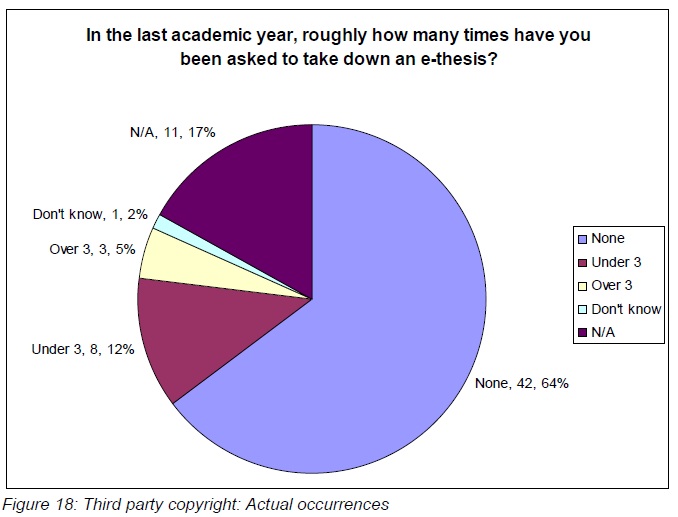
Well, it might, but in a recent survey only 7% of institutions cited this as a frequent concern amongst their students, and no concrete examples were found of publication being refused because the PhD thesis had been added to an open access repository. If reassurance is needed, then an embargo period can be applied, with may be the record plus abstract still being available to all.

2.    My work will be plagiarised

It’s possible, but then again people can plagiarise from printed theses too, and in those cases there’s no automated way to detect the crime.

Allowing open access to your thesis does open it up to all sorts of people who may come along and use the content in whatever way they like. But plagiarism detection services can help to mitigate the risks, and in EThOS at least, users have to register their details, so we could if necessary track all users of a particular thesis. So far that’s never been needed. And as people get more and more used to open access and theses become increasingly available in institutional repositories, it may be that the login process is becoming a tiresome deterrent to use and has had its day.

Brown J. (2010) Influencing the deposit of electronic theses in UK HE: report on a sector-wide survey into thesis deposit and open access. UCL. http://eprints.ucl.ac.uk/116819/

3.    All that hassle with third party copyright

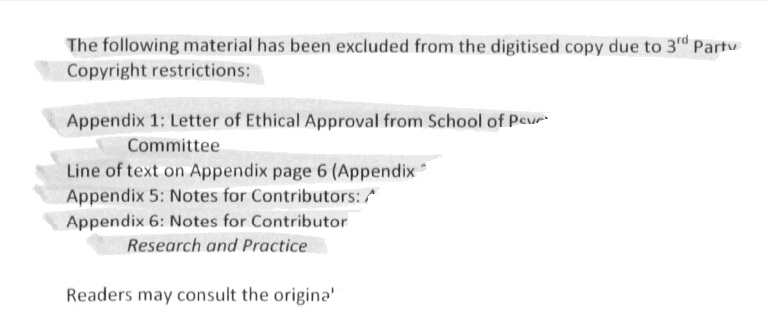
We do need to take copyright ownership seriously and it can be really time-consuming to seek permissions from any third party for permission to publish. Some university libraries are able to support their students to make sure any third party copyright is managed properly, but most don’t have the resources to undertake such a massive task. Take-down policies and embargoes come into play here, and digitisation services, whether through EThOS or another route, will carefully redact any sections, diagrams etc that aren’t copyright cleared on instruction from the institution.

List of redactions from a 2002 thesis held in EThOS.

The world of repositories and open access is moving fast. EThOS celebrated its third birthday last month. When it launched – on the same day as another auspicious event – theses were held in paper format in the university library and a microfilm copy held by the British Library. Now those microfilms have been packed away, and an average of 450 people a day download a copy of a full-text thesis from EThOS. With possibly the same number again accessing copies held directly in university open access repositories, it appears that full-text open access is here to stay.

No Comments Posted in Academic Life, Authors, Online Thesis, Pitching & Publishing, Research, Self Promotion, Tips, Writing
Tagged , , , , , , , , , , , ,
Part 3: Should you make your thesis available online? Thinking about publishing
Posted by atarrant

You have made your thesis available online, but does that affect whether or not it will get accepted for publication as a monograph? Academic publishers have varying opinions about this…

This is a very important issue for postdocs who are planning how to disseminate and publish the findings from their PhD research and an increasingly common question that academic publishers are now being asked. It was this question that originally kick-started my desire to run this blog series and start this conversation (#onlinethesis). I know that I am not the only one who has been dealing with this question either. One of the comments made in relation to Part 1 of this series was that a thesis that is available online is something that may be seen as problematic to publishers if a monograph based on a PhD is proposed. Others on Twitter are also interested in how publishers responded to this question. I contacted several publishers to find out more about this and these were the responses.

Jay Dew of University of Oklahoma Press informs me that this is a question he is frequently asked and his response is in favour of making theses online:

“On the whole, I don’t believe that having a dissertation or thesis available online works to the detriment of publishing a monograph. Indeed, more and more dissertations and theses are available online through library databases such as Dissertation Abstracts, etc. A dissertation and a book are two different things, with two different and distinct audiences. The revisions that are almost always necessary to bring a dissertation into book manuscript form are usually substantial enough that one need not cannibalize the other. There may be exceptions, of course, especially in the hard sciences, but at least for my press and the kinds of books we publish, this is not a problem.”

John Yates of University of Toronto Press extends this debate further arguing:

“I believe the situation in North America is different from yours [in the UK]. I understand that here all PhD thesis are licensed to ProQuest. I also understand that in Canada, theses are posted on-line by University libraries. Consequently scholars have quite a bit of work to do to convert their thesis into a scholarly monograph since libraries are not interested in purchasing titles that are effectively a thesis with minor revisions.

In your situation, if there is no requirement to post the thesis on-line and you’d like to have it published it as a monograph, I would think by not posting it on-line you’d be able to have the monograph published sooner, since fewer changes would be required than if the full thesis was publicly available on the web.”

The responses I have received in relation to this issue support the idea that making a thesis available online is generally acceptable to academic publishers, as long as the proposed monograph is substantially different to the submitted PhD thesis. Nonetheless, concerns are still evident amongst authors and researchers and it is recommended that potential publishers are contacted in advance of proposing a monograph to find out how they view this because opinions may vary depending on discipline and research topic. A more specialised research topic for example with a smaller market and audience may be seen as more problematic for some publishers if the material is already accessible online. It is possible to embargo the publication of your thesis in university depositories if this is considered an issue and you plan to propose a monograph but it is increasingly important to make this decision before the thesis is submitted, and made available electronically.

The key message then, is that the monograph based on a PhD thesis should be in substantially different format to the submitted PhD. Publishing houses from different countries are in agreement about this as presented here but it is important to be aware that making it available in an online depository may slow down the process of writing a book. It is also important to check the position of publishers who you wish to write book proposals for, to ensure that your decision is well informed. In a period of increased debate over open access to research, making the thesis online should not be, and doesn’t appear to be, a barrier to publishing a monograph but is certainly a consideration.

1 Comment Posted in Academic Life, Future of Academic Publishing, Online Thesis, Pitching & Publishing, Publishers, Research, Self Promotion, Uncategorized
Tagged , , , , , , , ,
Part 2: Should you make your thesis more widely available online? Fear of idea theft
Posted by atarrant

Following my first post that introduced my musings on the debate about making a PhD thesis or dissertation available online, this blog explores the issue of fear in relation to the theft of your ideas. This is an issue that is fairly central in Alex Galarza’s article for @GradHacker. The student in question feared that their ideas may be more susceptible to being stolen if they were to be made available online; a reasonable assumption given that, if the intention to put your thesis online is to make it more widely accessible, then the more likely it is that the ideas can be accessed and potentially lifted.

For me, this fear is not altogether unfounded and essentially boils down to a lack of knowledge about how online material is managed and regulated. In university teaching in the UK at least, students are taught about plagiarism, or the use of someone else’s work without acknowledgement, and are warned of the need to avoid doing it. Not only is it considered bad academic practice, but a plagiarised essay or piece of coursework is more likely to be of poor standard. As academics this becomes deeply ingrained in everyday working and writing practices, and is currently regulated through the processes of peer review and assessment. How this may be regulated online however, is less clear and the boundaries of citing and discussing the work of others is increasingly blurred.  Similarly if the aim of publishing online is to reach broader audiences, there is potential that those audiences are unfamiliar with referencing practices or maybe unwilling to use them.

A research paper about electronic theses by Copeland et al (2005, pg 195) suggests however that ‘it is easier to detect instances where this activity [plagiarism] has taken place when the material is published on the web. Electronic detection software is available’. My university in the UK uses Turn-It in for student essays for this purpose.

While this is comforting to know to some extent, an important thing to do before making your thesis available online is to check the copyright regulations of the archive you post to and to ensure that you own those rights as primary researcher. This should discourage any potential theft, protect your property rights and discourage the potential for idea theft by others. Where you make the thesis available online is also a consideration. The chances of having your ideas stolen and reproduced online or elsewhere are much less likely if you post to a university online archive than a personal blog for example because these are better regulated. It is also recommended that you seek advice from your PhD supervisor before posting online to check if there are any issues with copyright that you hadn’t thought of (especially important if the work is funded). You could also protect your work using a Creative Commons license. These allow ‘everyone from individual creators to large companies and institutions a simple, standardized way to grant copyright permissions to their creative work’ (Creative Commons website).

Fear of theft of your work when making it more readily available online is reasonable, and was something that led me to research and produce this series of blog posts. However there are frameworks and laws in place that are designed to protect your ideas and your intellectual property, as well as new technologies that are detecting plagiarism online. Make sure you are aware of these before you make your research outputs available online however. If you want to disseminate your work more widely to broaden its impacts, you should be able to, and it is important that academic work is accountable but also used in appropriate ways.

A recent hashtag on Twitter that has been used in relation to these ideas (and also Will’s post) is #notopenenough (thanks @ThomsonPat). Publishing online is becoming more popular, and hopefully fear of theft won’t stand in your way in your quest to make your research more widely known.

Join the conversation at #onlinethesis.

Reference

Copeland, Susan,  Penman, Andrew and  Mime Richard (2005) “Electronic Theses: The Turning Point.” Program: Electronic Library & Information Systems 39, no. 3 : 185-197.

No Comments Posted in Academic Life, Future of Academic Publishing, Online Thesis, Pitching & Publishing, Research, Self Promotion, Uncategorized, Writing
Tagged , , , , , , , ,
Structural Engineering Journals: A Top 5 by Eva Lantsoght
Posted by atarrant

Eva Lantsoght is a structural engineer currently pursuing a PhD at Delft University of Technology on the topic of shear in one-way reinforced concrete slabs. Originally from Lier, Belgium, she received an Engineering Degree from the Vrije Universiteit, Brussels and an MS from Georgia Tech. At her blog PhD Talk, she blogs about her research, the process of doing a PhD, the non-scientific skills you need during your PhD, living abroad and her travels.

Recently on Twitter, PhD2Published posed the question “What is your academic discipline and what are your top 5 recommended high impact journals?”

I am a structural engineer with a focus on bridge engineering, and my research is done in the Concrete Structures group at Delft University of Technology. For my PhD research on the shear capacity of concrete slab bridges under the wheel loads of trucks, I’ve been reading about bridge engineering as well as about structural concrete. For bridge engineering, I’ve been mostly focused on gaining an understanding of how slab bridges work, and how we model the traffic loads on bridges. For structural concrete, I’ve been focusing on slabs (as structural elements) and shear (as a failure mode). My scope has been from the small scale of how the different elements in concrete, which is a non-homogenous material, work together and transfer stresses, to the scale of real-life bridges.

I’ve mostly been reading papers from these five journals (in no particular order). In between brackets you can see the impact factor of these journals:

- ACI Structural Journal (0.782 in 2010)
- Journal of Structural Engineering / ASCE (0.834 in 2010)
- Journal of Bridge Engineering / ASCE (1.009 in 2010)
- Beton- und Stahlbetonbau (0.265 in 2010)
- Magazine of Concrete Research (0.52 in 2010)

Three of these journals are American, one is German and one is British. Two of the journals are publications of ASCE, the American Society of Civil Engineers, and these two are as well the publications with the highest impact factor in the list. The ACI Structural Journal is a publication of the American Concrete Institute, and the Magazine of Concrete Research is issued by the Institution of Civil Engineers.

As a final remark, I would like to zoom in to Beton- und Stahlbetonbau, a German journal. Even though I can barely put a sentence together in German, I don’t have much trouble reading technical German. Initially I had to read German papers with a dictionary right next to me, but by now I know most of the technical vocabulary. I do think it was worth the effort of trying to understand technical German. I’ve found information in German journals which I did not find published elsewhere at all, and I’ve found a goldmine of carefully described and executed experimental research in there. It’s been of tremendous importance to my own research so far.

No Comments Posted in Journal Articles, Pitching & Publishing, Research, Tips, Top Tips, Uncategorized, Writing
Tagged , , , , , , , ,
The Now Frontier: Posting Dissertations Online
Posted by atarrant

A note from Anna: As part of a series of blogs on PhD2Published about Online Theses, Will Deyamport, III explains why he will definitely post his dissertation online. To engage in this conversation on Twitter please use the Online Thesis hashtag #thesisonline

Will Deyamport, III is an Ed.D student in Educational Leadership and Management at Capella University. He is the founder of peoplegogy.com, a blog that focuses on life and career developments. He is a monthly contributor to MyPathfinder Career Blog, where he writes about higher education. Currently, Will is writing his dissertation on how Twitter can support the professional learning needs of teachers.  You can follow him on twitter @peoplegogy.

This digital world we live in isn’t going anywhere. We pay bills online, we shop online, we make phone calls online, we date online, and now we’re streaming movies and going to school online. So why wouldn’t I post my dissertation online?

Has the academy become so insular that it has failed to understand and embrace the realities of this digital age? Has it become so arrogant that it believes that it can remain the sole guardian of academic knowledge? Or has the academy so blindly held on to its beliefs of what scholarly work is that it refuses to see this work being published on a daily basis on blogs around the globe?

Whatever its reasons, I plan to publish my dissertation online and here’s why:

  • I happen to have a passion for digital media and most of what I read is read online.
  • What I do and want to do for a career is done online. I’ve been a social media strategist, I blog, and I am earning my doctorate online. So for me the online space is a place of isn’t some separate entity. It’s a part of who I am and how I express my ideas.
  • I am a digital citizen. As such, I see the online world as the way for mobilizing the world towards a common humanity.
  • I routinely seek out information online. Whether it is via Youtube, LinkedIn, or my personal learning network on Twitter, I am able to gain access to experts from a variety of fields and disciplines.
  • I believe that academic knowledge belongs to the masses and should be made available and given freely to those who seek it.
  • My dissertation is on teachers using Twitter to support their own professional development.  The topic doesn’t belong is some bound book. It was meant to be posted online and shared with scholars and practitioners alike.

The ivory tower and those who worship at its feet need to understand that education is no longer insular. Holding information hostage does nothing for the academy or the betterment of society. In order to truly build a thriving academic knowledge-base and further the continued and expansive research expected in academia, technology has to be a part of how that research is shared and disseminated. Using emerging technologies, schools have the capacity to expose its students’ research to every corner of the globe. It is with this type of free exchange that the academy can reinvent itself and lead the way in today’s growing global economy and workforce.

Moving forward, I would like to see every doctoral student publish their dissertation on ProQuest or some other online platform. Just like TED has revolutionized the conference model, as current and future scholars, we have an opportunity to revolutionize the way people think, learn, and are taught about academic research.

1 Comment Posted in Academic Life, Future of Academic Publishing, Online Thesis, Publishers, Self Promotion
Tagged , , , , , , ,
Should you make your thesis more widely available online? Part 1
Posted by atarrant

A brief note from Anna: Being Managing Editor of PhD2Published has been a fantastic opportunity for me so far. It has introduced me to lots of interesting people and has helped me to think about key issues I am facing post-PhD. My current thinking is about whether or not to make my PhD thesis more readily available online. This post, which is the first in a series, explores this idea in more detail.

Impact has increasingly become an academic buzzword and requirement, which has led me to think much more about my PhD thesis, its accessibility and the impact it could (and should) have on a variety of audiences, both academic and public. I have heard from several colleagues that the only people who are ever likely to read the actual thesis are yourself and your supervisor (my family and friends certainly haven’t read it!). Frankly this seems wasteful and a bit sad (just look at the picture!), especially considering all of the hard work that went into it, including by myself, my participants and my supervisors. Even with the potential of developing publications and monographs from it in different formats, later on, in its unpublished form, my thesis is meaningful to me and took time and effort to construct.

This thinking prompted me to consider how I could make my thesis more accessible and more widely read, particularly in an age of social media and open access. Before launching into making it available online however, I wanted to do some research into the potential barriers to publishing online and the current debates that will inform this decision.

Following these musings, I posted this question on Twitter: “What are people’s opinions on making theses available online?” Several interesting and important issues and questions were raised. While limited,  there is already an emerging debate about the digital dissertation, which you can read about in this interesting and informative post by Alex Galarza for @GradHacker. There are several positives for doing this, and indeed many universities are now making it a requirement, if it isn’t already. @Gradhacker outlines that online material such as the unpublished thesis for example is still protected by copyright, useful to know if there is concern about the acknowledgement of your work. At the same time, in being overly cautious about protecting your thesis/dissertation you may risk restricting the development of your academic identity, online and otherwise. Furthermore (and some publishers may vary on this) putting your thesis/dissertation online may actually aid in the communication and appeal of your research to a variety of audiences and may even encourage sales of subsequent published work should you wish to publish it elsewhere in a different form. Twitter follower Christina Haralanova (@ludost11) has also received positive replies from people who have read hers.

Despite the many positives, I still think it is important to consider the range of different issues relating to putting a PhD thesis out there; issues that I will explore in a short series of blogs that will be posted here on PhD2Published in the coming weeks. These include posts I have constructed myself, and also opinion posts, and feedback from academic publishers. If any of this resonates and you have anything to add that has occurred to you, please do get in touch, either by Email or Twitter (@PhD2Published). Should you wish to join an online discussion on Twitter about the debate please use hashtag thesisonline (#thesisonline).

1 Comment Posted in Academic Life, Authors, Future of Academic Publishing, Online Thesis, Pitching & Publishing, Publishers, Self Promotion, Uncategorized
Tagged , , , , , , , , ,
Genetics Journals: A Top 5
Posted by atarrant

Today’s post is written by our resident Science Correspondant Katherine Reekie (@katreekie). She has written interesting posts for PhD2Published on adapting to scientific writing and Publishing in the Sciences. Here she shares her Top 5 choices of Genetics journals

Recently on Twitter, PhD2Published posed the question “What is your academic discipline and what are your top 5 recommended high impact journals?” Well, I am a geneticist, and for my top 5 I picked, in no particular order:


1)      Nature Genetics

2)      Human Molecular Genetics

3)      American Journal of Human Genetics (AJHG)

4)      Proceedings of the National Academy of Sciences (PNAS)

5)      Nucleic Acids Research

This is a somewhat arbitrary list, which was drawn up on the spur of the moment. Other journals which could well have made the list are Genome Research, Trends in Genetics, Human Mutation…I could go on. So how did I come up with my list? For me, it was down to journals in which I (and my colleagues) either hope to publish, regularly find interesting articles, or regularly cite. I excluded a number of excellent review journals, as for this purpose I was thinking in terms of original research only.

Subsequent to coming up with this list, I did a bit of research on the impact factors of my chosen journals, and was not surprised to find that all five were towards the top of the scale for genetics, with Nature Genetics at the very top with an astounding 2010 impact factor of 36.3 (according to the Thomson Reuters Journal Citation Reports) – but then the Nature journals are always very highly ranked (to put this into perspective, the others titles on my list had impact factors ranging from 7.8 – 11.6, all of which are considered high). The “Impact Factor” is the system most commonly used to rank journals. This figure is calculated annually, by taking into account the number of times papers from the journal have been cited in the two previous years, and dividing this number by the number of articles and reviews which were published in the journal in those same two years. So the 2011 impact factor = (number of 2010 & 2009 citations)/(number of 2010 & 2009 articles & reviews).

It is important to note that the “impact” of a journal is not always the most important factor to bear in mind when considering publication. It is certainly worth researching the impact factors of journals in your discipline, and thinking about where your research might fit in.  However, you must also take into account which journal is most appropriate for your work in terms of its “novelty value” (groundbreaking research will always be of interest to the very top journals), strength of the findings (how robust are your data and conclusions) and also your target audience (who you are hoping will read your paper). For example, Nature has a very high impact factor, but it covers a broad subject area and focuses on cutting edge research. Therefore it is unlikely to be the best fit for a paper which describes an association study which considers a single region of the genome. Compare this with Human Molecular Genetics, which has a specific section dedicated to reporting the results of association studies – clearly a much better fit for this research. Typically, authors aim high with the first submission of a journal article. However, the higher the impact of the journal, the more submissions they are likely to receive and therefore the more competition there will be for publication. Subsequent submission to a good journal with a slightly lower (but still high) impact factor is a perfectly respectable option!

Brief note from Anna: What are the Top 5 journals in your discipline? Tell us on Twitter (@PhD2Published) and DM us if you wish to contribute a blog.

No Comments Posted in Academic Life, Authors, Journal Articles, Top Tips, Uncategorized
Tagged , , , , , ,
Reflections on taking the intellectual carving knife to your PhD thesis by Mark Carrigan
Posted by atarrant

Today‘s post follows a Twitter conversation @dratarrant had with our post author Mark Carrigan (@mark_carrigan) about the challenges and choices faced by those making the decision of how best to publish the material from their thesis. Mark is a doctoral researcher in the Department of Sociology at Warwick University and his own website can be viewed here. He also has his own podcast series here.

The tag line for this post?: ”That awkward moment when you find yourself standing over your PhD thesis with an intellectual carving knife wondering what to do…”

I remember very distinctly the moment when I first took a figurative carving knife to my PhD thesis. I was in a careers workshop at a conference and a senior academic had just explained how the oh-so-rational metric of the REF placed the same value on monographs and journal articles. From the start of my PhD I’d always been drawn to the prospect of publishing it as a monograph, drawing together years of work and sending it out into the world in a pretty package with a shiny cover. I liked the idea of turning my thesis into something which would be read by people other than my parents, supervisors and examiners. Perhaps even something that people responded to? Yet I also wanted a job and, at the same time as I was growing attached to the idea of the monograph, I was also rapidly internalizing that horrible motif which plagues the psyches of aspiring academics everywhere: publish or perish. As much as I liked the idea of a monograph, I liked the idea of getting a job more. So upon learning the value of a monograph relative to a paper, I picked up the intellectual knife and started to ponder how many choice cuts I could get from my thesis.

After an afternoon of hacking away at my planned thesis, it turned out I could spin off a lot of papers. Sure there would be repetition and overlap but that’s inevitable, right? In the months since then, this sense of inevitability has troubled me. I realized how quickly and deeply I’d come to accept the ‘rules of the game’, making plans that were entirely contrary to what I believed and cared about because I couldn’t see any choice other than submitting to the logic that defines the contemporary academy if I wanted a career within it. Which left me with the obvious question: did I want a career within it? The perverse eagerness with which I instrumentally carved up my long treasured post-PhD monograph became symptomatic of everything I disliked about the modern university. The fact that just three years of a PhD, framed in terms of ‘playing the game’ in order to win autonomy within it, had left me able to be so thoughtlessly instrumental truly worried me. If this was what academia would do to me then I didn’t want to be an academic.

Since then I’ve relented somewhat, partly due to realizing that there was no need to see it as a matter of being entirely in or entirely out of the university. But mostly through talking to  friends, some in similar situations and others with no connection to higher education, about these questions and why they troubled me. If we want academic careers after we finish our PhDs then, inevitably, we have to make some sacrifices. If we want to be employable then we, at least to some extent, have to make choices that fit the imperatives of institutions within which we seek employment. But if we’re doing this because we care about it then we need to constantly ask ‘why?’ at every stage. We need to be clear that we’re doing what we do because we CHOOSE to rather than because we’ve internalized a set of perverse imperatives which actively erode the values that motivate us. We have to continue to look for alternatives to passively reproducing the demands of neoliberal academia. Otherwise I fear we’re going to look in the mirror twenty years from now and wonder what the point of it all was.

No Comments Posted in Academic Life, Journal Articles, Pitching & Publishing, Research, Uncategorized, Writing
Tagged , , , , , , , , , , ,
7 Habits Of Highly Effective People: Part 2 by Julio E. Peironcely
Posted by atarrant

Julio E. Peironcely is a PhD student in Metabolomics and Chemoinformatics at Leiden University, The Netherlands. In his free time he writes for his site juliopeironcely.com about his research, academic life, social media, and lifestyle design. You can follow him on twitter @peyron.

This is the second part of two that reviews the book 7 Habits of Highly Effective People, providing academic advice for PhD students and post-docs. To view the first article and the helpful tips it provides, follow the link here.

Interdependence

Now that you control yourself, start working with other people and get the most of it. How can we collaborate? How can we convince them to join us?


Habit 4: Think Win-Win

This sounds a bit business-like. You should seek for partnerships that are mutually beneficial, where both parties benefit after the interaction.

If no win/win can be achieved, realize that a no-deal is a perfect compromise.

For PhD students and academics: Are you a theoretician? Seek for an experimentalist and propose to collaborate on a project (and agree on the other of authorship in related publications). See it as a project that without the other person could not be performed.

Does somebody want you to process a lot of data and do some statistics? And they don’t plan to add you as co-author? This is a win/lose situation that should be answered with a “no-deal”.

Habit 5: Seek First to Understand, Then to be Understood

This chapter is not only about listening, but to listen using empathy. Do not rush into offering solutions when somebody is presenting a problem. Let them finish, make the effort to understand the problem at hand. If you do so, they will reciprocate with you.

Using empathy means putting ourselves in the perspective of the other person. Do not try to filter what they say with your own assumptions and way of thinking.

For PhD students and academics: Coming again to collaborations between theoreticians and experimentalists. Try to understand how the other person’s thoughts compare to yours in key topics.

Your approach to science might be different. Your timing as well. Maybe you care more about interpretation of results while another person cares more about describing a solid methodology. You might be data-driven and the other person hypothesis-driven. In any case, see what are the other person’s fears and hopes before exposing yours.

Habit 6: Synergize

Use trust and understanding to maximize the output of a group. With careful communication, leverage the differences of the individuals in the group, so the product is much larger than the sum of the individuals.

Identify in others what’s in them that is beneficial for the group. As well, you should detect what it is about them that sets you back so you can work on adapting yourself to that.

For PhD students and academics: In a large collaborative project you might find young motivated PhDs, busy supervisors, retired experts, and other people. Instead of getting frustrated, try to maximize what they have to offer: like the energy of the PhD students, the network amplification the supervisors, or the experience of the retired guru.

Next, use your empathy skills to minimize the effect on the team of what you don’t like: the chaos of the graduate student, the busyness of the supervisor, and the same old stories by the retired expert.

Self Renewal

It is not enough to work once on each habit and forget about them, in fact, it is a lifetime effort. Think of it as an iterative process, that you should evaluate and repeat every now and then.

Habit 7: Sharpen the Saw

Here, the author makes reference to habit 3 and encourages you to identify those things that might be keeping us from our goals. Step back, take a break, and decide what to do to renew yourself. It might be getting healthier by doing some exercise, meditating to clear your thoughts, or even re-write your mission statement.

In any case, schedule time to perform those activities that will keep your whole system running in the right direction.

For PhD students and academics: Senior scientists the sabbaticals. Since you are a PhD it might still be early for this. What you can do is to join a short side project, in order to try something new, recharge your motivation batteries, and collect new ideas.

You might want to  allocate some minutes a day to just think. What? Yeah, thinking, aren’t you paid to think? Spend time generating (and writing) ideas for future projects, grant applications, daydreaming, or simply to help others.

Conclusion

The 7 Habits Of Highly Effective People is a bit of a philosophical book; sometimes even religious. Despite this, it can be applied in many areas of life and it can definitely help PhD students and academics to organize themselves better. If used correctly, the learning’s in this book can help you to be more effective and motivated. At the end, you will create new habits, in a natural way.

No Comments Posted in Academic Life, Journal Articles, Management, Research, Tips, Top Tips, Writing
Tagged , , , , , , , ,
7 Habits Of Highly Effective People: Part 1 by Julio E. Peironcely
Posted by atarrant

Julio E. Peironcely is a PhD student in Metabolomics and Chemoinformatics at Leiden University, The Netherlands. In his free time he writes for his site juliopeironcely.com about his research, academic life, social media, and lifestyle design. You can follow him on twitter @peyron.

This is the first part of two that reviews 7 Habits of Highly Effective People, a book that provides advice relevant to PhD students and post-docs.

I have lost a lot of time during my PhD. On the one hand I waste time as everybody does; on the other hand, I waste time searching for the best tool to organize my time.

Initially I thought that I was not using the right tools to manage my projects, tasks, and time. Therefore, I tried all sorts of analog and digital tools, like a Moleskine, the GTD methodology, the pomodoro technique, Wunderlist, Remember The Milk, Google Tasks, Evernote … you name it. So much wasted time searching for the tools, implementing them in my workflow, and testing them. Can you imagine all I could have achieved if I had instead just, well, worked?

But something did not feel right. Once the new system was implemented I would not stick to it, by not creating the habit of using the tool and using it effectively. I would move on the next tool and start all over again.

I had to change myself.

I came to realize there was something deeper that needed to be changed, something within me. But all those time management books were talking about externalities that after hard experimentation were far from my control. This was when the 7 Habits Of Highly Effective People came my way. This book goes further than time management. It is about defining who you are and who you want to be. It presents the tools you need to define the rules you want your life to be based on. Although it is not aimed at PhD students and academics, it should be included in the Top 42 Books For PhD and Graduate Students.

I found out that these 7 general principles, outlined in these two posts could help me to be more effective during my PhD and in any writing projects I undertake.

Continue Reading »

No Comments Posted in Academic Life, Management, Productivity, Research, Social Media, Tips, Top Tips, Writing
Tagged , , , , , , , ,
Sarah Caro – REVISING YOUR PhD: Part 6 ‘More Revisions for a Monograph’
Posted by Charlotte Frost

Sarah Caro, author of How to Publish Your PhD has kindly offered us this six-part guide on revising a thesis for publication as a book. Over the coming weeks she’ll be explaining how to understand what type of book you can produce as well as discover ways of shaping it up into a more book-like body of material.

As final summary of how to revise your thesis into a publishable book:

  • Do be aware of the stylistic and structural differences between the different genres of academic writing.
  • Do identify those features which are original to your thesis and those which are common to the genre so that you can work to enhance the former and minimize the latter.
  • Do remember that a journal article needs to be focused, concise and is geared towards a highly specialized audience so you don’t need to spell everything out.
  • Do bear in mind that in a monograph theory, data and methods should be synthesized and integrated into the text rather than merely described. Continue Reading »

No Comments Posted in Pitching & Publishing, Tips, Writing
Tagged , , , ,
Sarah Caro – REVISING YOUR PhD: Part 5 ‘Some Additional Tips’
Posted by Charlotte Frost

Sarah Caro, author of How to Publish Your PhD has kindly offered us this six-part guide on revising a thesis for publication as a book. Over the coming weeks she’ll be explaining how to understand what type of book you can produce as well as discover ways of shaping it up into a more book-like body of material.

How you decide to restructure your thesis will depend in part on the subject matter and discipline within which you are working but there are some more general points regarding style that are relevant what­ever your topic and disciplinary background.

One of the most common problems is a too heavy reliance on the opinions of others – in other words too many direct quotes from other critics/theoreticians/scholars. While it is perfectly understand­able that you will wish to position your own work in relation to those who have gone before you and show how your own work builds upon theirs, excessive direct quotation can distract from and weaken your own argument and even be quite confusing out of context. It can also become quite tedious if you are constantly referencing the same people and may give the impression that you are less well read than is actually the case (not a desirable outcome!). To avoid this pitfall read through your manuscript looking for opportunities to reduce the amount of direct quotation. Paraphrase or summarize arguments instead of reproducing them verbatim and perhaps cut them out altogether if they are not strictly necessary. Do make sure, however, that you still scrupulously reference any idea that is not your own – the last thing you want is to make yourself vulnerable to accusations of plagiarism. Continue Reading »

No Comments Posted in Pitching & Publishing, Tips, Writing
Tagged , , , ,
Sarah Caro – REVISING YOUR PhD: Part 4 ‘More Revisions for a Monograph’
Posted by Charlotte Frost

Sarah Caro, author of How to Publish Your PhD has kindly offered us this six-part guide on revising a thesis for publication as a book. Over the coming weeks she’ll be explaining how to understand what type of book you can produce as well as discover ways of shaping it up into a more book-like body of material.

Returning to the example thesis from last week, let’s look at content. Here’s the thesis outline:

Chapter 1: Definitions, Empirical Puzzle and choice of case studies

Chapter 2: Literature Review

Chapter 3: Timing, size and composition of X

Chapter 4: Social and political factors affecting X in the Netherlands 1975-1990

Chapter 5: Social and political factors affecting X in Austria 1975-1990

Chapter 6: Some additional factors affecting X in the Netherlands and Austria

Chapter 7: The impact of X in the Netherlands and Austria: a com­parative perspective

Chapter 8: Consolidating X in the Netherlands and Austria References Appendix 1 a

Continue Reading »

No Comments Posted in Pitching & Publishing, Tips, Writing
Tagged , , , ,
Sarah Caro – REVISING YOUR PhD: Part 3 ‘Revisions for a Monograph’
Posted by Charlotte Frost

Sarah Caro, author of How to Publish Your PhD has kindly offered us this six-part guide on revising a thesis for publication as a book. Over the coming weeks she’ll be explaining how to understand what type of book you can produce as well as discover ways of shaping it up into a more book-like body of material.

Transforming your thesis into a format suitable for publication as an academic monograph may or may not involve much cutting down of length. In fact it may require the inclusion of some additional material or expansion of existing sections (as we shall see below). What is cer­tain, however, is that unless you are exceptionally gifted, lucky, or have been guided by a supervisor who has early-on spotted the publication potential of your work, it will need substantial reworking and restruc­turing if it is to escape its roots and become a convincing monograph.

As discussed before the average monograph does not follow the thesis-methods-results-analysis paradigm unless it has started life as a PhD and it is usually screamingly obvious when this is the case and the author has not revised it. Recently I received a pro­posal with the following table of contents (some details have been changed to avoid the person and project being identified): Continue Reading »

1 Comment Posted in Pitching & Publishing, Tips, Writing
Tagged , , , ,
Matthew Paterson – Strategies for Getting Published: Thoughts From a Journal Editor
Posted by Sarah-Louise Quinnell

This weeks post comes from Prof Matthew Paterson, University of Ottawa. He is co-editor of the journal Global Environmental Politics. His latest books are “Climate capitalism: global warming and the transformation of the global economy” (with Peter Newell) and “Cultural Political Economy” (edited, with Jacqueline Best). Here he looks at strategies for getting published from a journal editors perspective.

Getting published is one of the big sources of stress for many young scholars in the early stages of an academic career. It poses generalised anxiety as it is often determinant of getting a job, but it is one of the situations where you are forced to submit yourself to the vagaries of the review process.

After 4 years of co-editing a major Political Science journal (Global Environmental Politics, ranked 24th overall according to the Web of Science, if you like such figures), two things about the review and editing process seem to me really useful to think through as you work through the choices involved in preparing an article.

Revise and Resubmit (R&R) is your friend. It is your point of entry into the publishing process.

You may be used to getting As all the time and feel it is a failure. So you sit on an article until you feel it is so solid, whereas it could be out there in the review process. Continue Reading »

3 Comments Posted in Academic Life, Journal Articles, Pitching & Publishing, Tips
Tagged , , , ,