Browsing the archives for the Review tag

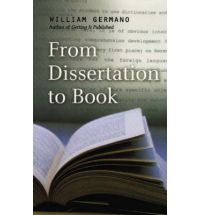
Thinking From Dissertation to Book, and back again…A review of William Germano’s From Dissertation to Book by Helen Wainwright
Posted by atarrant

Todays post is written by Helen Wainwright. Helen is a final year PhD Candidate from The Department of Art History at The University of Nottingham, researching conceptual art’s supposed demise in the early 1970s in New York, and the concurrent redefinition of the spaces and/or places of artistic practice and dissemination stemming from the period. She is particularly interested in the work three separate artists: Stephen Shore (1947-present), Gordon Matta Clark (1943-78) and Anthony McCall (1946-present), and the gap that exists between their early works and later (re)interpretations of them.

Twitter: @adxhw1

http://nottingham.academia.edu/HelenWainwright

Recently, the thoughts of what to do post-PhD have started to worm their way into my mind – a good six months ahead of schedule. Rather than ignoring my subconscious efforts to prompt me into a premature job search, I used them as a nudge in the right direction to think about what I really want to accomplish in the year leading up to my viva, and likewise what I would need to accomplish in the subsequent year (or two) after it. This is when I metaphorically stumbled, via Twitter, across William Germano’s book From Dissertation to Book, an extremely useful and accessible text first published in 2005 by University of Chicago Press. I initially approached it with caution, thinking it would ultimately lead to a flurry of self-doubt, but what I actually found was an insider’s guide to what it takes, and how to make the first moves towards publishing your thesis as a book, and what decisions and barriers will more than likely be encountered along the way.

As the Dean of the Faculty of Humanities and Social sciences at Cooper Union for the Advancement of Science and Art, and a former Vice President and Publishing Director at Routledge, William Germano knows exactly what it takes to take those first steps towards publication. The message running throughout the book is clear: be willing to revise, rework and even rethink your PhD research. This advice is coupled with a hefty warning: a thesis is not a book manuscript and will more-often-than-not be rejected by a publisher without any form of editing. Germano provides his readers with a list of eight options to choose from when considering what to do with the thesis once complete: ‘do not resuscitate’; ‘send the dissertation out as is…’; ‘publish the one strong chapter’; ‘publish two or three chapters as articles’; ‘revise the dissertation lightly’; ‘revise the dissertation thoroughly’ or ‘cleave the ample dissertation in two’ (p.38). It is safe to say that readers of From Dissertation to Book are most likely seeking advice on just that topic, and are thus left with the sole prospect of gentle/hefty revision. However, reading between the lines, I think the underlying message of the book is clear: there are more routes towards writing your first book than simply turning your doctoral dissertation straight into a manuscript.

One suggestion is the transformation of chapters into publications. Not only will this allow ideas to be transmitted to a larger audience; gaining much needed publicity, but it will grant the opportunity for a moment’s pause to deliberate whether these ideas could actually form the basis of further research, and lay the foundations for an entirely different book proposal. Likewise, such reflection may aid in the dissection of the thesis as a whole; allowing it to be sliced in two, moving both parts in separate directions, and therefore furthering the possibilities of future research and publication. Alternatively, as Germano continually recommends: revision is the key. Whilst attempting to re-work the thesis, it is also highlighted that a publisher who can recognise the potential audience for a book is far more likely to accept a manuscript or proposal, because they can clearly see who the text is aimed at and who it will be sold to. In contrast to the doctoral thesis, which will only ever meet the eyes of a handful of people, despite best wishes, the book must have a definite audience, and therefore a direct and highly relevant message. If you can argue this case straight away, then perhaps you are on to a winner.

The awareness of your thesis as something far from finished, but as the stepping stone into the world of academia is a daunting prospect, given the amount of blood, sweat and tears which are poured into the work. However, this realisation is also entirely invigorating when realisation dawns that all the routes of thought that had to be closed off in order to concentrate on getting to the finish line, could one day be re-opened. As a researcher you are expected to be adaptable and full of belief in your ideas, and From Dissertation to Book echoes these basic assumptions, asking its readers to think in the same way about their doctoral research: that it is malleable and full of potential, whether published as a book on first attempt, or not.

No Comments Posted in Pitching & Publishing, Publishers, Review, Uncategorized
Tagged , , , , , ,
Becoming a journal editor by Dr Tseen-Ling Khoo
Posted by atarrant

Dr Tseen-Ling Khoo blogs regularly for the Research Whisperer and is currently Senior Advisor in Research Grant Development at RMIT University. Prior to joining RMIT, Tseen completed research fellowships at Monash University (2004-2010) and the University of Queensland (2001-2004). She also convenes the Asian Australian Studies Research Network (asianaustralianstudies.org; 160 members), and was editor of the Journal of Intercultural Studies (Routledge; ERA A-ranked) which she reflects on in today’s post. 

There is no better way to fast-track your grasp of academic productivity and evaluation than becoming a journal editor.

A stint as an editor for a collection of essays in a book or the role of a guest-editor for a journal will give you taste of what it’s like, but nothing can prepare you for being an ongoing journal editor.

It’s not for everyone, and its rewards can be great.

What makes a good editor?

The qualities a good editor needs are:

  • The ability to make fast, good decisions about papers or issue proposals.
  • Thoroughness with processes and around reviews and revisions.
  • Good academic network, or the potential to grow one.
  • Tenacity about doing the job well, even though it’s the kind of thing that doesn’t often get concrete rewards. It’s also the kind of role where the recognition you might get never reflects the amount of time you’ve put into it.

Given this somewhat daunting list that nudges close to martyrdom, why would you do it?

  1. Being an editor of a good journal repays you with prestige points, and you get to list it on your CV as an ‘esteem factor’.
    With your name on the mast-head of every issue and on the publication’s website, it also helps with getting your name out there consistently.
  2. You get to grow a field in your own image. Sort of.
    With journals that cover more specific topic areas, you can often manage the content such that areas you feel are neglected get more love or, if you feel they’re overrepresented (over-saturated), these topics get ‘rested’. You can tap promising early scholars to submit and have your journal associated with their probable rise through the ranks.
  3. If you’re lucky, you’ll get to work with a good, tight editorial team.
    In my experience, if you couldn’t work well with your editorial team colleagues, life as a journal editor would be hellish. I was lucky enough to have a team with whom I loved working and could have a laugh. We also had a publisher who treated us to 3-course lunches once a year. This helped.

That’s all very well, and what many academic mentors may tell you, but here’s why I say you should do it:

  1. Being a journal editor gives you a crash course in high level, on-the-job professionalism.
    You think you have editing expertise? It’s not until you are editing a constant stream of papers, revisions, and whole special issues that you appreciate what ‘being an editor’ means.a) You get an intimate perspective on how your own work may travel through a journal’s processesand start to realise the profoundly unpredictable input and schedule that’s involved in just one paper’s review. The editing skills you pick up as a journal editor feedback, of course, into the quality of your own writing and how you may pitch proposals to journals or editors in the future. You will necessarily have picked up on what kinds of things slow or expedite work through the academic journal system.b) You realise what the time pressures really are in producing publications. I had always thought I was a fairly organised and efficient worker, but it wasn’t until I became a regular editor of publications that I realised I had a shallow idea of the intricate juggling process that gets a book or journal from go to woe. If you’re lucky, you’ll have an associate/assistant editor who also works on the journal and they may well take responsibility for the lion’s share of the proofing and stylistic aspects (all hail associate editors, I say!). Still, ensuring that the publication is consistent, each piece as intellectually exciting as possible, and any glitches are addressed and accounted for (with authors and publishers) is gruelling. As a guest-editor, it’s bad enough; for an ongoing editor, multiply this by at least four.
  1. You get to see the seedy and noble sides of your colleagues.
    It would only really make sense to take up big editorial duties with a journal if the publication was in your area and fed your critical and professional knowledge. When I say “professional knowledge”, I’m not referring here to the process of editing per se; I’m talking about how you get to know the academics in your discipline. Chances are, they’re your reviewers and contributors. How do they assess their peers or deal with criticism of their own work? As I’ve written about in more detail elsewhere, you can tell a LOT about your colleagues through how they review (and are reviewed). This kind of information pays dividends immediately in your broader academic life and ‘insider’ knowledge about the personalities at play in a given field.

For me, having been an editor in various capacities (including five years at the helm of a rapidly growing quarterly journal), the experience and insight I’ve gained is invaluable.

No doubt, the time that the editing gigs took up could have been channelled into a few more papers and chapters on my CV. But there is no way I would have known as much about the academic game, or as many players in that game, as I do now.


1 Comment Posted in Academic Life, Productivity, Publishers, Review, Tips, Uncategorized
Tagged , , , , ,
Weekly Wisdom #93 by Paul Gray and David E.Drew
Posted by atarrant

DO SERVE AS A REVIEWER for journals, particularly top journals. Treat this job seriously. You will see much junk being submitted and appreciate why some journals reject 80% or more of their submissions. You will develop an aesthetic for what is good and what is not. You will correspond with some powerful people. When you do get a good paper to review, you will receive much earlier knowledge of an important new development. The information gained is worth more than the time you take reviewing.

No Comments Posted in Academic Life, Review, Top Tips, Weekly Wisdom
Tagged , , , , , ,
The finished article? by Claire Warden
Posted by atarrant

In her latest post for PhD2Published, Claire Warden raises those all important questions about what it is that makes a good journal article.

In the feedback for a recently submitted journal article, the reviewer said that, although s/he liked it (phew!) it was just a little bit ambitious. Alright, a lot too ambitious. So, a little adjustment here, a little tinker there, take out 1000 words and change the focus of the argument completely and I would have the makings of a successful journal article. Rewriting an article is about as pleasurable as toothache so, at first I let out an audible groan and, in typical English fashion, made a comforting pot of tea.

Recently, in the wake of my first book, I have been writing a few journal articles and this has forced me to move academic genres, one of a number of transitions that we often make from book to conference paper, dissertation to article, blog post to review. Getting back into article writing has been a sharp learning curve for me and has forced me to reassess the genre entirely. What is the primary thing to think about when writing a journal article? Are we focusing on the need to improve our publication record, the importance of publications as we apply for those allusive tenured jobs or the joy of writing about something we find fascinating for a few months? I think I probably consider all these things. But more and more I have been thinking about my readership. Who is reading the article? Why are they reading it? What are they hoping to find? Which leads me to a question (yes, another one!) I constantly grapple with: what is my audience? To make an article engaging, this is a really important issue. If the journal is about crochet then you can safely assume that your readership knows about needles and wool. If it is not then you probably need to explain chains and slip stitches at the start.  

My recent article writing extravaganza led me to read a load of papers from different journals in an attempt to discover what an engaging reader-focused article really looks like. I came up with the following checklist:

  • A balance of academic rigour and accessibility – if I am going to talk about either difficult or niche topics then there is all the more reason for syntactical clarity and straightforward structure.
  • Brevity and specificity – these two important aspects are an anathema to my rather distended writing style but are both vital for article writing.
  • Niche but relevant – under-researched topics are fascinating but they need to be framed by recognisable theoretical models.
  • Explanatory notes and expository analysis – there is always a need to decide how much your audience needs to know: a full biography, a complete synopsis, a footnote for further study suggestions?

These are the four elements that I’ve noticed in the best articles I’ve been reading recently and often they are missing in the less impressive ones. So, returning to my own article dilemma, fuelled by the obligatory teapot, I got rid of 1000 words, added 1700 and it was accepted.

No Comments Posted in Journal Articles, Research, Review, Tips, Uncategorized, Writing
Tagged , , , , , , , ,
Weekly Wisdom #80 by Paul Gray and David E. Drew
Posted by atarrant

LEARN HOW TO WRITE CLEARLY. Some graduate programs do their best to stamp out this skill, persuading doctoral candidates that a ten-syllable word is better than a two-syllable word. Reviewers are more likely to persevere to the end of your journal submission or your grant proposal if they can easily follow what you say. They are also more likely to give you a favorable review.

1 Comment Posted in Academic Life, Journal Articles, Pitching & Publishing, Tips, Top Tips, Writing
Tagged , , , , , , , , , ,
Review of How to Publish Your PhD
Posted by James L. Smith

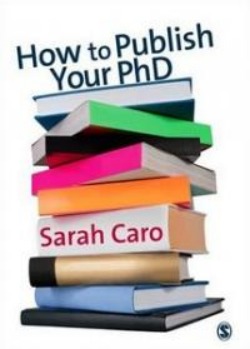
As a PhD student puzzled and disorientated by the seemingly impenetrable complexity of academic publishing, reading How to Publish your PhD by Sarah Caro was a balm for my anxieties. At present, I find myself occupying a point on the winding and erratic road to doctoral submission at which I am grateful (sometimes pathetically so) for advice, any advice, about demystifying academia. Having read several books on thesis writing early in my doctoral research, I had yet to discover a book that convincingly dealt with the practicalities of publishing a book from one’s thesis. In this ‘publish or perish’ world, it is really never to early to begin thinking about ‘the m word’. Monograph. Even reading the word itself gives me the willies.

This thin volume (a sprightly 136 pages) is packed with valuable material for the angst-ridden PhD student with no idea of where to start, or the confused early career academic staring down the barrel of their first monograph. Filled with sensible advice and divided into self-evidently useful chapters such as ‘Books or Articles?’ and ‘Revising your PhD’, Caro has created a text to be read, re-read and referred to when needed. Every chapter is summarised in point form, making quick checks exceedingly simple. As the current Publisher for Economics and Management journals at Wiley and obvious veteran of the publishing world, Caro is ideally suited to be the author of such a book.

The text provides the reader with a series of things that a would-be creator of an academic monograph can do to help themselves, with particular focus on small and yet oft-overlooked details. Attentiveness to these details, according to Caro, can mean the difference between a submission ending up in the ‘no’ pile or the ‘maybe’ pile (p. vi). To say that Caro has thought of everything in this book would naturally be an exaggeration, but it is definitely fair to say that the book contains all of the major aspects of importance to the author. Given that these points are based on years of experience, I am inclined to believe that they are significant. Continue Reading »

2 Comments Posted in Market, Pitching & Publishing, Publishers, Review
Tagged , ,