Exact matches only
Search in title
Search in content
Search in comments
Search in excerpt
Search in posts
Search in pages
Search in groups
Search in users
Search in forums
Filter by Categories
Academic Practice
Academic Writing Month
AcWri
AcWriMo
Blogging and Social Media
Book Editing
Book Literature Review
Book Marketing and Impact
Book Planning
Book Proposals
Book Publishing
Book Writing
Books
Citations and Referencing
Collaboration
Community
Conference Paper Abstracts
Conference Paper Editing
Conference Paper Literature Review
Conference Paper Marketing and Impact
Conference Paper Planning
Conference Paper Presenting
Conference Paper Writing
Conference Papers
Digital Publishing
Experimental Digital Publishing
Grant Abstracts
Grant Completion Reporting
Grant Impact Statement
Grant Literature Review
Grant Methods Section
Grant Writing
Grants
Journal Article Abstracts
Journal Article Editing
Journal Article Literature Review
Journal Article Marketing and Impact
Journal Article Peer Review
Journal Article Planning
Journal Article Writing
Journal Articles
Networking
News
Open Access
Productivity
Reading and Note-Taking
Reseach Project Planning
Resources
Tools
Uncategorized
Website
Weekly Wisdom #89 by Paul Gray and David E. Drew

INCLUDE SINGLE-AUTHOR PAPERS IN YOUR PORTFOLIO. Review committees wonder about people who always publish with someone else. Did they do the work or did they ride the coauthor’s coattails? Were they the first author? If you must coauthor, pick people whose names follow yours alphabetically and then suggest that your name really belongs first. (Choosing the order by drawing lots, as was done for this book, is not recommended.) If you are unfortunate enough to be named Zyzygy, go to court and get it changed.

Academic Blogging – Our latest #acwri live chat – 24/05/12
May 25, 2012
0

How to Publish a Book from Your Dissertation by Tanya Golash-Boza
May 23, 2012
3

Today’s post written by Tanya Golash-Boza is her second blog post for PhD2Published (see her first, very popular post about writing a peer review here). Here she reflects on her experience of publishing a book from her dissertation, providing particularly useful insights into the publishing process.

When I finished my dissertation, I knew I wanted to transform it into a book. I did not, however, know anything about the publishing process. As I am now finished with this long process, this is an ideal time for me to outline the steps so that others can know how to publish a book from your dissertation. In this blog post, I will explain the book publishing process. However, keep two things in mind: 1) there is a lot of variation beyond what I describe here and 2) this is generally the process for the first book, not necessarily for the second or third.

Step One: Write the Book Prospectus

Although it seems daunting, a book prospectus is not a complex document. I describe the book proposal in detail here. Briefly, it contains: 1) a summary of your book that outlines the main argument; 2) a one-paragraph summary of each chapter; 3) a timeline for completion of the book manuscript; 4) a brief description of the target audience and potential classes for course adoption; and 5) the competing literature. Usually these are short documents. Mine have ranged from four to seven single-spaced pages.

Step Two: Submit the Book Prospectus

The second step is to find a press that might be interested in your book manuscript and to send them a book prospectus. I explain how to find a press here and how to contact the aquisitions editor here. Once you have selected the press and found out the name of the acquisitions editor, you can send them the prospectus.  Often, the press also will want one or two sample chapters. You can send your prospectus to as many publishers as you like. Most publishers list submission guidelines on their websites. These guidelines often indicate exactly what materials they would like to see: usually a prospectus, one or two sample chapters, and a two page CV.

Step Three: Submit the Book Manuscript

When acquisitions editors receive your prospectus, they make a decision as to whether or not they will send your book manuscript out for review. If they do not, they will send you a letter with their regrets. However, if they are interested, they often will call or email you with a request to see more materials. Some presses want to wait for the whole book manuscript to be completed. Others will send out just the prospectus for review. Others will send out 1-4 finished chapters. That depends on the book and the press. They will let you know.

Step Four: The Press Sends Your Manuscript out for Review

You wait between one and twelve months for the reviews to come back. If just the prospectus is under review, this will not take very long. If it is the whole manuscript, usually you will wait several months.

Step Five: You Get a Contract

The press makes a decision based on the reviews. They can decide to a) offer a contract based on the reviews; b) ask you to do more revisions and send it out for review again or c) decline to offer a contract based on the reviews. If it is c), you go back to Step Two.

Step Six: You Sign a Contract

If the reviews are favorable, the press will offer you a contract, which you first negotiate and then sign. Here are some items often up for negotiation: 1) who will pay for the index; 2) who pays for the cover and inside pictures; 3) who pays for the copy-editing; 4) the royalties rate; and 5) when and whether the book will be released in paperback. You may or may not be able to negotiate these items, but it does not hurt to ask.

Step Seven: You Revise the Manuscript

You revise the manuscript based on the reviews. Some presses will send it out for review again once you revise it. Others will review it internally and ask you to make further revisions. Still others will send it as is to the copy-editor after you make your revisions.

Step Eight: Copy-Editing

Once the book manuscript is revised, it goes to the copy-editor and they proofread the text. This usually takes 1 to 3 months.

Step Nine: Revision

You revise it again, based on the suggestions made by the copy-editor. You then send it back to the copy-editor who sends it to the press after your final approval. You usually have one month to respond to the copy edits.

Step Ten: Page Proofs

Your book is put into page proofs that you get to read and revise again. At this stage, however, you can only make very minor changes. You correct any mistakes and then it goes to the printer.

Step Eleven: In Press

The page proofs are sent to the printer, and you wait for your book to be printed. Printing usually takes a couple of months.

Step Twelve: On the Shelf

Your book is available for sale! Now that your book is for sale, be sure to include a link to the publisher’s website or to Amazon.com in your email signature to advertise your book.

As made clear in these twelve steps, publishing an academic book is often a very long process. It is important to keep in mind that it can take years to publish a book, even after you have completed the manuscript.

For example, I completed the manuscript for my first book in May 2009 and sent it to a publisher who had agreed to review it. I received the reviews in November 2009, and the publisher offered me a contract on the basis of the reviewers’ evaluations at that time. I signed the contract and then revised the book according to the suggested revisions and returned it to the publisher in March 2010. In June 2010, I received and reviewed the copy-edits. In October 2010, I received and reviewed the page proofs. The book was released in February 2011 – nearly two years after I had originally “finished” the book manuscript! Keeping this timetable in mind is particularly important if your university prefers you to have a bound book when you go up for tenure.

Weekly Wisdom #87 by Paul Gray and David E. Drew

YOUR DISSERTATION IS A PUBLISHING ASSET. You should receive a return on your investment for the time spent on your dissertation. Avoid advisers who insist on joint authorship on all papers that result. They are exploiting you.

How to Write a Peer Review for an Academic Journal: Six Steps from Start to Finish by Tanya Golash-Boza
Image by James Yang http://www.jamesyang.com
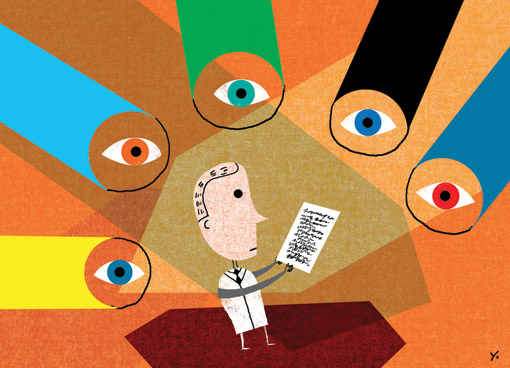
Image by James Yang http://www.jamesyang.com

PhD2Published has several informative posts about writing journal articles, and more recently has featured a post outlining a potentially revolutionary collaborative peer review process for this kind of publishing. Todays post offers an alternative perspective; that of the journal article peer reviewer. Doing peer reviews provides important experience for those writing their own papers and may help writers consider what they should include based on what peer reviewers are looking for.

At some point in your scholarly career, you likely will get asked to review an article for a journal. In this post, I explain how I usually go about doing a peer review. I imagine that each scholar has their own way of doing this, but it might be helpful to talk openly about this task, which we generally complete in isolation.

Step One:  Accept the invitation to peer review. The first step in reviewing a journal article is to accept the invitation. When deciding whether or not to accept, take into consideration three things: 1) Do you have time to do the review by the deadline? 2) Is the article within your area of expertise? 3) Are you sure you will complete the review by the deadline? Once you accept the invitation, set aside some time in your schedule to read the article and write the review.

Step Two: Read the article. I usually read the article with a pen in hand so that I can write my thoughts in the margins as I read. As I read, I underline parts of the article that seem important, write down any questions I have, and correct any mistakes I notice.

Step Three: Write a brief summary of the article and its contribution. When I am doing a peer review, I sometimes do it all in one sitting – which will take me about two hours – or I read it one day and write it the next. Often, I prefer to do the latter to give myself some time to think about the article and to process my thoughts. When writing a draft of the review, the first thing I do is summarize the article as best I can in three to four sentences. If I think favorably of the article and believe it should be published, I often will write a longer summary, and highlight the strengths of the article. Remember that even if you don’t have any (or very many) criticisms, you still need to write a review. Your critique and accolades may help convince the editor of the importance of the article. As you write up this summary, take into consideration the suitability of the article for the journal. If you are reviewing for the top journal in your field, for example, an article simply being factually correct and having a sound analysis is not enough for it to be published in that journal. Instead, it would need to change the way we think about some aspect of your field.

Step Four: Write out your major criticisms of the article. When doing a peer review, I usually begin with the larger issues and end with minutiae. Here are some major areas of criticism to consider:

–          Is the article well-organized?

–          Does the article contain all of the components you would expect (Introduction, Methods, Theory, Analysis, etc)?

–          Are the sections well-developed?

–          Does the author do a good job of synthesizing the literature?

–          Does the author answer the questions he/she sets out to answer?

–          Is the methodology clearly explained?

–          Does the theory connect to the data?

–          Is the article well-written and easy to understand?

–          Are you convinced by the author’s results? Why or why not?

Step Five: Write out any minor criticisms of the article.  Once you have laid out the pros and cons of the article, it is perfectly acceptable (and often welcome) for you to point out that the table on page 3 is mislabeled, that the author wrote “compliment” instead of “complement” on page 7, or other minutiae. Correcting those minor errors will make the author’s paper look more professional if it goes out for another peer review, and certainly will have to be corrected before being accepted for publication.

Step Six: Review. Go over your review and make sure that it makes sense and that you are communicating your critiques and suggestions in as helpful a way as possible.

Finally, I will say that, when writing a review, be mindful that you are critiquing the article in question – not the author. Thus, make sure your critiques are constructive. For example, it is not appropriate to write: “The author clearly has not read any Foucault.” Instead, say: “The analysis of Foucault is not as developed as I would expect to see in an academic journal article.” Also, be careful not to write: “The author is a poor writer.” Instead, you can say: “This article would benefit from a close editing. I found it difficult to follow the author’s argument due to the many stylistic and grammatical errors.” Although you are an anonymous reviewer, the Editor knows who you are, and it never looks good when you make personal attacks on others. So, in addition to being nice, it is in your best interest.

Tanya Golash-Boza is  Associate Professor of Sociology and American Studies at the University of Kansas. She Tweets as @tanyagolashboza and has her own website.

Weekly Wisdom #86 by Paul Gray and David E. Drew

SUBMIT YOUR PAPERS (other than those you know are stinkers) first TO THE BEST JOURNALS IN THE FIELD. Work your way down the list if a paper is rejected. Many articles rejected by a poor journal were later accepted by a leading journal, so you might as well start with the best. It is easier to follow this rule if you are thick skinned. Two additional factors should affect where you place a journal on your “go-to”list (not all journals make this information public): (a) the percentage of submitted papers the journal accepts, and (b) the length of time the journal takes to review a submission.

The Finished Article? by Claire Warden

In her latest post for PhD2Published, Claire Warden raises those all important questions about what it is that makes a good journal article.

In the feedback for a recently submitted journal article, the reviewer said that, although s/he liked it (phew!) it was just a little bit ambitious. Alright, a lot too ambitious. So, a little adjustment here, a little tinker there, take out 1000 words and change the focus of the argument completely and I would have the makings of a successful journal article. Rewriting an article is about as pleasurable as toothache so, at first I let out an audible groan and, in typical English fashion, made a comforting pot of tea.

Recently, in the wake of my first book, I have been writing a few journal articles and this has forced me to move academic genres, one of a number of transitions that we often make from book to conference paper, dissertation to article, blog post to review. Getting back into article writing has been a sharp learning curve for me and has forced me to reassess the genre entirely. What is the primary thing to think about when writing a journal article? Are we focusing on the need to improve our publication record, the importance of publications as we apply for those allusive tenured jobs or the joy of writing about something we find fascinating for a few months? I think I probably consider all these things. But more and more I have been thinking about my readership. Who is reading the article? Why are they reading it? What are they hoping to find? Which leads me to a question (yes, another one!) I constantly grapple with: what is my audience? To make an article engaging, this is a really important issue. If the journal is about crochet then you can safely assume that your readership knows about needles and wool. If it is not then you probably need to explain chains and slip stitches at the start.  

My recent article writing extravaganza led me to read a load of papers from different journals in an attempt to discover what an engaging reader-focused article really looks like. I came up with the following checklist:

  • A balance of academic rigour and accessibility – if I am going to talk about either difficult or niche topics then there is all the more reason for syntactical clarity and straightforward structure.
  • Brevity and specificity – these two important aspects are an anathema to my rather distended writing style but are both vital for article writing.
  • Niche but relevant – under-researched topics are fascinating but they need to be framed by recognisable theoretical models.
  • Explanatory notes and expository analysis – there is always a need to decide how much your audience needs to know: a full biography, a complete synopsis, a footnote for further study suggestions?

These are the four elements that I’ve noticed in the best articles I’ve been reading recently and often they are missing in the less impressive ones. So, returning to my own article dilemma, fuelled by the obligatory teapot, I got rid of 1000 words, added 1700 and it was accepted.

Weekly Wisdom #83 by Paul Gray and David E. Drew

EDITING YOUR OWN MATERIAL. As you write your dissertation or a paper it is natural to make changes and major revisions. You are, in effect, editing your own material. That’s good and bad. It is good because you add intellectual capital, you clarify, and you consider the knowledge (or lack thereof) of your readers.  It is bad if, like most of us, you become infatuated with the sound of your own words.  It is difficult, if not impossible; to change language or ideas you labored over long and hard. Just like job application letters, have at least one (preferably more) people read what you wrote and suggest improvements. If a word, a paragraph, or a section is unclear to them it is likely to be unclear to others. Better to receive critiques and suggested improvements from your peers than from referees or decision makers.

Weekly Wisdom #82 by Paul Gray and David E. Drew

BE SURE TO SPELL-CHECK AND GRAMMAR-CHECK AND FACT-CHECK your work. Your degrees certify you as a literate, educated person. Grammatical or spelling errors in a résumé or in an article submitted for publication turn off reviewers who are making judg­ments about you. For example, in a résumésent to one of us as an outside reviewer for tenure we found the following: “My research activities has centered on . . .” and a reference to the journal Group Decision and Negotiation wound up as Group Decision & Negation.

Weekly Wisdom #81 by Paul Gray and David E. Drew

LEARN THE FINE POINTS OF ENGLISH. With multiple degrees in hand, you are assumed to be an educated person. Writing and speaking mistakes turn off your students, reviewers, and the editors of journals. If you need help, buy a copy of Fowler’s Modern English Usage and William Strunk Jr. and E. B. White’s The Elements of Style. Read them. When in doubt, consult them. A well-written paper is more likely to be accepted than a poorly written one. For example you should: Know the difference between assure, ensure, and insure, and between affect and effect. Recognize that criteria is plural and criterion is singular

Blind Spots: Using Collaborative Open Peer Review to Support PGR Publishing. Part 1 by Sarah Pett
The editors, taken by Imke van Heerden on 3 February 2012, University of York. From left: James Fraser, Ben Madden (postcolonial hanger-on), Isabelle Hesse, Anna Bocking-Welch, and me (Sarah Pett).

The editors, taken by Imke van Heerden on 3 February 2012, University of York. From left: James Fraser, Ben Madden (postcolonial hanger-on), Isabelle Hesse, Anna Bocking-Welch, and me (Sarah Pett).

Four PhD students at the University of York are currently piloting an innovative peer review process for developing postgraduate conference papers into an edited collection. In the first of a series of posts, Sarah Pett (whose has her own blog and Tweets as @essiepett) discusses the project’s ethos, as well as the practicalities of turning an ambitious idea into a successful reality.

Prompted by a shared experience of the difficulties inherent in positioning our individual research projects in relation to postcolonial studies, in 2010 Anna Bocking-Welch, Isabelle Hesse, James Fraser and myself established Postcolonial Perspectives, an interdisciplinary reading group for postgraduates at the University of York. From the beginning, the group focused on unconventional approaches to the postcolonial, with an emphasis on contexts that troubled its paradigms. It soon became apparent that we were not alone in our frustrations – discussions with postgraduates from across the UK revealed that we were grappling with an issue of increasing relevance and concern to PGRs working in a range of disciplines, periods, and contexts. Thus the Living Beyond Theory: Interdisciplinary Perspectives on the Postcolonial postgraduate conference was born. The event was a resounding success, and highlighted an emerging body of research into contexts that trouble the established paradigm of postcolonial studies. But how, we wondered, to sustain the dialogue that shaped the event, and disseminate the wealth of ideas it generated? Given the different stages of our projects, it will be several years until our individual monographs appear, while their disciplinary and contextual diversity means that our shared concerns would inevitably be diluted. With the help of Dr Jason Edwards at the University of York, as well as funding from the Postcolonial Studies Association and York’s Centre for Modern Studies, we decided to keep the momentum generated during the conference going by developing a selection of the papers into an edited collection.

Why open peer review?

“Blind peer review is dead. It just doesn’t know it yet.”

Inside Higher Ed’s Scott Jaschik begins his report on the Future of Peer Review session at the 2012 MLA convention with this provocative statement from CUNY’s Dr Aaron J Barlow. As Barlow points out in his paper, “The Bearable Light of Openness: Renovating Obsolete Peer-Review Bottlenecks”, the rise of digital publishing has brought traditional peer review procedures into question. For Barlow, its impression of “quality control” is no longer a fair exchange for the publication delays and complex, occasionally unethical, personal and institutional agendas blind peer review entails – a foible I know all too well. Full of the bravado of youth, I thought I’d try my hand at academic publishing soon after completing my BA. Without any knowledge of established protocol, I made the mistake of submitting my paper to two journals simultaneously. Not a wise move, but it did open my eyes at an early stage to the inconsistencies of the field. One journal returned my article within the fortnight, accompanied by a largely positive review that recommended only a handful of minor revisions. Several months later, I received a two page review from the other journal, which included an ultimatum: significantly shift the focus of the paper, or it won’t be published. The recommended shift seemed to reflect the reviewer’s research interests, rather than my own, which was an unpleasant and demoralizing experience for a young researcher. More importantly, however, it was disabling, leaving me with no platform from which to respond to the reviewer’s diktat.

Clearly, this is not something we wished to replicate in the preparation of the edited collection. What’s more, as postgraduate researchers, we have been aware from the outset that the collection has to be tip-top to stand a chance with a “proper” academic press. And finally, with an editorial committee made up of four researchers in the final stages of their PhDs, we simply couldn’t afford to commit to providing each participant with the level of feedback and writing support we hoped to offer. To optimize what we could do in the time available, we opted to select and improve articles via an intensive, collaborative process based around realtime participation. To do so, we designed a series of open peer review workshops that allowed our authors to participate in providing and responding to feedback over the course of several months: a model that closely resembles that employed by Kairos, whose editor Cheryl Ball appeared alongside Barlow at the MLA. Kairos—a journal of rhetoric, technology, and pedagogy—employs a three tier review process. In tiers one and two, submissions are evaluated by individual editors before being forwarded for discussion to the editorial board as a whole. In tier three, a staff member is assigned to mentor the author in implementing revisions for up to three months. The Postcolonial Perspectives publication workshop series sought to emulate and even build on this process. In stage one, the editorial committee selected papers from the conference to invite as contributors; stage two involved refining the ethos of the project and requesting that contributors develop their papers with this in mind. Stage three is when the realtime workshops came into play, allowing contributors and reviewers to meet and discuss feedback over the course of a day.

The first workshop, which took place at York on 16 January 2012, was extremely successful—one academic staff member said he was keen to adopt our model in his own work—and demonstrates how a collaborative open peer review model can be implemented at a grassroots level to support the career development of PGRs and ECRs. The second workshop is scheduled to take place in early May, during which participants will go over the final revisions and collaborate in refining the book proposal and editorial introduction as a group. We are also looking into using an open source manuscript management and publishing system such as the Public Knowledge Project’s Open Journal Systems as a means of continuing the workshops’ collaborative format remotely. While the project’s aim—publication with an academic press—is ambitious, the workshop format means that, at worst, our contributors can walk away with a carefully revised paper for submission to an international peer reviewed journal, a committed mentor, and a handful of supportive peers with shared research interests and career goals.

Workshop One: From left: Dr Jason Edwards (York), Professor David Attwell (York), James Fraser (York), Anna Bocking-Welch (York), Rebecca Jones (Birmingham), and Katherine Ebury (York).

The radical in me would love the project to culminate in a high profile open access publication, accompanied by a creative and thought-provoking social media campaign to raise awareness about postcolonial studies, its contributions and its limitations. For the time being, we’ll continue to play it safe, but it won’t stop me thinking about the possibilities for reform in academic publishing, and the instrumental role PGRs have to play in changing the game. Hopefully before too long there will be a copy of Beyond the Postcolonial Paradigm: Interdisciplinary Perspectives on the Parapostcolonial on a library shelf—or Kindle—near you…

Weekly Wisdom #80 by Paul Gray and David E. Drew

LEARN HOW TO WRITE CLEARLY. Some graduate programs do their best to stamp out this skill, persuading doctoral candidates that a ten-syllable word is better than a two-syllable word. Reviewers are more likely to persevere to the end of your journal submission or your grant proposal if they can easily follow what you say. They are also more likely to give you a favorable review.

Weekly Wisdom #79 by Paul Gray and David E. Drew

COLLABORATE AND COOPERATE. You are not alone either as a graduate student or as a young faculty member. You cooperate and collaborate with many others. Even the dissertation is not a one-person effort inasmuch as you work with an advisor and a committee, with people you study if your work involves human subjects as well as interacting on your topic with fellow graduate students.  When you begin your academic career, you need not sit off in a corner and try to do it all by yourself. You can collaborate and cooperate with peers, senior faculty, and even students. In a research institution, you will find you collaborate on projects with coauthors.  Most will be close by, but others are from your doctoral program or people whom you know through conferences and other professional interactions.  Your teaching assistants and your students will help you with specific tasks, including routine ones. You become part of an ongoing group that cooperates on projects, reads and critiques each other’s papers before submission, gives you ideas, and receives ideas from you.  It is a two-way relationship that you need to cultivate.  Although telecommuting is needed to obtain integrated blocks of time, you should allocate some time on campus for collaboration and cooperation.  It will make you more productive and enrich your life as an academic.

Should You Make Your Thesis Available Online? Part 6: On the outside of Academic Publishing by Kathryn Allan

The final post in this series about posting a thesis online is by Kathryn Allan. Kathryn completed her PhD (English) at McMaster University in 2010. Her doctoral thesis, Bleeding Chrome: Technology and the Vulnerable Body in Feminist Post-Cyberpunk Science Fiction, is awesome and available online for free here. She operates an (academic) copy editing and dissertation coaching business, Academic Editing Canada, as she pursues independent scholarly research into (feminist/cyberpunk) science fiction. Dr. Allan is currently putting together a collection of essays that deal with the representation of disability in science fiction. She tweets under @BleedingChrome.

When I finished my PhD in English Literature in 2010, I also said good-bye to the ivory tower. Frustrated with the current funding and work environment of academia (in North America), I set out on my own – and I took my dissertation with me. While my committee members encouraged me to consider publishing my thesis the old-fashioned way, I felt like it wasn’t the right option for me. Instead, I decided to publish my dissertation in pdf format and make it freely available on my professional blog to anyone interested in reading it.

At first, I was slightly worried that someone might plagiarize my work, but after a minute of thought, I remembered that nothing stops students who want to plagiarize from doing so, regardless of the medium of the text. With confidence, I made my thesis available on my blog. It shows up in relevant Google searches and I have repeatedly shared the link over email and Twitter with people who share my research and reading interests.

I share my thesis online because: (1) I believe that publicly funded work (like my Canadian graduate education) should be publicly accessible; and, (2) as an independent scholar who studies feminist and cyberpunk science fiction, I want to easily share my work with the science fiction fan community.

Accessibility

When I state that I believe academic work should be accessible, I mean it in all aspects of the word. I put in a good deal of effort into writing my thesis in language that can be followed by non-academic readers, so putting my thesis online is a natural extension of my dedication to open research and communication.

My PhD thesis is available on ProQuest through the university where I studied, but access to that database is still limited to people with university library access or who are willing and able to pay. Since I don’t believe that anyone should have to pay to read my thesis, simply having it available on academic marketed sites like ProQuest is not a good enough solution to accessibility.

Independent Scholarship

My thesis was a labour of love and passion for the subject matter. I want to share the knowledge I gained with as many interested individuals as I can. Admittedly, I also enjoy operating outside of the formal academic system. Science fiction, particularly the feminist science fiction of my interest, has generally been a marginalized field of study, so it felt right to pursue a more marginal and independent approach to publishing my dissertation.

One of my goals as an independent scholar is to connect with fans in the vibrant and diverse science fiction community. If my thesis was only available through one university and a pay-to-read internet platform, then most fans are not going to read it (or even know that it exists). While I could have arguably sought out a publisher to reach this fan audience, I am also aware that “free” and “online” appeal to far more readers. And it has.

It’s All Good

It has almost been a year since I made my thesis available online and the response I have received has been overwhelmingly positive. Many people – some are academics, some are science fiction fans – have emailed or tweeted me about my thesis. Most of the comments I get are “thanks for sharing” or specific nerdy questions about something I’ve written. To date, I can’t think of one drawback from having my thesis online. Not a single one. I don’t intend on applying for an academic position, nor am I pursuing independent scholarship for financial gain. For me, there is simply is no downside to having my thesis online.

Weekly Wisdom #77 by Paul Gray and David E. Drew

DEVELOP A POOL OF RESEARCH REFERENCES STORED IN YOUR COMPUTER. It is one of the most useful things you can do. You will use the same references over and over as you do research, as you write pa­pers, and as you teach. You will add to this list as you read new articles and books in the literature. We personally recommend the software called EndNote although other similar kinds of software are on the market. Software for references contains three useful features: It provides a standard form for entering references so that you remember to include all the necessary data. Separate forms are provided for each type of reference (books, articles, newspa­pers, Internet URLs, etc.). It automatically converts the format to the reference style of the journal to which you are submitting. Lots of different styles are available. Since you may be sending an article to several journals sequentially before it is accepted, this au­tomated feature saves you hours of drudge work in converting reference formats. It provides space for including abstracts and notes so that you can record what the reference was about for future retrieval.