Exact matches only
Search in title
Search in content
Search in comments
Search in excerpt
Search in posts
Search in pages
Search in groups
Search in users
Search in forums
Filter by Categories
Academic Practice
Academic Writing Month
AcWri
AcWriMo
Blogging and Social Media
Book Editing
Book Literature Review
Book Marketing and Impact
Book Planning
Book Proposals
Book Publishing
Book Writing
Books
Citations and Referencing
Collaboration
Community
Conference Paper Abstracts
Conference Paper Editing
Conference Paper Literature Review
Conference Paper Marketing and Impact
Conference Paper Planning
Conference Paper Presenting
Conference Paper Writing
Conference Papers
Digital Publishing
Experimental Digital Publishing
Grant Abstracts
Grant Completion Reporting
Grant Impact Statement
Grant Literature Review
Grant Methods Section
Grant Writing
Grants
Journal Article Abstracts
Journal Article Editing
Journal Article Literature Review
Journal Article Marketing and Impact
Journal Article Peer Review
Journal Article Planning
Journal Article Writing
Journal Articles
Networking
News
Open Access
Productivity
Reading and Note-Taking
Reseach Project Planning
Resources
Tools
Uncategorized
Website
Introducing #AcWri live!

Source: http://seo-contentwriter.com/

PhD2Published has made some exciting changes in the past couple of weeks. We have officially joined forces with Dr Jeremy Segrott to run fortnightly live chats on Twitter focused on academic writing (or AcWri, which is our associated hashtag). To celebrate this we now have a new live chat tab on the home page of the site!

In the about section you can find out more about the live chats and a little bit about us but essentially we saw this as a fabulous opportunity to build upon the previous success of the AcBoWriMo project and to develop the community of academic writers that this helped to establish. We will also be posting summaries of each discussion on a fortnightly basis in the archive section so if you miss the chat itself you can still see what was discussed and benefit from the communities wisdom by picking up some useful hints and tips.

If you’re interested in participating (the more the merrier!) you can either join the fortnightly live chats on Thursdays at 6pm GMT or contribute to the more regular community conversation using the #AcWri hashtag on Twitter. We also welcome AcWri themed blog posts so if you have something to say and want to join us get in touch!

Should You Make Your Thesis Available Online? Part 5: Where Can I Make My PhD Thesis Available Online?

If, having considered all of the issues, you still feel that you want to make your thesis available online, the question you may now face is where to post it? This blog post explores where you can publish your thesis online and what options there are.

Library and university archives for E-Theses

According to Emily Kothe on Twitter (@emilyandthelime) some universities already require students to post their thesis online upon submission, along with paper copies. When I submitted in July 2011 I was not required to do this, but having contacted the librarian at the university where I conducted my PhD, I learned that it has now become a requirement for students submitting their thesis from 2011/2012 onwards to submit a further digital copy. I missed out on this but have been informed that if I want to, I can make it available through this outlet. At present I am uncertain who is aware of this service, other than students who submit their thesis to it from now on, or who can access the service beyond the university, if at all. According to the online deposit for Lancaster University (which you can view here) there are benefits to both the student and the university itself:

For the student

  • Increased visibility for your work
  • Easier access to your thesis
  • Raise your personal profile
  • Can use digital services such as links to datasets, videos etc.

For Lancaster University

  • Raise institutional profile
  • Showcase successful graduate research

There are several of these services now available and visible through a simple Google Search that PhD students in particular may find useful if they are looking for ways to structure their thesis and want to look at some examples of theses that have passed. Durham University depository and Nottingham University depository are good examples. It may be important too inform academic book publishers if your thesis is available in this way; these issues are discussed in Part 3 of this series.

Ethos – British Library

Rob Myers on Twitter (@robmyers) initially drew attention to Ethos, an electronic online thesis service run by the British Library (see Part 4 of this series about EThOS by Sara Gould). This is a site I had actually used myself when writing my PhD. I downloaded some theses in order to explore how they were structured and to access additional research in my topic area. My university does subscribe to the service and I was informed that “if a thesis is only available in print form, we send it to the British Library to be digitised, and the person making the request has to pay the British Library £40 towards the cost of digitisation”, not entirely free but eventually Open Access. There are now 44,000 online theses available, and to download a copy you first need to register so that records can be kept and to ensure the intellectual property of the author is protected.

Personal Blog Site

I have also considered posting a copy of the thesis to my own personal blog. Before I posted it online however I wanted to check copyright right and intellectual property issues, something that RuthFT (@RuthFT) warned me of and that I discuss in Part 2 of this series. Some universities hold intellectual property rights to the thesis even if you have written it and conducted the research for it so it is essential that this is considered before rushing ahead to do it. A librarian at my university informed me that because my thesis is an unpublished piece of work it can be uploaded online on my personal blog, as long as I respect and observe the rights of those who participated in the study, which of course is part of ethical research practices anyway. It is highly recommended that you check with your own institution first though because rules may differ.

There are therefore several places where the unpublished PhD thesis can be deposited online, if you deem the issues detailed in previous posts to be outweighed by the benefits of disseminating your research more widely. These are just a very few of those I have explored (in repsonse to Part 3 for example user moorbi, introduces us to GRIN, a free German publisher). Having researched this in greater detail, I am still concerned that by posting my thesis online I may face additional challenges in publishing a monograph. This ultimately has become an issue of Open Access and I have to admit I find it encouraging that universities (in the UK at least) and EThOS and the like, are making it easier for PhD researchers to make their PhD research available online.

I’d love to hear more about this issue, particularly if anyone is against doing this or has critiques of it (most people I have spoken to support onlinethesis). Please do get in contact if you want to add, or contribute any ideas and do let us know if you plan to submit your thesis online (#onlinethesis).

Should You Make Your Thesis Available Online? Part 4: Introducing EthOS by Sara Gould

Today’s post, which contributes to our series about publishing dissertations and theses online is written by Sara Gould. Sara is the EThOS Service Manager at the British Library, UK. She is managing the transition of this e-theses website to a sustainable Higher Education shared service.

Anna has been wondering whether to publish her thesis. Or if not ‘publish’ then put it online somewhere to share the results of her work more widely, and gain the benefits she mentions, like raising the level of interest in her research and making connections with like-minded researchers.

EThOS is the UK’s e-theses website that gives instant access to 55,000+ doctoral theses. Pretty much all UK universities have their theses listed in EThOS so there’s around 300,000 records in all, with a variety of routes to get hold of the full text if it’s not already available.

That’s a fantastic resource for students and all researchers, not just to be able to dig deep into research that’s already happened, but to see who’s researching what and who the key players are – individuals, departments, institutions, even funders.

It almost goes without saying that open access to research theses is a ‘good thing’ for new researchers, for those looking for source material. But what about for thesis authors themselves? Should Anna try to make sure her PhD thesis appears in her university’s repository and/or EThOS, or not?

Here are a few frequently expressed concerns:

1.    It’ll spoil my publication chances later

Well, it might, but in a recent survey only 7% of institutions cited this as a frequent concern amongst their students, and no concrete examples were found of publication being refused because the PhD thesis had been added to an open access repository. If reassurance is needed, then an embargo period can be applied, with may be the record plus abstract still being available to all.

2.    My work will be plagiarised

It’s possible, but then again people can plagiarise from printed theses too, and in those cases there’s no automated way to detect the crime.

Allowing open access to your thesis does open it up to all sorts of people who may come along and use the content in whatever way they like. But plagiarism detection services can help to mitigate the risks, and in EThOS at least, users have to register their details, so we could if necessary track all users of a particular thesis. So far that’s never been needed. And as people get more and more used to open access and theses become increasingly available in institutional repositories, it may be that the login process is becoming a tiresome deterrent to use and has had its day.
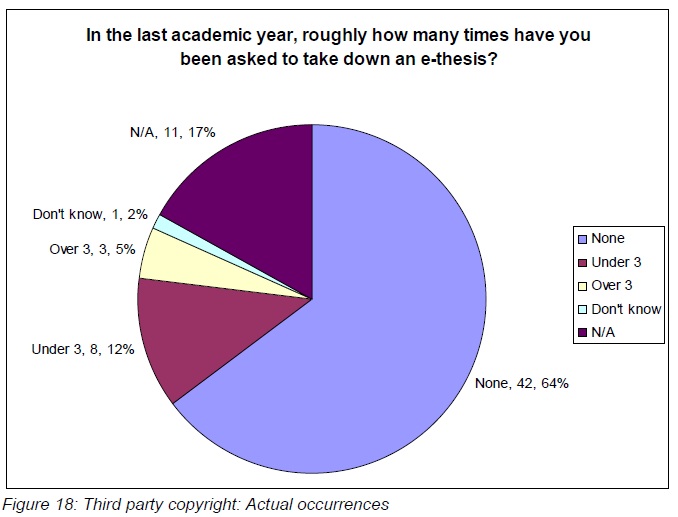
Brown J. (2010) Influencing the deposit of electronic theses in UK HE: report on a sector-wide survey into thesis deposit and open access. UCL. http://eprints.ucl.ac.uk/116819/

3.    All that hassle with third party copyright

We do need to take copyright ownership seriously and it can be really time-consuming to seek permissions from any third party for permission to publish. Some university libraries are able to support their students to make sure any third party copyright is managed properly, but most don’t have the resources to undertake such a massive task. Take-down policies and embargoes come into play here, and digitisation services, whether through EThOS or another route, will carefully redact any sections, diagrams etc that aren’t copyright cleared on instruction from the institution.
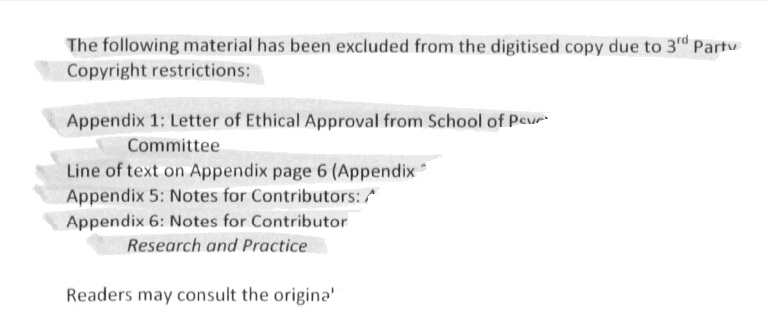
List of redactions from a 2002 thesis held in EThOS.

The world of repositories and open access is moving fast. EThOS celebrated its third birthday last month. When it launched – on the same day as another auspicious event – theses were held in paper format in the university library and a microfilm copy held by the British Library. Now those microfilms have been packed away, and an average of 450 people a day download a copy of a full-text thesis from EThOS. With possibly the same number again accessing copies held directly in university open access repositories, it appears that full-text open access is here to stay.

Should You Make Your Thesis More Widely Available Online? Part 2: Fear of Idea Theft

Following my first post that introduced my musings on the debate about making a PhD thesis or dissertation available online, this blog explores the issue of fear in relation to the theft of your ideas. This is an issue that is fairly central in Alex Galarza’s article for @GradHacker. The student in question feared that their ideas may be more susceptible to being stolen if they were to be made available online; a reasonable assumption given that, if the intention to put your thesis online is to make it more widely accessible, then the more likely it is that the ideas can be accessed and potentially lifted.

For me, this fear is not altogether unfounded and essentially boils down to a lack of knowledge about how online material is managed and regulated. In university teaching in the UK at least, students are taught about plagiarism, or the use of someone else’s work without acknowledgement, and are warned of the need to avoid doing it. Not only is it considered bad academic practice, but a plagiarised essay or piece of coursework is more likely to be of poor standard. As academics this becomes deeply ingrained in everyday working and writing practices, and is currently regulated through the processes of peer review and assessment. How this may be regulated online however, is less clear and the boundaries of citing and discussing the work of others is increasingly blurred.  Similarly if the aim of publishing online is to reach broader audiences, there is potential that those audiences are unfamiliar with referencing practices or maybe unwilling to use them.

A research paper about electronic theses by Copeland et al (2005, pg 195) suggests however that ‘it is easier to detect instances where this activity [plagiarism] has taken place when the material is published on the web. Electronic detection software is available’. My university in the UK uses Turn-It in for student essays for this purpose.

While this is comforting to know to some extent, an important thing to do before making your thesis available online is to check the copyright regulations of the archive you post to and to ensure that you own those rights as primary researcher. This should discourage any potential theft, protect your property rights and discourage the potential for idea theft by others. Where you make the thesis available online is also a consideration. The chances of having your ideas stolen and reproduced online or elsewhere are much less likely if you post to a university online archive than a personal blog for example because these are better regulated. It is also recommended that you seek advice from your PhD supervisor before posting online to check if there are any issues with copyright that you hadn’t thought of (especially important if the work is funded). You could also protect your work using a Creative Commons license. These allow ‘everyone from individual creators to large companies and institutions a simple, standardized way to grant copyright permissions to their creative work’ (Creative Commons website).

Fear of theft of your work when making it more readily available online is reasonable, and was something that led me to research and produce this series of blog posts. However there are frameworks and laws in place that are designed to protect your ideas and your intellectual property, as well as new technologies that are detecting plagiarism online. Make sure you are aware of these before you make your research outputs available online however. If you want to disseminate your work more widely to broaden its impacts, you should be able to, and it is important that academic work is accountable but also used in appropriate ways.

A recent hashtag on Twitter that has been used in relation to these ideas (and also Will’s post) is #notopenenough (thanks @ThomsonPat). Publishing online is becoming more popular, and hopefully fear of theft won’t stand in your way in your quest to make your research more widely known.

Join the conversation at #onlinethesis.

Reference

Copeland, Susan,  Penman, Andrew and  Mime Richard (2005) “Electronic Theses: The Turning Point.” Program: Electronic Library & Information Systems 39, no. 3 : 185-197.

Should You Make Your Thesis More Widely Available Online? Part 1

A brief note from Anna: Being Managing Editor of PhD2Published has been a fantastic opportunity for me so far. It has introduced me to lots of interesting people and has helped me to think about key issues I am facing post-PhD. My current thinking is about whether or not to make my PhD thesis more readily available online. This post, which is the first in a series, explores this idea in more detail.

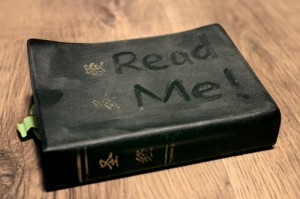
Impact has increasingly become an academic buzzword and requirement, which has led me to think much more about my PhD thesis, its accessibility and the impact it could (and should) have on a variety of audiences, both academic and public. I have heard from several colleagues that the only people who are ever likely to read the actual thesis are yourself and your supervisor (my family and friends certainly haven’t read it!). Frankly this seems wasteful and a bit sad (just look at the picture!), especially considering all of the hard work that went into it, including by myself, my participants and my supervisors. Even with the potential of developing publications and monographs from it in different formats, later on, in its unpublished form, my thesis is meaningful to me and took time and effort to construct.

This thinking prompted me to consider how I could make my thesis more accessible and more widely read, particularly in an age of social media and open access. Before launching into making it available online however, I wanted to do some research into the potential barriers to publishing online and the current debates that will inform this decision.

Following these musings, I posted this question on Twitter: “What are people’s opinions on making theses available online?” Several interesting and important issues and questions were raised. While limited,  there is already an emerging debate about the digital dissertation, which you can read about in this interesting and informative post by Alex Galarza for @GradHacker. There are several positives for doing this, and indeed many universities are now making it a requirement, if it isn’t already. @Gradhacker outlines that online material such as the unpublished thesis for example is still protected by copyright, useful to know if there is concern about the acknowledgement of your work. At the same time, in being overly cautious about protecting your thesis/dissertation you may risk restricting the development of your academic identity, online and otherwise. Furthermore (and some publishers may vary on this) putting your thesis/dissertation online may actually aid in the communication and appeal of your research to a variety of audiences and may even encourage sales of subsequent published work should you wish to publish it elsewhere in a different form. Twitter follower Christina Haralanova (@ludost11) has also received positive replies from people who have read hers.

Despite the many positives, I still think it is important to consider the range of different issues relating to putting a PhD thesis out there; issues that I will explore in a short series of blogs that will be posted here on PhD2Published in the coming weeks. These include posts I have constructed myself, and also opinion posts, and feedback from academic publishers. If any of this resonates and you have anything to add that has occurred to you, please do get in touch, either by Email or Twitter (@PhD2Published). Should you wish to join an online discussion on Twitter about the debate please use hashtag thesisonline (#thesisonline).

Introducing Our New Managing Editor: Dr Anna Tarrant

Introduction to Me

Hello everyone,

I am delighted to announce that I am the new Managing Editor of phd2published! Just by way of introduction, here is a bit about me and my intentions for this role:

Anna 2011: Questions galore!

I am a human geographer by training and my thesis examined the social geographies of contemporary familial identities in a British context. I completed my PhD in July 2011 and have since realized my ambition to stay in academia. Currently I am a Senior Teaching Associate at Lancaster University, teaching a broad range of topics at both undergraduate and postgraduate levels. This is a short term, 10 month post and I view it as my opportunity to fill in the gaps of my knowledge, to get established as an academic and to develop my networks. So how do I asked? Read more